Pádraig Hoare: Cop28 spins bare minimum into landmark deal
Cop28 was a capitulation to special interests where the world's most vulnerable people will pay the heaviest price for the richest folks' folly, writes Pádraig Hoare
Pádraig Hoare: Cop28 spins bare minimum into landmark deal

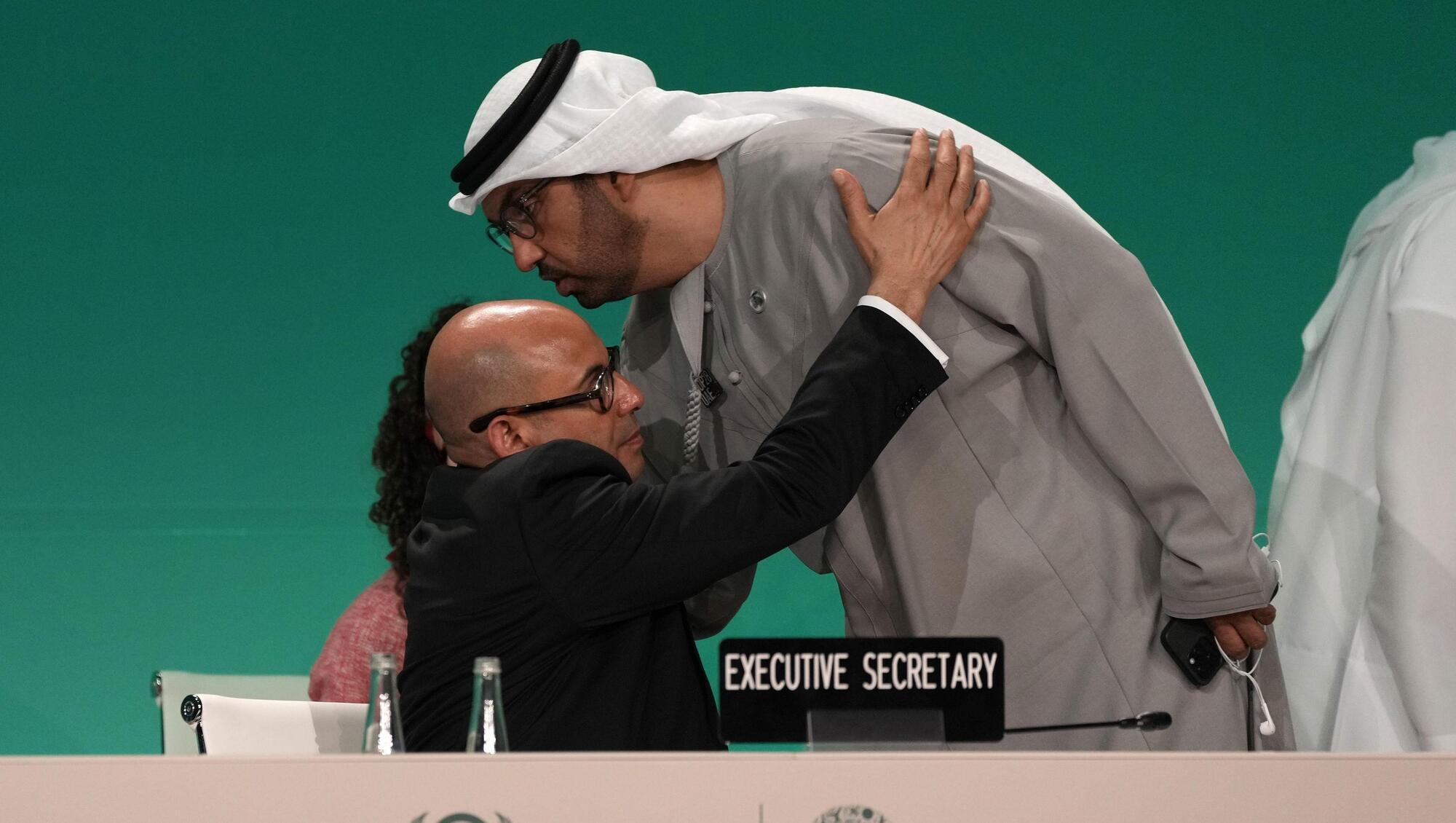
UN climate chief Simon Stiell embraces Cop28 president sultan Ahmed al-Jaber as he returns to a plenary session at the climate summit on Wednesday. While it is true that even the mention of reducing fossil fuels was a first for a Cop agreement, it is hardly groundbreaking. Picture: Kamran Jebreili/AP.

Cop28 has managed, somehow, to spin the bare minimum in the fight against climate change into a landmark agreement of historic proportions.

The cheers that went up as the oil and gas baron, sultan Ahmed al-Jaber, brought the UN’s climate change summit to a close in Dubai were profoundly depressing.

Countries will merely look to transition away from fossil fuels instead of an explicit vow to do so. There is a world of difference in the two.

“Together, we have confronted realities and we have set the world in the right direction. We have given it a robust action plan to keep 1.5C within reach. It is a plan that is led by the science,” said the president of Cop28, Mr al-Jaber.

This is the same sultan al-Jaber that, weeks before Cop28 even began, cast doubt on the science that fossil fuel reduction is imperative if global warming is to be kept to 1.5C in the coming years.

While it is true that even the mention of reducing fossil fuels was a first for a Cop agreement of the nations of the world, it is hardly groundbreaking.

The naive hope among environmental activists and scientists before Cop28 was that, somehow, the countries of the world would come to their senses.

That worsening extreme weather — prolonged heatwaves, droughts, vicious monsoons, and flooding — would surely be the smoking gun to compel us to act, with certainty and clarity, when it comes to the fossil fuels that are incontrovertibly heating the planet to dangerous levels.

Calling for an eventual phase-out of oil, gas, and coal as the means to provide the bulk of the world’s energy should not be difficult. Yet it remained an unattainable goal in Dubai. Instead, we are left with vague language about trying to do so.


We can all strive to do things, but that doesn’t make it so. I could strive to woo Taylor Swift, win a World Cup with Argentina, or shoot a 59 at Augusta, but that doesn’t make me a Superbowl-winning tight end with the Kansas City Chiefs, a team-mate of Lionel Messi, or a world-class golfer.

There is a world of difference between explicitly calling for the phase-out of fossil fuels that are gravely exacerbating the climate crisis, and striving to do so.

Striving is such a nebulous concept that it’s difficult to even measure what is progression.

As Master Yoda said: “Do or do not, there is no try.”

It is profoundly depressing that even with all the incontrovertible evidence that much of the world is hurtling to an unlivable heat in the coming decades, we still cling to the hope that some sort of John Wayne of Big Technology will come and save the day instead of weaning ourselves off of the obvious culprits of oil, gas, and coal.

Oil executives and oil-producing nations instructed their men — invariably it was men in fancy suits and shiny shoes — on the ground in Dubai to hold the line and not cede an inch.

Obfuscate, obstruct, confuse, point elsewhere but inward, lest the trillion-dollar profits are eroded.

There were nearly 2,500 fossil fuel delegates in Dubai trying to influence proceedings, more than the combined passes of 10 of the countries across the world that are most vulnerable to climate change, and seven times the number given to delegates from indigenous people.

They pointed to carbon capture and storage as a saviour — a fine idea in theory, but already shot down by scientists as unworkable in the main and a deflection from the obvious culprit.

There will be no moonshot and no lodestar to get us out of the fix we are in.

We signed our own Faustian pact with the Devil when the industrial age began, and it is now coming home to roost.

The Industrial Revolution brought the West startling progression in the likes of economics, health, social mobility, and comfort, of that there is no doubt.

We owe much, if not most, of our modern lifestyles to oil and gas. However, it was never going to be without a cost.

The best time to begin taking evasive action on climate change was before it even began to turn, but that ship has long sailed.

Even as recently as the 1970s and 1980s, there were enough times to switch tack — but we long-fingered it.

Time is up.

The 40C summers in much of Europe and much of the world are locked in, flooding and extreme rainfall are now common, and storms will torment us with much greater intensity.

And we are only at around 1.1C to 1.3C hotter on average today, compared to the pre-industrial age.

When the UN warns that our current trajectory is one of 3C global warming in the coming decades, never mind the 1.5C limit aimed at in the Paris Agreement, you would hope the urgency would hit home.

The Paris Agreement was eight years ago and we are still squabbling in 2023 about the language around oil, gas, and coal, instead of taking fundamental steps to stop the metastasis.

This was no victory in the desert. It was a capitulation to special interests where the most vulnerable people of the world, yet again, will pay the heaviest price for the richest folks’ folly.

CLIMATE & SUSTAINABILITY HUB

More in this section

Revoiced

Newsletter

Sign up to the best reads of the week from irishexaminer.com selected just for you.

Cookie Policy Privacy Policy Brand Safety FAQ Help Contact Us Terms and Conditions

© Examiner Echo Group Limited