Question mark now hangs over Ireland's plan to recognise Palestinian state after Hamas attack
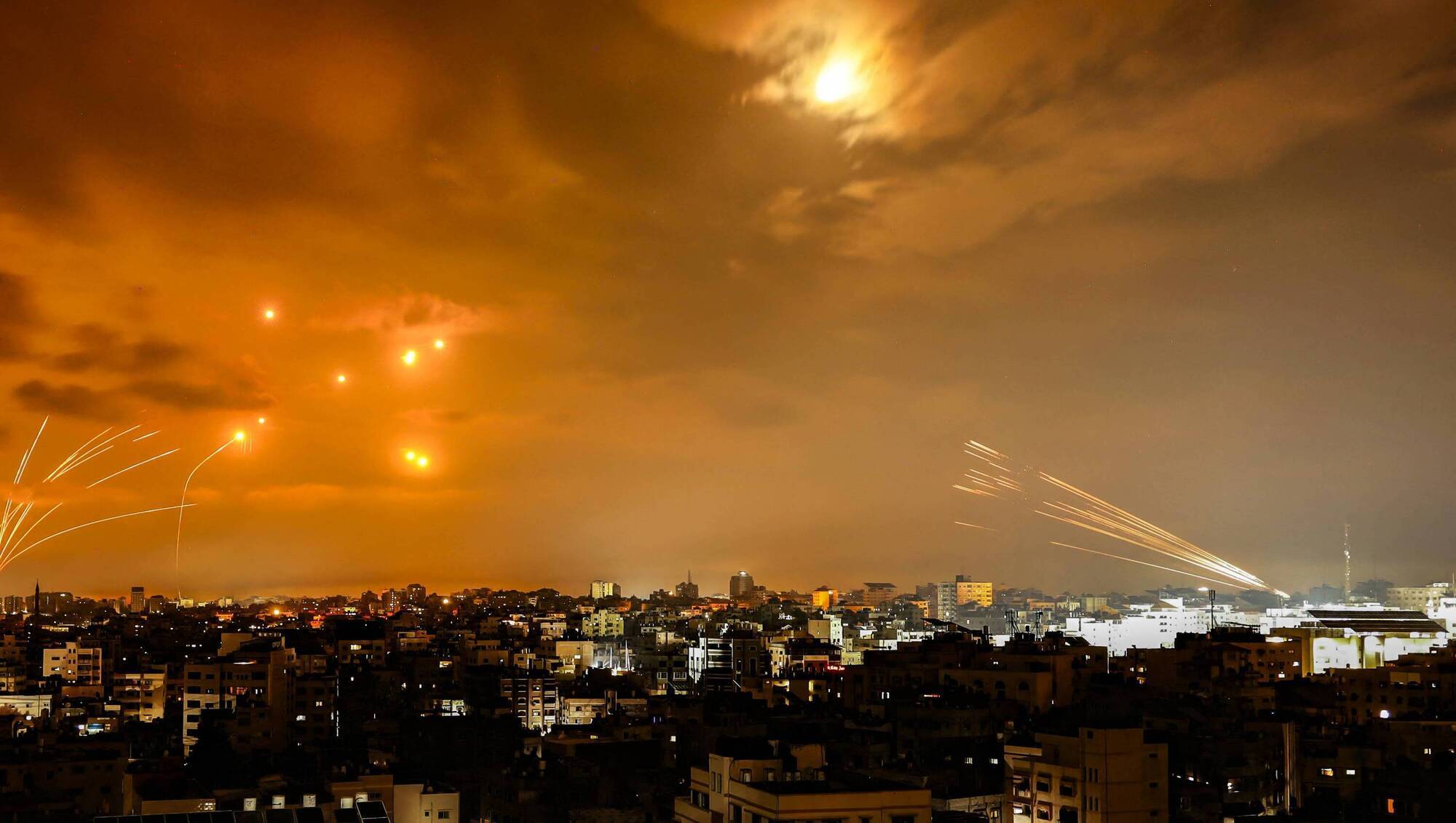
Rockets fired by Palestinian militants from Gaza City are intercepted by the Israeli Iron Dome defence missile system in the early hours of Sunday. Picture: Eyad Baba/AFP via Getty Images
At the UN in New York last month, Minister for Foreign Affairs and Defence Micháel Martin announced that the coalition favoured recognising Palestine as a state in its programme for government.
Mr Martin added that the timing of the decision would be critical and the "impact of taking such a decision has to be weighed up".
It was a sharp U-turn from what he told reporters during his official visit to Israel/Palestine two weeks before when he said he believed that Ireland recognising Palestine alone would have little impact compared with collective EU recognition.
Co-ordinated EU action on the Israeli occupation of Palestine, particularly regarding the mass expansion of illegal settlements, has become increasingly difficult as the Israeli government strengthens its alliance with Hungary.
Martin was right: Timing is indeed everything. On Saturday morning, Hamas, the Islamist militant group which has controlled the Gaza Strip with an authoritarian grip since it took control in 2007, launched an unprecedented attack on Israel.
So far, rockets and armed attacks by Hamas militants have killed 600 mostly civilian Israelis.
Hamas’s wide-reaching operation involved land, sea, and air crossings and almost certainly required outside assistance, likely from Iran and its sponsored militia, Hezbollah.
The Hamas attack took place in the context of a 16-year blockade that has crippled the Gazan economy, a recent uptick in settler violence and lethal military operations in the West Bank, and repeated violations of an agreement surrounding the use of Al-Aqsa Mosque in Jerusalem, one of the holiest sites in Islam.
With fighting still ongoing in South Israel as of Sunday, Hamas has unquestionably demonstrated its strength over Fatah, its political rival which controls the increasingly weak Palestinian Authority which administers the West Bank.
As images of Palestinians bulldozing the security fence along the Gazan border appeared, crowds lined the streets of the West Bank city of Ramallah in celebration.
In the aftermath of the attack, US President Joe Biden quickly emphasised Israel’s right to defend itself, while EU buildings in Brussels were lit up with the Israeli flag in solidarity.
Meanwhile, 370 mostly civilian Palestinians have been killed since the Israeli military began retaliatory aerial strikes on the densely populated Gaza strip, which lacks bomb shelters or any easy means of escape for Palestinians.
Already sensitive, the political mood for discussions surrounding Palestinian statehood will undoubtedly become even more tense, as videos of Hamas militants taking Israeli citizens hostage circulate online.
Germany has already said it is reviewing its aid to the Palestinian territories. Against this backdrop, it would be surprising if the Irish Government’s plans to recognise Palestinian statehood were not stalled — although, hopefully not shelved completely.
There had also been a quiet debate in some EU diplomatic circles in Ramallah and Jerusalem about whether there could be some relaxation of the EU's strict no-contact policy with Hamas.
In Ramallah during his official visit, Martin rejected any change to the longstanding no-contact policy with Hamas, but some diplomats view even limited dialogue with Hamas as a more effective way to influence the militant group than a no-contact policy.
It’s hard to know yet whether the recent attack will extinguish that debate, or force the EU to begin a dialogue with a group that has viscerally demonstrated that it cannot be ignored.
So far, Israeli and Palestinian civilians have paid the biggest price for the decisions and failures of their ruling class (and in the case of the Palestinians, a ruling class that has long since lost its democratic mandate after 16 years without elections).
The Hamas attack represents a major security breach for Israel which is, in part, explained by the large military resources currently deployed in the West Bank to safeguard illegal settlements.
In a post on X (formerly known as Twitter), Breaking the Silence, a group of former Israeli soldiers who campaign against the occupation of the West Bank, said: “We send soldiers to secure settler incursions into the Palestinian city of Nablus, to chase Palestinian children in Hebron, to protect settlers as they carry out pogroms.
"Settlers demand that Palestinian flags are removed from the streets of Huwara; soldiers are sent to do it
“Our country decided — decades ago — that it's willing to forfeit the security of its citizens in our towns and cities, in favour of maintaining control over an occupied civilian population of millions, all for the sake of a settler-messianic agenda.”
The international community have enabled a status quo where the primary price has been paid by Palestinians but violent occupation has been revealed as an unreliable security policy and the resources required to occupy the West Bank and to maintain the Gaza blockade no longer seem tenable.
But at the same time, the most right-wing government on record is in power in Israel and its people are now overwhelmingly unified by the mass attacks which have struck directly in their heartland.
No one knows exactly what will come next.
On Sunday, two Israeli tourists were shot dead by a policeman in Egypt, a country which since 1979 has had a peace deal with Israel; while in the coming days, many more Palestinians in Gaza are likely to lose their lives, as Israel mounts its counterattack on the besieged enclave.
Hamas’s long-term goal remains unclear but the immediate fallout from its strike seems likely to involve more chaos in the region than any prospect of peace — although, it’s worth noting that there wasn’t a genuine peace process for them to derail.
Some media commentators have referred to Hamas’s attack as “Israel’s 9/11.”
It’s worth reminding ourselves that what followed 9/11 was a devastating and misguided “war on terror” that cost millions of lives and destabilised the Middle East and Central Asia until the present day.
With the death toll still rising in Israel and Gaza, the decisions made by Netanyahu’s coalition will likely dictate the scale of the latest cycle of violence, or whether some elusive political will can be found for an alternative.


CONNECT WITH US TODAY



Be the first to know the latest news and updates