Libya floods: A Mediterranean city has simply been swept away
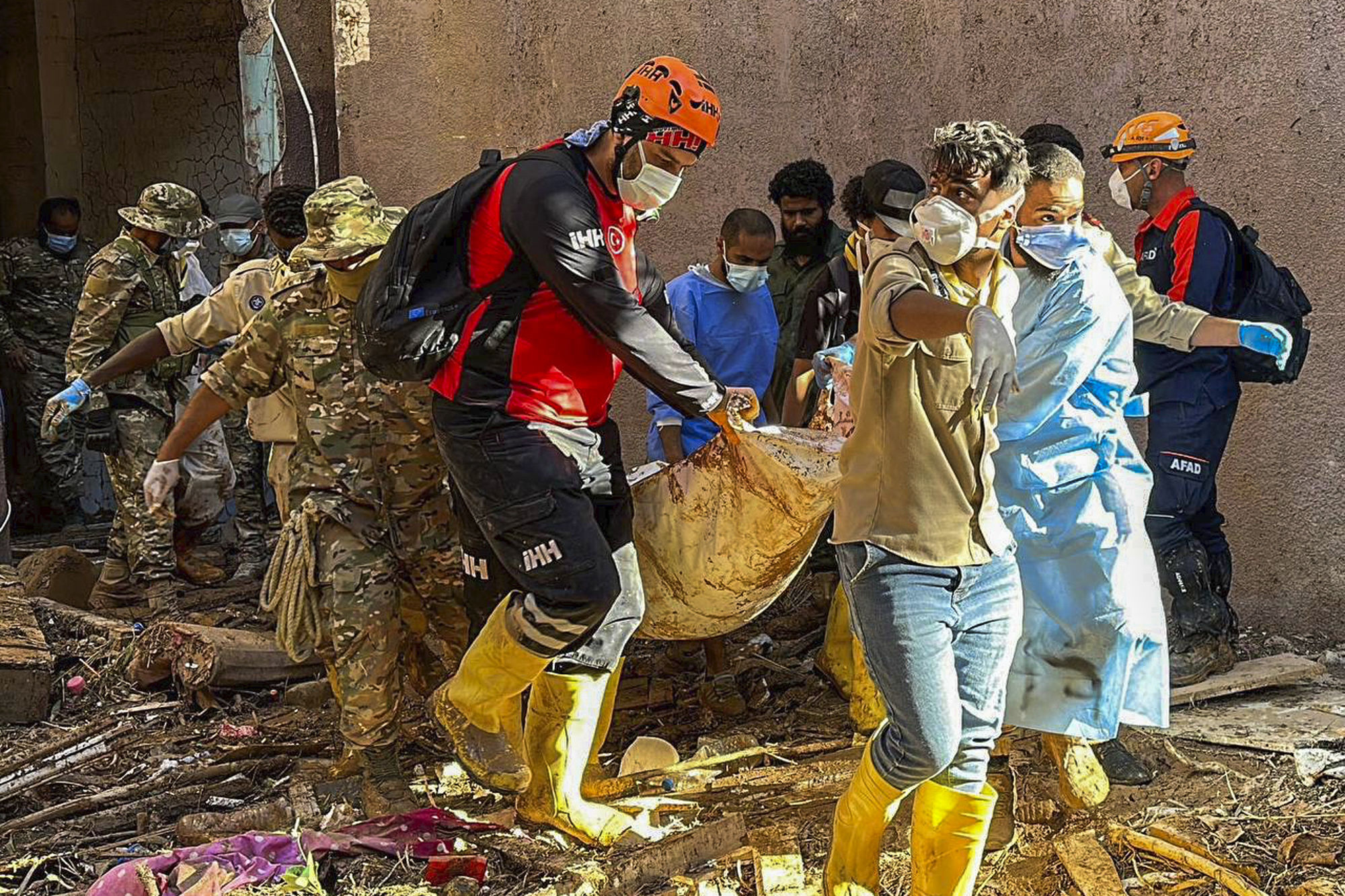
Rescuers from Turkey's IHH humanitarian aid group retrieving the body of a flooding victim in Derna, Libya, where the collapse of two dams unleashed a massive flash flood that killed thousands of people. Picture: IHH/AP
Last year, he wrote that repeated flooding threatened the dams built in the wadi, a usually dry riverbed, above the city of Derna. Last week, that Mediterranean coastal city was home to over 90,000 people.
“If a huge flood happens the result will be catastrophic for the people of the wadi and the city,” he said, urging steps be taken immediately to ensure regular maintenance of the dams.
Mr Ashoor’s grim prediction came to pass this week.
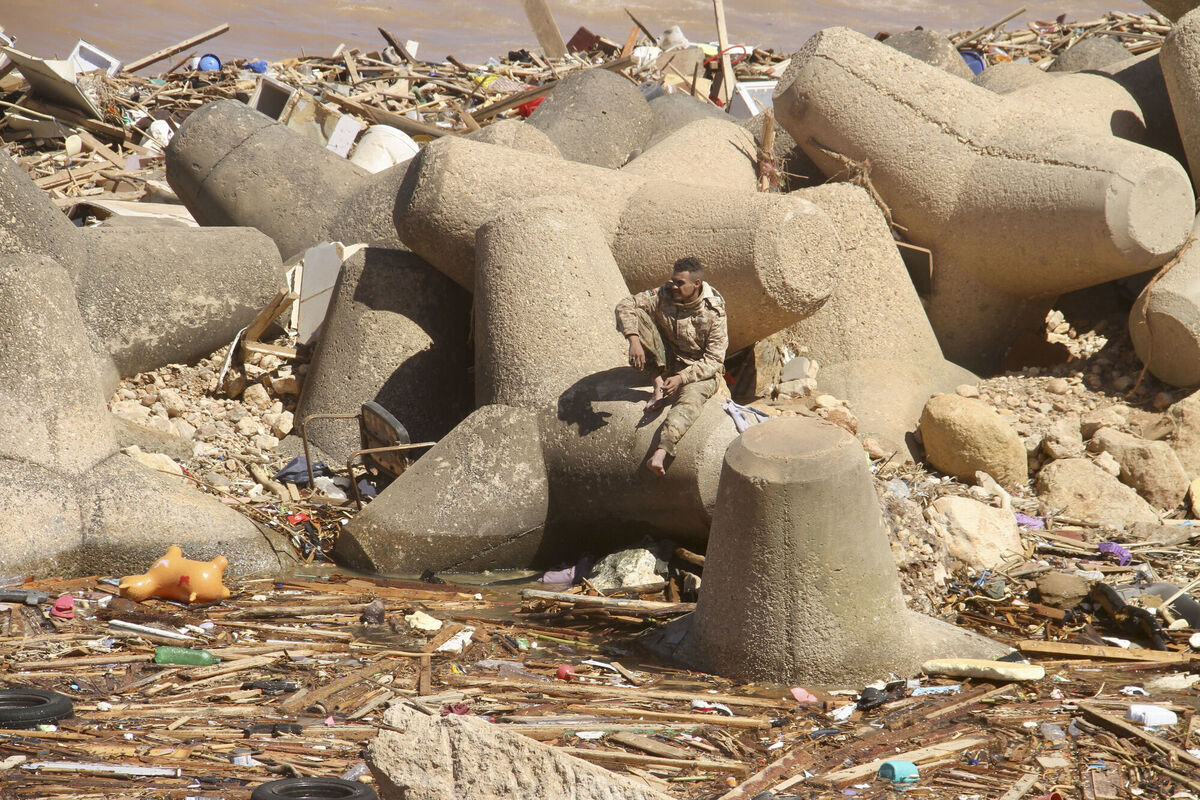
As aid workers and survivors describe bodies lying in the streets and being “constantly dumped” by the sea, the death toll of thousands is still rising.
The risks facing the eastern city of Derna had been flagged in advance.
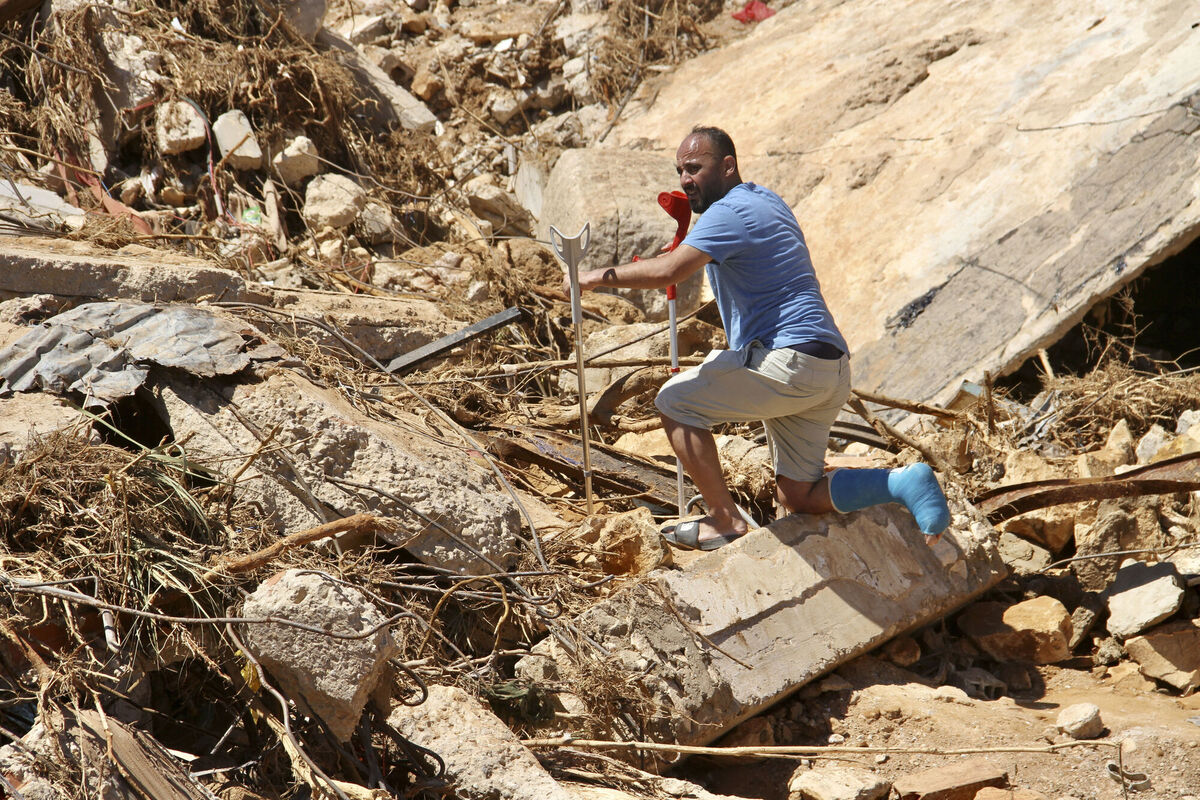
It isn’t fully clear yet whether it was crumbling infrastructure or decisions made by authorities — or a combination of the two — that contributed to the devastation the world witnessed this week as Storm Daniel swept through the region. But those questions have been and will continue to be asked in the weeks ahead.
The deputy mayor of Derna, Ahmed Madroud, told Al Jazeera that the dams, which had been built in the 1970s, had not been maintained since 2002 and that “they are not big”.
“When the river overflowed its banks, then it just took all the buildings with it, and the families that were in it,” he said.
And with a death toll that, at the time of writing, has already reached over 5,000 with thousands more missing, it is clear that humanitarian efforts as well as the ensuing recrimination and consternation over what has happened may persist for some time.
Storm Daniel had already pummelled Greece last week for three days. Meteorologists there described it as the worst storm to hit the country since regards began almost 100 years ago.
In the wake of a summer of extreme heat, Daniel left a ruinous trail in its wake with at least 15 dead and €2bn worth of damage caused in Greece.
Libya was warned of what was to come. In advance of it making landfall overnight into Sunday morning, prime minister Ossama Hamad’s government — based in the east of the country — declared a state of emergency.
Early reports into Monday morning suggested deaths in single figures in the town of Susa as the storm brought floodwaters that destroyed homes and businesses. Across that eastern region, a death toll of 27 was offered by health minister Othman Abduljaleel early on Monday but he added that the situation in Derna was “less clear”.
The initial confusion was caused partly by the deluge that struck Derna overnight making it inaccessible for many, as the roads were simply washed away.
It wouldn’t be long, however, until the horrific scale of the devastation inflicted upon the city was laid bare.
From a death toll in double figures, suddenly it had jumped to 2,000.
Residents reported hearing explosions on Sunday night, as the dams outside Derna collapsed and unleashed the flash floods which then reached the city.
Newer footage has shown the first dam to be completely destroyed. After breaching the first, the floodwater progressed downstream before then overwhelming the second dam in the southern part of the city.
Once that second dam was breached, the floodwater then had free rein to rip through Derna.
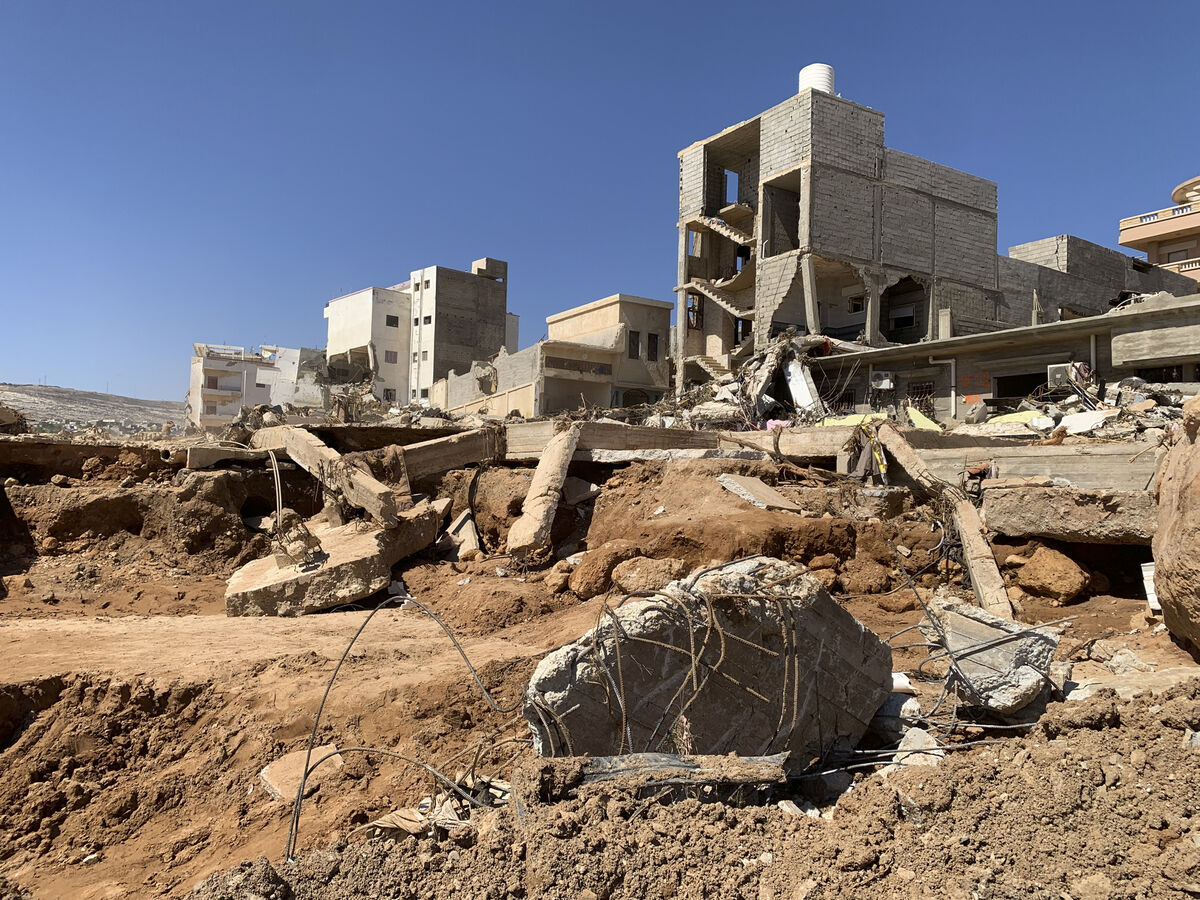
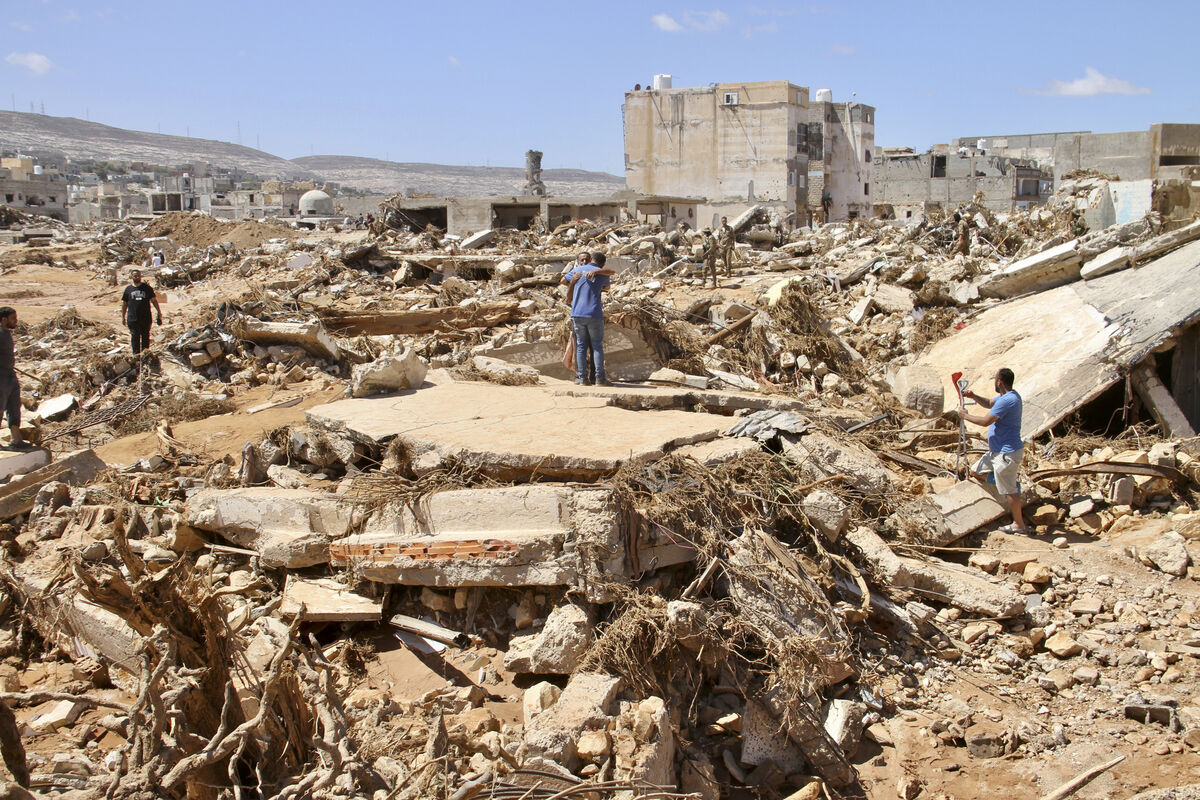
Videos by residents of the city posted online showed major devastation. Entire residential areas were erased along the river that runs down from the mountains through the city centre.
Multi-storey apartment buildings that once stood well back from the river were partially collapsed into the mud.
The flood reached seven metres high in some of the valley-affected areas, according to the Libyan Red Crescent — part of the International Federation of the Red Cross. Almost a quarter of the city of 90,000 inhabitants was washed away by the floods according to volunteers on the ground.
Usama Al Husadi, a 52-year-old driver, has been searching for his wife and five children since the disaster. “I went by foot searching for them ... I went to all hospitals and schools but no luck,” he told Reuters, weeping with his head in his hands.
Husadi, who had been working the night of the storm, dialled his wife’s phone number once again. It was switched off. “We lost at least 50 members from my father’s family, between missing and dead,” he said.
Aid worker Emad al-Falah said:
Three bridges have also been destroyed and Derna’s hospital was badly damaged. Given the complete collapse of services, the need for medical equipment quickly became desperate.
“The huge water quantity stored in the dam was so strong it literally took entire high-rise buildings away from their very foundations and swept them away to sea,” the Libyan Red Crescent said.
“Some of the buildings were 11 floors high, each floor with five apartments. There is no trace at all of these buildings which were swept out to sea and now some bodies are turning up on the shore.”
That initial death toll of 2,000 rose quickly. Health authorities put the death toll in Derna at 5,100 as of Wednesday. The number of deaths was likely to climb as there were at least 9,000 people still missing, said Ossama Ali, a spokesman for an ambulance centre in eastern Libya.
In comments to the Saudi-owned Al Arabia television station, Derna mayor Abdel-Raham al-Ghaithi said the tally could climb to 20,000, given the number of neighbourhoods that were washed out.
An official with the UN’s World Health Organisation in Libya said the fatalities could reach 7,000, given the number of people who were still missing.
“The numbers could surprise and shock all of us,” said the official.
As the rescue and humanitarian efforts ramped up in the hard-to-reach area, the spotlight also fell on the particular political context of Libya as a stumbling block for getting help to reach those who need it.
Put simply, Libya, a country with more than six million people, has and continues to suffer from extremely poor infrastructure after more than a decade of conflict.
The country has plunged into chaos since a Nato-supported uprising in 2011 toppled long-time dictator Muammar Gaddafi, who was later killed.
The oil-rich country has been divided for most of the past decade between rival administrations in the east and west.
Each administration is backed by armed groups and militias, and foreign governments. It has been seen as a dangerous, volatile place for some time. With the promise of the Arab Spring giving way to a destabilising, fractured country.
World Meteorological Organization secretary general Petteri Taalas said the tragedy in Libya demonstrates the “devastating and cascading consequences of extreme weather on fragile states”.
“If there would have been a normally operating meteorological service, they could have issued warnings,” Taalas said.
“The emergency management authorities would have been able to carry out evacuation of the people. And we could have avoided most of the human casualties.”
Taalas said that Libya’s National Meteorological Centre did issue early warnings for heavy precipitation and floods, but they didn’t address the “risk posed by the ageing dams”.
“The fragmentation of the country’s disaster management and disaster response mechanisms, as well as deteriorating infrastructure, exacerbated the enormity of the challenges,” Taalas said.
“The political situation is a driver of risk, as we are seeing in many countries currently.”
Even before the storm, the advice from the Irish Department of Foreign Affairs was not to travel to Libya.
“Due to the ongoing fighting and the risk of kidnapping or terrorist attacks throughout the country, the situation in Libya remains extremely dangerous,” it said.
“There are reports of increased military activity in the areas surrounding Tripoli and in the city itself and all Irish citizens are advised to avoid the region.
“Irish citizens who decide to travel to or remain in Libya are doing so at their own risk and against the advice of the Department of Foreign Affairs. If you remain in Libya, you should exercise caution, avoid large gathering, and ensure that you have appropriate personal security measures in place, including access to money and supplies of food, water, medicine, fuel, and other essentials.”
The International Federation of the Red Cross said that, due to past conflicts, Derna remains a “contaminated area with explosive remnants of war”. It said:
“It adds another layer of complexity to the compounded crises in the North African country.
“Crucially, the Libyan Red Crescent is politically neutral and therefore despite the political divide it has access and acceptance across the country.”
The catastrophe in Derna was described in as what happens “when the climate crisis meets a failed state”.
As Ireland often does in such situations, the Government has pledged financial support.
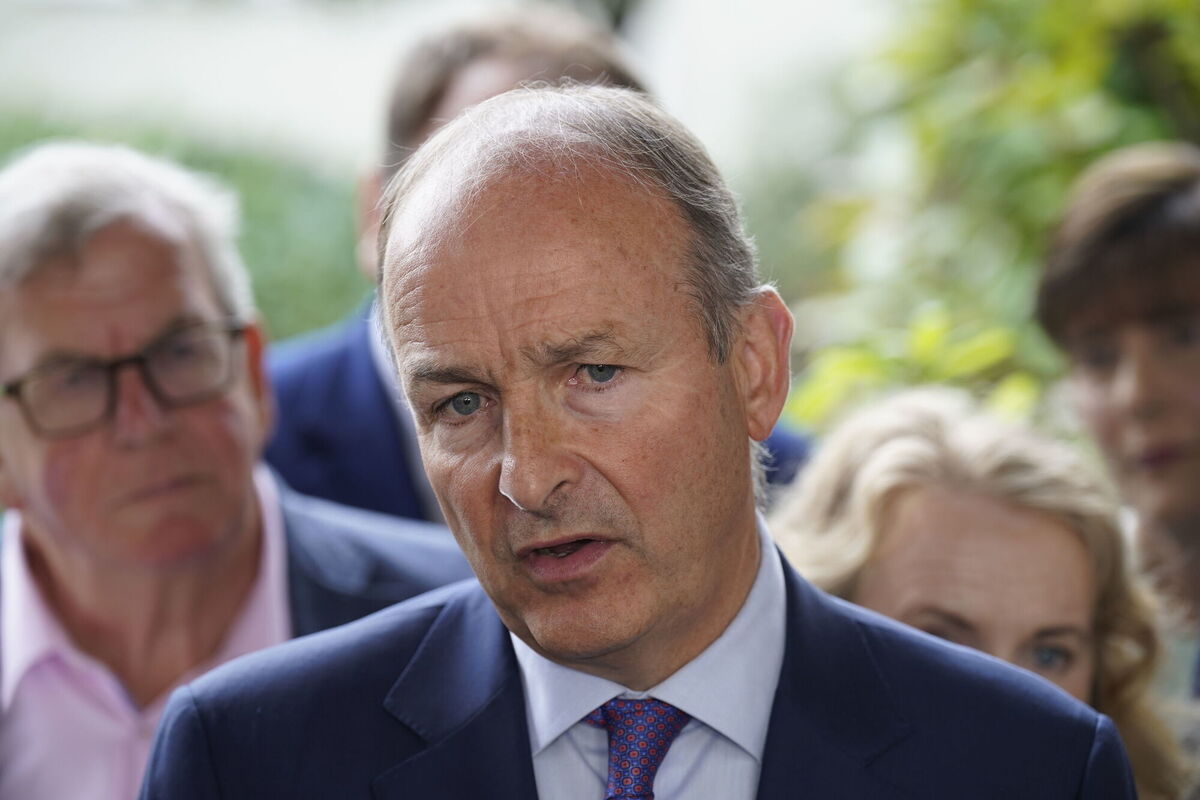
On Wednesday, Tánaiste and Minister for Foreign Affairs Micheál Martin said €1m of Irish aid would be provided to support the people of Libya.
“The Libyan people have already endured years of conflict, poverty, and displacement and the crisis caused by this flooding, a direct result of the impact climate change is having in the region, will exacerbate the difficulties they are experiencing,” he said.
“Funding from Ireland is facilitating a response at local level to those in desperate need.”
Aid money is being pledged from around the world. But it is logistics on the ground and getting the aid to those that need it that will be a key issue in the coming weeks.
As Derna reels from this monumental tragedy, images have emerged showing before and after images of the city just how utterly destroyed the city has been.
From above, a typical-looking medium-sized city now appears to have literally washed away. The rebuild will cost astronomical sums, and it remains to be seen if the authorities And the situation on the ground remains bleak.
Red Crescent volunteers say there are still dead bodies in the streets. They say that the need on the ground surpasses the capacity of authorities and humanitarian organisations to respond.
Compounding that is the inaccessibility of Derna making it difficult to assess the full scope of needs. Reaching the affected area has been described as the “biggest obstacle” to the delivery of vital aid.
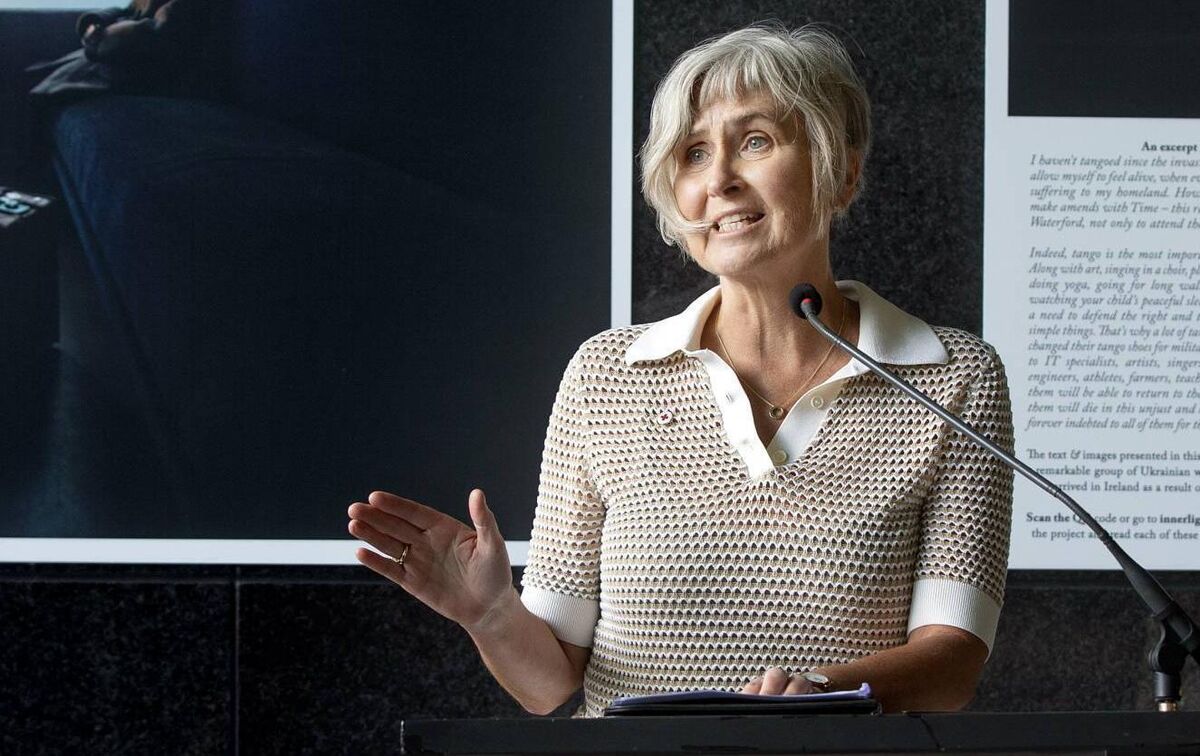
Irish Red Cross secretary general Deirdre Garvey said: “Right now Libyan Red Crescent (LRC) teams are focused on helping survivors. Thousands of people have lost their homes and are without proper shelter, they are using schools as a temporary solution.
“LRC teams are helping people shelter in two schools, they are helping reunite families, providing psychological support and distributing aid.”
The city’s mayor Abdulmenam al-Ghaithi said on Thursday that what they needed now was teams “specialised in recovering bodies”.
Another search director was quoted by Al Jazeera as saying “we need bags for bodies”.
While these desperate efforts continue, whether or not the pain and sorrow leads to anger at the authorities in the region remains to be seen.
But, for now, there is simply despair.
CLIMATE & SUSTAINABILITY HUB
CONNECT WITH US TODAY



Be the first to know the latest news and updates