Brian Tobin: Eight years after marriage referendum, all is not changed utterly
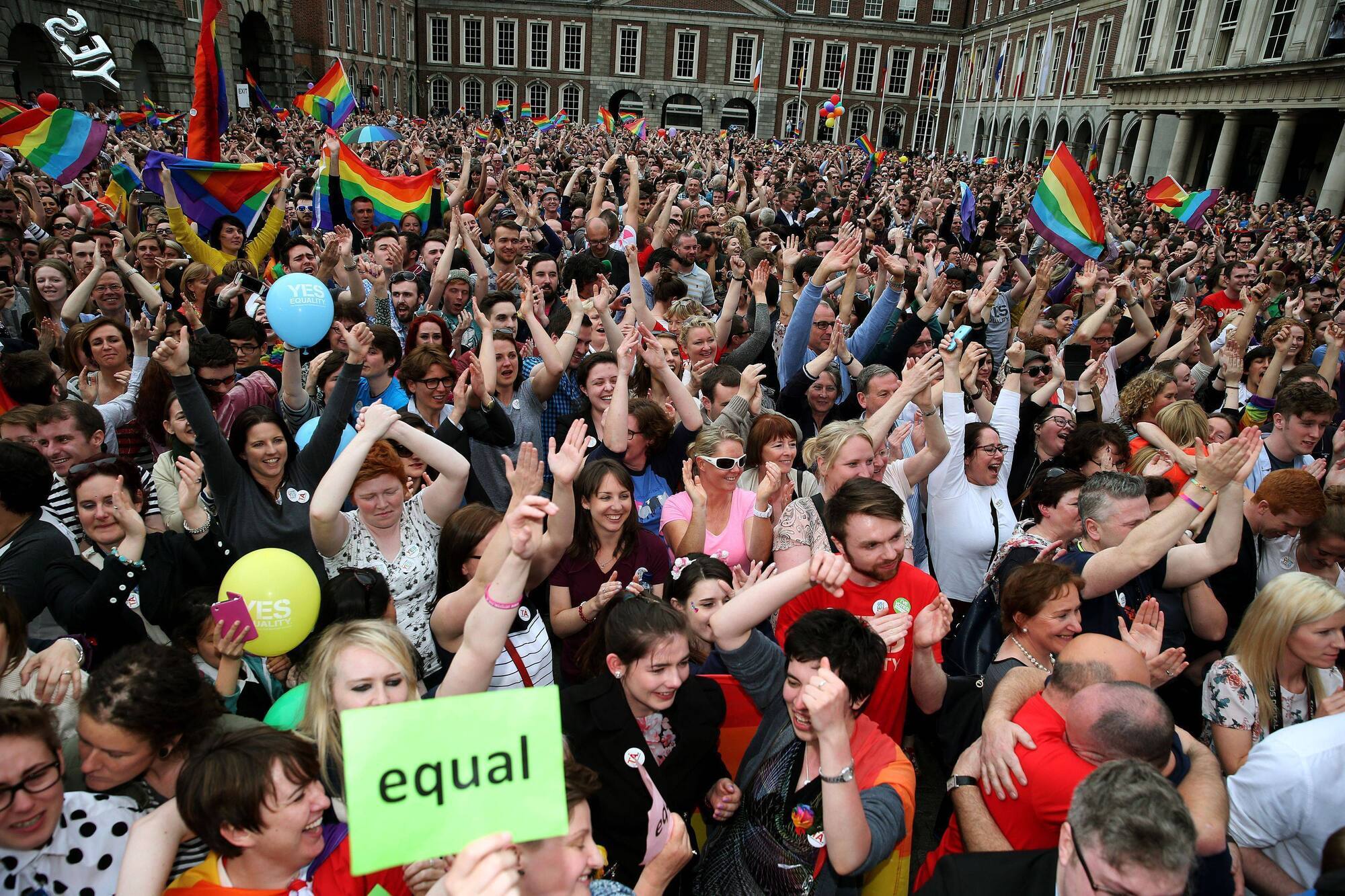
Yes voters celebrate in 2015 at the Central Count Centre in Dublin Castle as the country overwhelmingly voted in favour of gay marriage. While the positive result of the referendum was undoubtedly indicative of greater societal acceptance of LGBT+ identity and same-sex relationships, eight years on there is still much more work to be done to improve the situation of LGBT+ people in Ireland. File picture: Brian Lawless/PA
On May 22, 2015, a sizeable majority (62%) of the Irish electorate voted in favour of making marriage equality a reality, and later that same year same-sex couples were able to marry each other.
Societies that embrace marriage equality for opposite-sex and same-sex couples could be regarded as having reached the apex of social and legal assimilation for same-sex relationships. However, eight years later in Ireland, marriage equality has still not resulted in equal parental rights and responsibilities for many same-sex couples (married or otherwise) who are parenting children together, and recently there have been deeply concerning, serious ‘hate-motivated’ crimes against adults, and even children, who are members of the LGBT+ community.
Although same-sex couples acquired the right to marry following the success of the Marriage Referendum in 2015, their fight for recognition as equal legal parents of their children is still ongoing. It was only as recently as May 4, 2020, that Irish law enabled the female non-birth parent of a donor-conceived child born into a same-sex relationship to establish her legal parentage.
However, such law is only applicable where the child was conceived in a fertility clinic, and not through home-insemination. The latter is a practised and popular method of assisted human reproduction among female same-sex couples, but where a child is conceived in this manner, outside of the clinical setting, only the birth mother can be recognised as a parent.
In addition, it has long-since been established by the Supreme Court that in this context the sperm donor, as a genetic father, can seek a Declaration of Parentage from the courts and be regarded as the child’s legal father, entitled to seek the rights of guardianship, custody and access that accompany that status.
Further, for male same-sex couples raising children together but who needed the assistance of a surrogate to procreate, the non-genetic father of the surrogate-born child remains unable to establish his legal parentage. Although legislation to regulate surrogacy arrangements that take place in Ireland and abroad is about to be unveiled, its passage through the Oireachtas is likely to be a difficult one, given the legal and ethical concerns associated with the practice of international commercial surrogacy, in particular.
Although the same-sex parents discussed above cannot establish legal parentage in relation to the child they are raising, they can apply to the courts for guardianship if they are married to, in a civil partnership with, or cohabiting for over three years with a legal parent of the child, and have shared with that parent responsibility for the child’s day-to-day care for more than two years. However, acquiring guardianship only enables them to participate in important decisions concerning the child’s upbringing.
Also, legal guardianship should not be confused with the status of legal parentage — the latter status is lifelong but the former automatically ends when the child reaches the age of 18. The two-year waiting period also means that an application can only be made once the child is at least two years old.
As these same-sex parents can only acquire guardianship and not legal parentage, the child has no right to inherit from their estate or acquire their nationality. Further, the same-sex, non-parent guardian who is appointed by the courts may not acquire all of the same rights and duties as the child’s parent-guardian because Irish law provides that this type of guardian shall enjoy these "where the court expressly so orders" and only "to the extent specified in the order".
As adults in committed same-sex relationships campaign to establish crucial legal rights in relation to their children, hate crimes against members of the LGBT+ community also appear to be on the rise.
As reported in the last month, an Garda Síochána recorded a 30% increase in reported hate crimes in 2022 and the LGBT+ community were the second-most attacked minority group. Two LGBT+ men were killed in Sligo in 2022, one 23-year-old LGBT+ man was assaulted in Dublin and suffered a fractured eye socket, among other injuries, and just last week a 14-year-old schoolboy, a child, was assaulted in Navan and later hospitalised for his injuries.
Indeed, the organisation Belong To, which supports young LGBT+ people, carried out research in 2022 in which 76% of LGBT+ secondary school students reported feeling unsafe in Irish secondary schools.
While the positive result of the referendum on May 22, 2015, was undoubtedly indicative of greater societal acceptance of LGBT+ identity and same-sex relationships, eight years on there is still much more work to be done to improve the situation of LGBT+ people in Ireland. For members of the LGBT+ community, whether they are loving parents of donor-conceived or surrogate-born children, or whether they are among our LGBT+ youth, it is unfortunately clear that all is not changed, changed utterly in modern Ireland.
- Dr Brian Tobin, Lecturer in Law, School of Law, University of Galway.
- Dr Tobin is the author of The Legal Recognition of Same-Sex Relationships: Emerging Families in Ireland and Beyond (Oxford: Hart, 2023)
CONNECT WITH US TODAY



Be the first to know the latest news and updates