Mick Clifford: Is Patrick Kielty the man to save the Late Late?
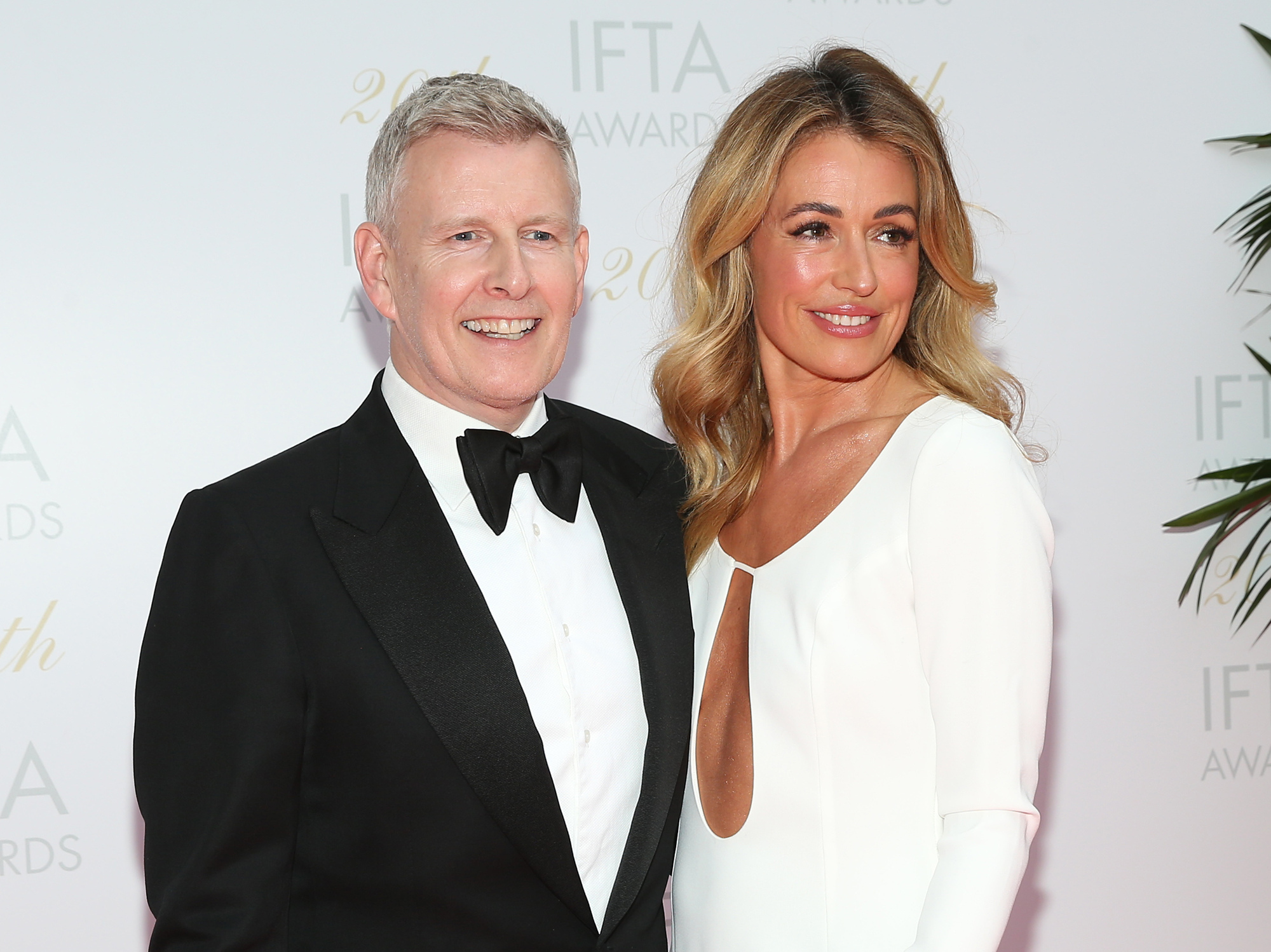
Patrick Kielty and Cat Deeley at the Irish Film and Television Awards in Dublin last Sunday. “Whoever gets that gig is going to be really, really lucky.” Picture: Brian McEvoy
“DO you want to know what I think?” So asked Brendan O’Connor on his RTÉ radio show two Sundays ago. The topic of conversation with his newspaper panel was the ongoing speculation about who was going to be appointed to succeed Ryan Tubridy as presenter of the Late Late Show. Of course, listeners wanted to know what O’Connor thought. If they were tuning to RTÉ radio on a Sunday morning there was a good chance that they were part of the shrinking demographic that still watched prime time TV live.
Over the previous few days, two of the frontrunners for the job had taken the high road. Claire Byrne, the unbackable favourite, and Sarah McInerney, who has acquired a reputation as an astute interviewer, had both declared they want to hang onto their Friday nights for themselves, rather than share it with the nation. Thanks, but no thanks. After the earlier departure from the race of Miriam O’Callaghan, the field had now seriously narrowed. Among those advancing to the front of the pack was O’Connor, who had previously hosted a TV chat show. So, Brendan, what do you think?
“I think this conversation has been based on free advertising for betting companies and I think I’m not contributing to that,” he said, and baited breaths across the country were released with a frustrated sigh. If O’Connor came up with that answer all on his ownio, he’s wasting his time in broadcasting. It was PR gold, expert deflection of an awkward question. If he’s that good at it he could make an absolute fortune spinning for the wealthy and powerful.
Later that Sunday another frontrunner was asked for his tuppence worth. Patrick Kielty was attending the IFTA awards in Dublin with his wife and fellow TV personality, Cat Deeley, when he was collared on the red carpet. Paddy, what’s the story with you and the Late, Late?
“Whoever gets that gig is going to be really, really lucky,” he said. “The one thing people have to remember though is how big shoes are to fill. You know, I’ve done a chat show before, I’ve done a live show before, it’s hard. Whenever you’ve been on the Late, Late Show as a guest and sat close to Ryan you see how he does his stuff.”
Another answer that PR dudes are paid big bucks to script, in which what was left unspoken screamed for attention. He didn’t follow the fashion and rule himself out. His hat was lying in the ring. Sweet Mother of Divine, he actually wants the gig. By that Tuesday, Paddy was the unbackable hot favourite.
When Tubridy announced that he was hanging up his Late Late boots the general consensus was that the successor would ideally be a woman. The time had come for a female presenter of the national broadcaster’s flagship programme. But everywhere that RTÉ looked, the top women were looking away.
The reality is that the three candidates most associated with the role initially were first and foremost journalists. They eat and drink current affairs, particularly politics, and all are at the top of their game. Sure, Byrne mixes light and shade on her radio programme, and O’Callaghan has a soft focus slot on a Sunday morning, but these are primarily broadcasters of serious stuff.
The gig at issue is as serious a job as can be imagined, but the fare scoots all over the place from heavy to light to, when the occasion calls, ridiculous, to wrapping your arms around the nation while winking that there’s one for everybody in the audience. And that’s all before you get to the toy show.
So in the end, the gig has gone to a person with a near-perfect profile for presenting a modern chat show. Kielty is a comedian who, like Tommy Tiernan for instance, can lean into the serious stuff with ease when required but has the performer’s innate sense of what his audience want. His only liability is his gender, but he can get past that.
O’Connor would have been perfectly capable of carrying it off also. As a refugee from light entertainment he has grown into a solid and accomplished broadcaster, lacking only in the kind of shine that comes with Kielty’s celebrity wattage.
What can be done with a show that was originally conceived as a vehicle for a superlative broadcaster 60 years ago? Gay Byrne left the stage in 1999 and since then the Late, Late has been chasing his ghost. His two successors, Tubridy, and before him, Pat Kenny, are highly competent broadcasters, but both quit while there was still fuel in the tank, as if after valiant attempts they accepted that they could not claim long term squatters’ rights on Gaybo’s home.
And how could they? Byrne’s huge advantage was timing. He took the helm in the early 60s, at a time when both Eamon DeValera and John Charles McQuaid had expressed fears as to what chaos of thought and Godless impulses the medium might deliver.
In 1984, over 20 years after Byrne’s first Late Late was broadcast, writer Colm Toibin wrote in Magill magazine about the impact the show had had on society.
"Gay Byrne understood that. He put it in his show, mixed it with a bit of music, visiting movie stars from Hollywood, pop stars from England, people you have heard about and now you can see, odds and sods from around Dublin.
“His influence arose not from any set of beliefs which he wished to present to the people of Ireland, but from the fact that the issues were presented in such a popular package. His talent was in knowing how fast the pulse of the country was beating and in knowing whose pulse he should be taking. In Ireland, like nowhere else, the airing of the problem was enough to cause a whole lot of trouble.

"Had he not come along with the instincts of a successful impresario and created a mass audience and then raised the issues he did, it is conceivable that dissent on the essential ingredients of Irish life would never have reached the ears of the majority of people in this country.”
How do you match that? Even Byrne in his prime would struggle to make a fraction of that impact today. This was alluded to by Kenny when he was interviewed by Anton Savage on Newstalk last week about the speculation around the gig. Pointing out that the show remained too valuable to RTÉ for advertising, he mused on whether there was any road less travelled down which it could venture.
“What kind of show do you put in there that will garner the audience,” he asked. “(What) if you can’t get the big stars to walk on because things are done differently now. If you want Jalo you can look at her Instagram and see what she’s having for breakfast.
No pressure so, Paddy.
Jane Suiter, professor of political communication and the institute for further media in DCU, believes that RTÉ needs to look at something different if it is to arrest the decline in viewership among the 20- to 40-year-olds.
“I thought it was interesting that a lot of the reporting on early discussions with Claire Byrne were saying that they were thinking of changing the format a little bit, maybe having fewer shows so the powers in Montrose look open to some sort of change,” she says.
“But you have to play to the strengths of who you choose. Patrick Kielty is interesting. He was the person chosen to interview Bertie Ahern and Tony Blair after the Good Friday Agreement was signed and he got an interview with Garth Brooks at one stage.
"So he has that kind of thing as well as the comedy and the ability to connect with a younger audience.
"I would imagine if they allow the format to change and somebody like him to have an input they should be able to maintain something that reflects back what a new Ireland looks like but also be able to bring in those people under the age of 40 on more than just the toy show night.”
By any standards, Kielty is indeed an interesting figure to occupy the hot seat. Unlike any other frontline media personality, the 52-year-old has a serious backstory that is part of the biggest issue to affect the island over the last half century.
He and his two brothers were brought up in the village of Dundrum in Co. Down. As a youngster he was a talented footballer, playing on the Down minor team that won an All-Ireland in 1987. The following January his businessman father John was shot dead by loyalist paramilitaries connected to the UDA.
On one level it would have been understandable if he had ended up as a participant in the Troubles, but he avoided it and went on to study psychology in Queens. His comedy career began there and quickly took off on the BBC and the stand-up circuit.
In 2002, he co-hosted the BBC talent show Fame Academy with Cat Deeley. They began a relationship and married in Rome a decade later. The couple lived in Los Angeles, where Deeley had a TV career, but relocated to London during the pandemic.

Kielty has not shied away from his past. In December 2021, he spoke at the Shared Island Forum about what the future might hold for the island as a whole. “A shared island means challenging ourselves to go beyond our own comfort zones,” he said. “And what we’re prepared to give up to make things better for others and ourselves.
"In this year of centenaries, the ghosts of the past are easy to honour. It’s way easier to sing a rebel song about a United Ireland than decide not to sign it in order maybe have one.” He also spoke in a documentary he’d made on the divisions in the North, during the course of which he sat down with Jackie MacDonald, the former commander of the UDA.
He said:
Kielty will in one small way be the recipient of good timing. If serious conversation is to be a part of the Late, Late’s diet then there is much that can be talked about in terms of the future of the island. Such fare in some hands could be stilted and boring. In Kielty’s it might well take off.
His avowed nationalism with a small n, in which he acknowledges that a new Ireland can’t be the current Republic with the fourth green field sewn on, makes him a perfect facilitator of wider debate on what kind of future awaits the island. He will need a lot more than that if he is to keep the Late Late Show on the road, but it would be a small start.