Elaine Loughlin: We must prepare to offer céad míle fáilte to climate refugees
Roderic O'Gorman says Ireland should prepare to accommodate increasing numbers of international protection applicants
Elaine Loughlin: We must prepare to offer céad míle fáilte to climate refugees

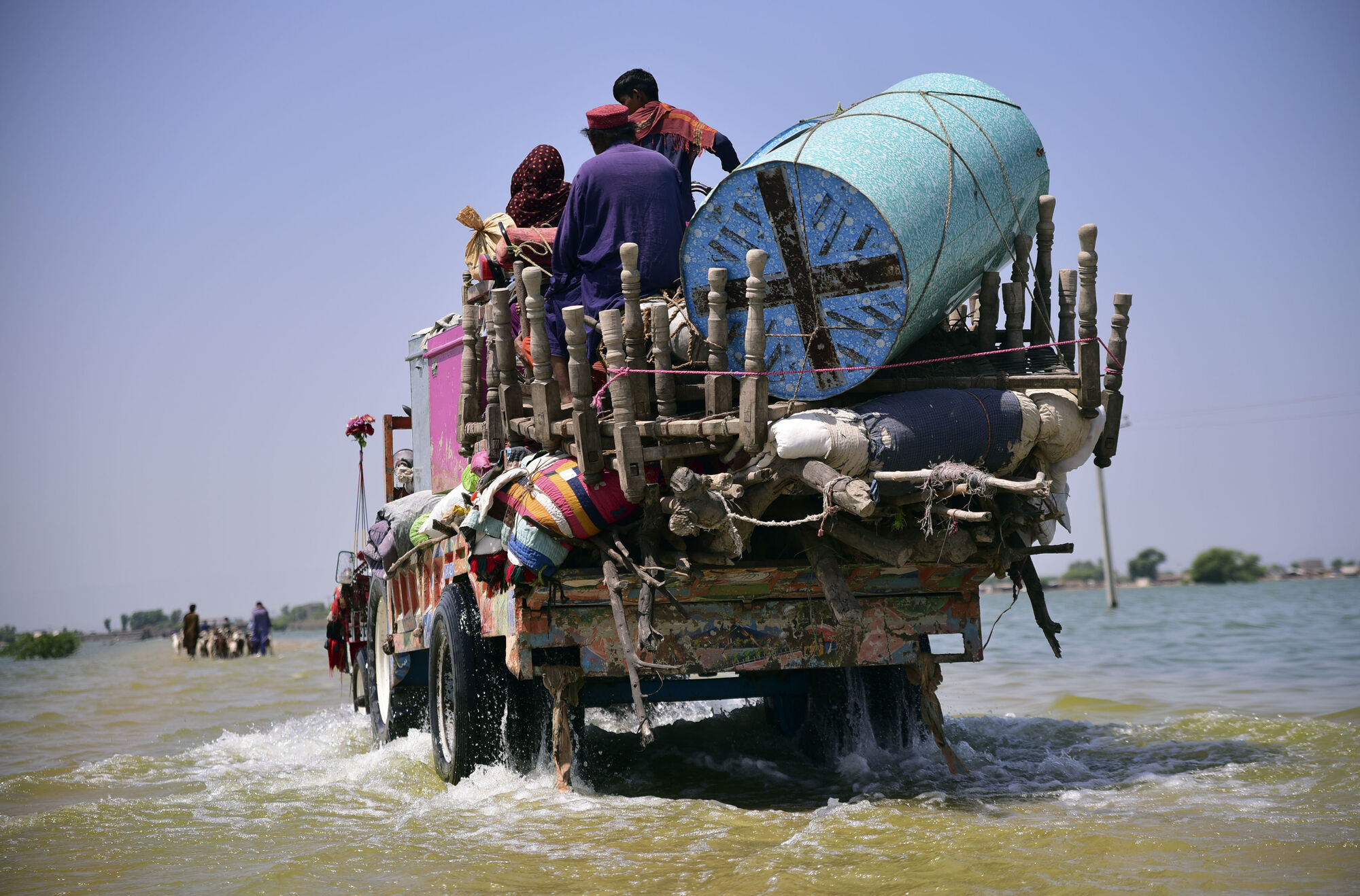
The Red Cross estimates that by 2050, 200m people a year will need international humanitarian aid as a result of  climate-related disasters and the socioeconomic impact of climate change. Picture: Pervez Masih/AP

The record 13,319 people who sought international protection in Ireland over the last 12 months cannot be seen as a blip.

While wars, oppressive political regimes, earthquakes and other one-off natural disasters have previously sparked mass movements of people fleeing their homes, changes in climate across the globe have become a major threat to many communities.

Climate change could leave some regions and even entire countries uninhabitable in the coming years, while many island nations and low-lying areas are expected to be engulfed by water.

Children's Minister Roderic O'Gorman has told the Irish Examiner that not only will we have to prepare to accommodate increasing numbers of international protection applicants each year, but he believes a new category should be established to recognise those who flee for climate reasons.

He said there is now a real "humanitarian element" to climate change, and this is something all governments will have to grapple with as the issue becomes more pronounced in the years to come.

"It is very real that habitable land is being rendered uninhabitable and that is going to have impacts across the world for the European Union and for Ireland," said Mr O'Gorman.

Numbers displaced because of rising sea levels, flooding, persistent drought, and other climate-related changes are stark. Picture: Fareed Khan/AP

The numbers of people now being displaced because of rising sea levels, flooding, persistent drought, and other climate-related changes are stark.

According to the Red Cross, by 2050 around 200m people every year will need international humanitarian aid as a result of a cruel combination of climate-related disasters and the socioeconomic impact of climate change.

This is nearly twice the estimated 108m people who currently need support each year from the international humanitarian system because of floods, storms, droughts, and wildfires.

The Institute for Economics and Peace (IEP) has estimated that 1.2bn people face being displaced within 30 years as the climate crisis and rapid population growth drive an increase in migration with “huge impacts” for both the developing and developed worlds.

Climate change is already very real. Fiji, for example, has drafted a plan to relocate 42 villages in the next five to 10 years to higher locations away from the shore.

Scientists predict Bangladesh will lose 17% of its land by 2050 due to flooding caused by climate change.  The loss of land could lead to as many as 20m climate refugees. Picture: AP

About half the population of Bangladesh lives less than five metres above sea level. Scientists predict the country will lose 17% of its land by 2050 due to flooding caused by climate change. The loss of land could lead to as many as 20m climate refugees from Bangladesh alone.

It is not just the developing world or far-flung tropical islands that are at risk.

Cities such as Shanghai, New York, and Venice are under significant threat from rising sea levels. 

It has been predicted that the entire population of the Netherlands could be forced to move as the country may disappear under water.

One of the challenges faced by those forced to leave their homes is a lack of real clarity around what constitutes a "climate refugee".

According to the 1951 Convention relating to the Status of Refugees, a “refugee” is defined as a person who has crossed an international border “owing to well-founded fear of being persecuted for reasons of race, religion, nationality, membership of a particular social group or political opinion”.

In 2020 the United Nations High Commissioner for Refugees (UNHCR) issued legal considerations which stated that there may be situations where the refugee criteria of the 1951 Convention or the broader refugee criteria of regional refugee law frameworks could apply. 

People may have a valid claim for refugee status, for example, where the adverse effects of climate change interact with armed conflict and violence.

However, a 2021 EU Parliament briefing paper said that the 1951 Refugee Convention does not fully cover climate refugees and there is no clear definition of this category of people.

"While the EU has not so far recognised climate refugees formally, it has expressed growing concern and has taken action to support the countries potentially affected by climate-related stress and help them develop resilience," the briefing paper states.

'All of Europe is going to have to expect more migration, more inward migration,' said Roderic O'Gorman. Picture: Naveed Ali

This vagueness not only leaves vulnerable communities in limbo, but it is also preventing countries which will be expected to welcome increasing numbers of refugees from fully planning.

"The absence of an accurate definition of what constitutes a person displaced by environmental factors has resulted in the inability to measure exactly the number of existing and potential displacement flows," Isabel Borges, professor and researcher at the Norwegian Business School and University of Oslo told a European Economic and Social Committee (EESC) hearing.

It will be up to the international community to put a definition on a growing group of people forcibly leaving their homes.

Regardless of how Europe reacts to and works to formalise climate refugees, Ireland will have to accept the reality that more people will seek protection on our shores in the years ahead.

"All of Europe is going to have to expect more migration, more inward migration," said Mr O'Gorman. 

"Parts of Europe have experienced very significant amounts in the last decade. By and large Ireland has been receiving relatively small amounts and I think it's likely that that's going to change," Mr O'Gorman said.

x

CLIMATE & SUSTAINABILITY HUB

More in this section

Revoiced

Newsletter

Sign up to the best reads of the week from irishexaminer.com selected just for you.

Cookie Policy Privacy Policy Brand Safety FAQ Help Contact Us Terms and Conditions

© Examiner Echo Group Limited