Mick Clifford: We are paying the cost of not having invested in infrastructure
The abrupt arrival of refugees into communities has sparked concerns, writes Mick Clifford
Mick Clifford: We are paying the cost of not having invested in infrastructure

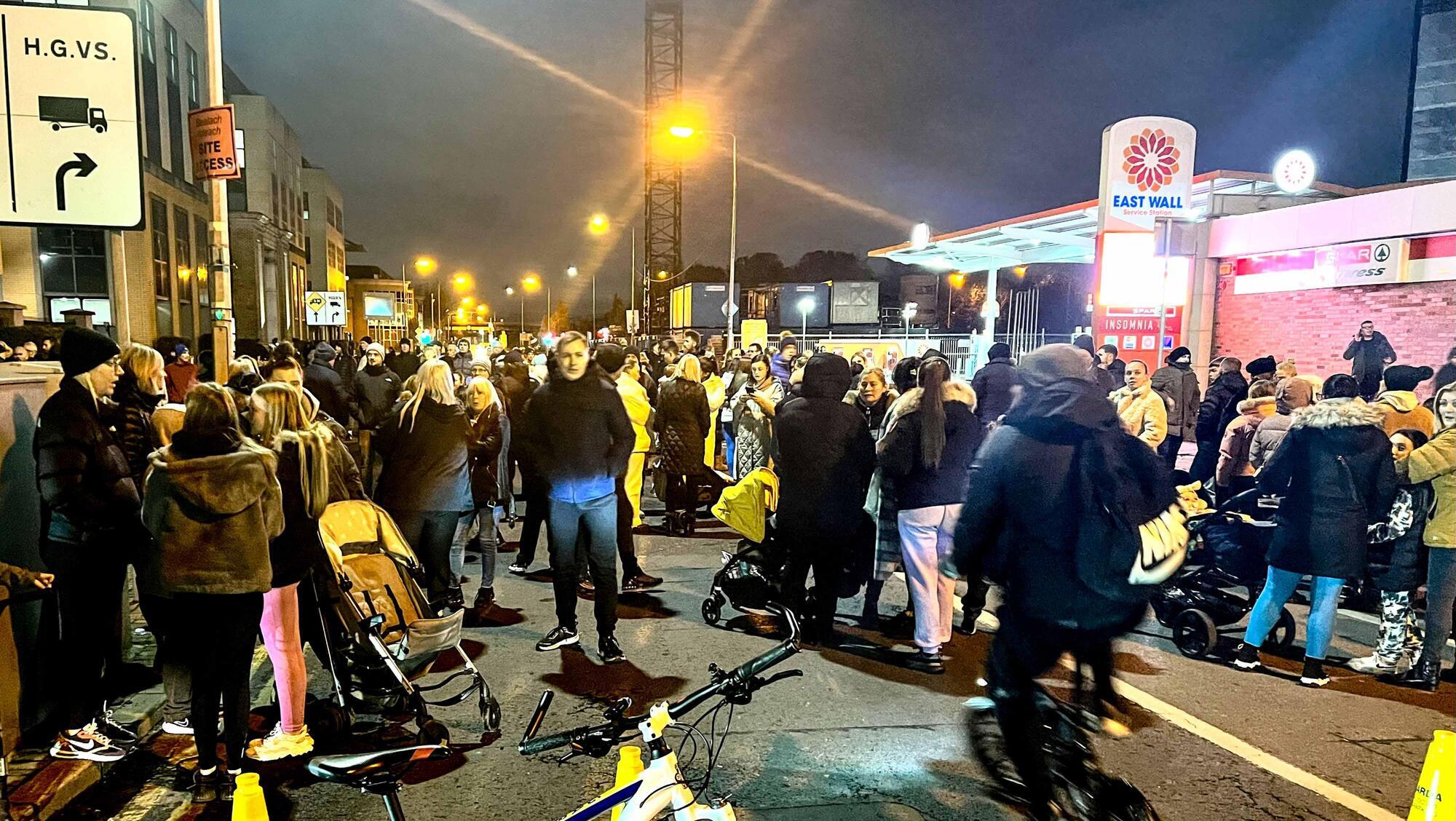
East Wall is the latest flashpoint in what is growing unease about the policy of housing asylum seekers and refugees across the country. Picture: Leah Farrell / RollingNews.ie

The 1913 lock-out got an airing. 

So did the IRA’s border campaign of 1956. History was invoked to show that the local community would live up to the best traditions of working-class resistance when pitted against major power.

On Tuesday evening at 5.10pm Malachy Steenson took the microphone to address the gathering of around 200 people on East Wall Road, in Dublin’s north inner city. 

They were there to protest the opening of an accommodation centre in premises formerly occupied by the ESB. 

As such, this was the latest flashpoint in what is growing unease about the policy of housing asylum seekers and refugees across the country.

A few minutes before Steenson spoke, a section of the crowd moved out onto the busy road to block traffic, as had been done at the protest on Monday evening. 

One difference on Tuesday, however, was that the protest was moved 50 yards up the road from the ESB centre. 

At the earlier protest, chants of “get them out” could be heard and this time the organisers didn’t want to see the new residents of the centre directly targeted in this manner.

Steenson is a local activist and former councillor for the Workers' party. 

He spoke as a guest at the Ard Fheis of the far-right Irish Freedom Party earlier this year about the "cultural war" faced by this country, railing against drug dealers and the "NGO class", although he says he is not a member of that party. He casts the issue as one of class.

“The establishment is on the run,” he told the gathering. 

“They are afraid of their lives of what is happening here.” 

Lilia Kristenko, 38, cries as city responders collect the dead body of her mother Natalia Kristenko in Kherson, southern Ukraine, on Friday. Picture: AP Photo/Bernat Armangue

He cited the 1913 lock-out and the revolutionary period and the IRA’s border campaign of 1956 as examples of where working-class people from East Wall rose up and did their duty.

Another speaker, Nigel Murphy from the East Wall Residents Association, pointed to an attempt to establish a direct provision centre in Ballsbridge in 2019 which was stopped by a legal challenge, made easier by access locally to “lawyers and judges”. 

In fact, that was in 2001, a lifetime away from the current situation.

Every community being affected by the current emergency has cited local circumstances as the reason why they had been unfairly selected for the location of a new facility. 

The reality is that the government appears to be scrambling to find beds anywhere in an unprecedented flow of refugees and asylum seekers into the country. 

There has, however, been no such facility located as of yet in salubrious neighbourhoods in the state’s cities.

An ESRI report, published on Thursday, showed that there has been a 191% increase in the number of asylum seekers who arrived in this country during the first half of 2022 compared to the same period in 2019, the last full year unaffected by Covid. 

Between January and June, the number of international protection applications rose from 2,235 to 6,494. 

A “confluence of factors” was cited as the reason for the increase.

Since the war in Ukraine began in February over 60,000 people fleeing that conflict have arrived here. 

There are forecasts that this number could top 70,000 by the end of the year. All of this is being superimposed on a prevailing housing crisis that shows no sign of abating.

People gather their belongings from a damaged house after Russian shelling in the town of Vyshgorod outside the capital Kiev, Ukraine, on Thursday. Picture: AP Photo/Efrem Lukatsky

Some of the 80 new residents already moved to the ESB facility came from the Crowne Plaza Hotel in Santry, which is not renewing its contract with International Protection Accommodation Service for 400 beds. 

More arrived from Athlone, having previously been living in tents on a state property. Around 360 hotels across the country are coming to the end of their current contracts and it is unknown how many will renew. 

The conversion of the East Wall centre from office to accommodation is not an outlier. Anywhere that has the potential to be fashioned into something habitable is being looked at.

On Tuesday, a delegation from Kill in Co Kildare met with the Minister for Integration Roderic O’Gorman over opposition to the conversion of an equestrian centre in their community to house 350 Ukrainian refugees. 

A lack of services in the small community there is cited as the main problem. 

In Mayo last week, a council meeting was told plans to build modular housing in Claremorris would create a “shanty town” and would be met by “vigorous opposition”.

The concerns being expressed have also given rise to fears that far-right anti-immigrant groups are attempting to stir things up. 

At an Oireachtas committee meeting this week, Mr O’Gorman referenced “nefarious elements” taking advantage of the concerns in East Wall.

There were far-right elements at East Wall, but by Tuesday the local people were getting a handle on things. 

One local man who said he’d been living in East Wall for 40 years was dismissive of their presence. 

“They’re not from here,” he told the Irish Examiner

They’ve come in to make trouble and we don’t want anything to do with them.” 

A few voices attempted to interrupt Steenson, one demanding that the protest be moved up to the ESB building, but he was having none of it. 

“We are not going to be distracted by other agendas who have come in here and allowed the media to paint us with brushes that we do not need to be painted with,” he said. 

“If they are not prepared to come here and abide by the instructions of the stewards then they can go someplace else.” 

After the protest ended, a group of around 20 people moved up to the ESB building, where a woman addressed them. 

“We have to protect our own people,” she said through a loudspeaker. 

She made a number of allegations against asylum seekers in general and suggested that events like the pandemic and even the war in Ukraine did not happen. 

“I am not a racist,” she said towards the end of what was a diatribe. 

They were ignored by the gardaí in front of the building and the majority of local people who began to disperse.

These elements have been a feature of protests and meetings about housing refugees around the country. 

A recent increase in refugees in Killarney prompted the arrival of far-right groups in the town. The town’s mayor Niall Kelleher says he was aware of them.

Residents queue to fill containers with drinking water in Kherson, southern Ukraine on Sunday. Picture: AP Photo/Bernat Armangue

“People saw them for what they were,” he says. 

“There was a protest last month but I don’t think many people showed up to it.” 

Where the far-right has made an impact is online. 

Rumours and baseless allegations are spread in attempts to play on fears. 

This tactic thrives in the vacuum created by the other constant theme of protests which is the lack of consultation with communities. 

At East Wall, the failure to inform local people of what was happening was repeatedly cited. In Killarney, Mr Kelleher says it was a major issue.

“It went out last month that 600 single men were coming to the town,” he says. 

“Neither I nor anyone else could agree or disagree because we simply didn’t know. I believe that the public not knowing is at the root of the problem.” 

Bryan Fanning, Professor of Migration and Social Policy at UCD, agrees.

“There is a challenge for leadership here,” he says. 

“It’s not easy but the state and government need to be far more front-of-house, to step in rather than let things play out. It’s difficult to provide leadership in these kinds of conditions, and very hard to get right. 

But I haven’t seen anybody step up and say, let’s talk about how we can make it better and move forward with this as best we can.” 

Niall Kelleher accepts that some people want advance warning or consultation simply to mobilise opposition to new arrivals.

“People will have issues and they have an entitlement to raise those issues,” he says. 

“I can understand the point that people might want notice in order to oppose it but without that (consultation) you can’t move forward and it often leading up other issues.” 

Another theme informing concerns in communities is hugely differing attitudes to Ukrainian refugees and those entering the country as asylum seekers.

At East Wall, the arrivals so far have been asylum seekers. 

One of the planks of opposition expressed at East Wall was that these were overwhelmingly single men. 

One woman, who declined to give her name, said she lived in an apartment block directly behind the ESB building. 

“I won’t let my 12-year-old daughter walk up the road to school,” she says. 

“All those men hanging around and have any of them been garda vetted”.

The vetting is a red herring. Only people who work with children or in sensitive areas require garda vetting. 

What is left of a playground following Russian shelling in the town of Vyshgorod outside the capital Kyiv, Ukraine on Wednesday. Picture: AP Photo/Efrem Lukatsky

For instance, if any major construction project gets underway in an area, which will attract a large volume of often young men, does anybody in the locale demand that they are garda vetted?

It is the case that a large portion of asylum seekers are single men while the majority of Ukrainians are women and children. Being white and from Europe would be more relatable as far as some communities are concerned. 

This is despite the reality that many asylum seekers are fleeing the same kind of oppression to which Ukrainians are currently being subjected.

The different attitudes were highlighted in what transpired in Killarney in early October. 

Plans to move 135 Ukrainian women and children to Co Mayo prompted a local outcry that it was cruel to uproot people who had settled into the town. 

The reason for the proposed move was to facilitate the arrival of 200 asylum seekers from Dublin.

The protest and petitions to government resulted in a reversal of the plans. 

The Ukrainians were allowed to remain in the town. 

However, the asylum seekers had by then arrived and the ultimate outcome was an increase in the total number of refugees and asylum seekers in Killarney. 

Within weeks some local representatives and business people were saying the town was being asked to take on too much.

“There are some people in the town questioning the countries were some (asylum seekers) are coming from,” Niall Kelleher says. 

“What they say to me and others is in places like Georgia they are not fleeing any war. 

A lot are aware of what is happening in Ukraine but not about what kind of issues there are in other places from where people are seeking international protection. 

"The fact is that between 30% and 40% are successful in getting status here, so questions will be asked about some of them.” 

The differing attitudes towards those arriving in the country has an official stamp. 

Ukrainians are provided with the PPS number and the right to work immediately in a manner similar to that afforded citizens of an EU country. 

Asylum seekers must wait six months before they can work. 

Also, sources in the system point to the fact that some facilities offering accommodation insist that they want Ukrainians to occupy the beds. 

The issue in Killarney arose because an accommodation provider in Mayo had such a stipulation. 

A further problem will arise in the Spring when contracts to provide accommodation in tourist destinations expire and the tourist season kicks in. 

Once more asylum seekers and refugees will be on the move and the government scrambling for a solution.

Unfortunately, this doesn’t look like a transient crisis. 

There is no sign of the war in Ukraine coming to an end and migration from developing countries, and increasingly as a result of climate change, is likely to increase further. 

It emerged during the week that an expert group appointed to examine the government’s attempts to end direct provision has warned that the country’s relatively positive attitude to refugees and asylum seekers could change and give rise to serious tensions. 

The group has recommended that the government use emergency powers to build six reception centres on state-owned land by the end of next year, each with the potential to house up to 750 people. 

The group was also critical of the policy of leaving the “heavy lifting” on the issue to the Department of Children.

“If we are now in a perma-crisis we are going to have to have systems to deal with it,” Bryan Fanning says. 

“What we do need is a refugee agency with a front-of-house person who can talk us through what is going on, a bit like Paul Reid or the chief medical officer did during the pandemic. 

"My sympathy goes out to those in government, but if I was starting I wouldn’t start from here. 

"We are paying the cost of not having invested in infrastructure but the question now is what do we do about it.”

x

More in this section

Revoiced

Newsletter

Had a busy week? Sign up for some of the best reads from the week gone by. Selected just for you.

Cookie Policy Privacy Policy Brand Safety FAQ Help Contact Us Terms and Conditions

© Examiner Echo Group Limited