Sean O'Riordan: Recruitment crisis leaves navy on 'eve of destruction'
With the Naval Service haemorrhaging critical staff and difficulties around recruiting personnel, Ireland is left in a vulnerable position when it comes to protecting our coastlines
Sean O'Riordan: Recruitment crisis leaves navy on 'eve of destruction'

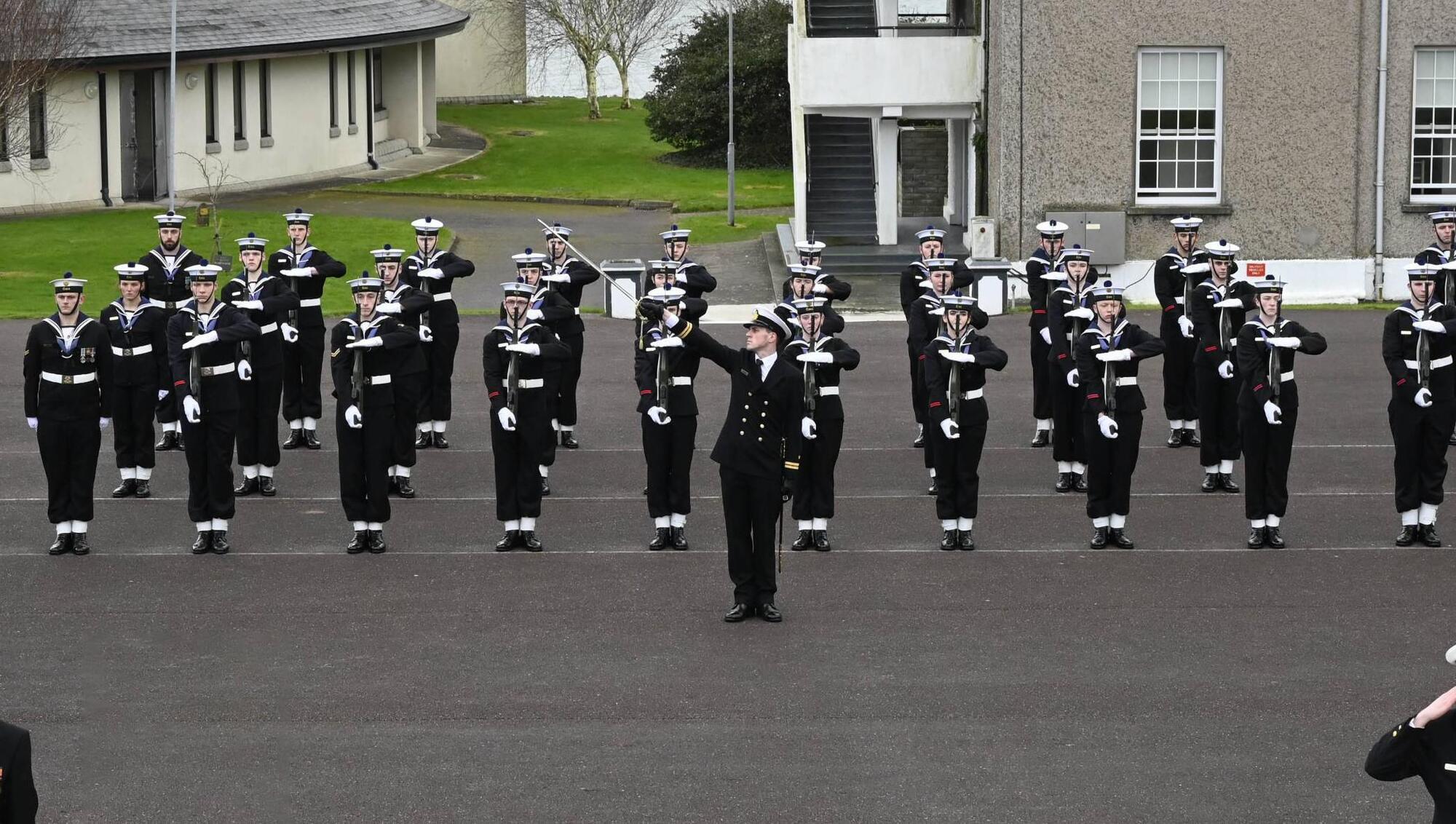
A Naval Service passing out ceremony at Haulbowline Naval Base, Cork, in February this year: By the end of the year the navy’s strength will dip below 800, nearly 300 short of the minimum number required. Picture: David Jones

The lookouts on the Titanic got very little time to alert the ill-fated ship’s captain of the looming iceberg that would sink them, whereas the Government has been repeatedly warned for the past seven years that the Irish navy is going under. Every year since, the warnings have become louder and the situation more critical.

The navy is now "on the eve of destruction", as the famous mid 1960s' hit song by Barry McGuire goes, because successive governments did not heed the advice of people who could see what was coming down the tracks. Questions are being asked now across the military: is it a case of too little too late, especially when it comes to protecting our maritime domain.

Both Raco, representing officers, and PDForra, for enlisted personnel, have highlighted concerns about retention and recruitment issues across the Defence Forces for many years, and in particular the Naval Service.

Concerns about staffing levels

Raco started to raise concerns about navy staffing levels in 2015, when the last White Paper on Defence was launched to supposedly address many issues going forward.

In August 2015, the total strength of the Defence Forces was 9,082. The army had 7,337, air corps 726 and navy 1,019. The navy’s minimum strength is supposed to be 1,094.

Fast forward to the August figures for this year and the picture is bleak. The total strength of the Defence Forces is now 8,146. The army at 6,621, the air corps 704 and the navy 821. The navy figure includes 14 new recruits. 

In addition, the Irish Examiner understands 30 personnel are awaiting their discharge, most of them quitting before reaching mandatory retirement age. Therefore, by the end of the year the navy’s strength will dip below 800. That is nearly 300 short of the minimum number required.

Crew shortages led two ships being tied up in the summer of 2019 and it has been predicted more will follow suit.

While naval management has been able to cobble together crews for general work, it needs a miracle to be able to scrape together specialists, for without them ships cannot go to sea.

The navy is seriously short of chefs, medics, electricians, officer engineers, communications officers, and radar and radio technicians. But the most critically endangered species are Engine Room Artificers (ERAs).

These technicians are vital in keeping the ships’ engines running and vessels cannot mount patrols without them onboard.

Staffing levels will become so acute in 2023/24 the navy will have no choice but to tie up two more ships — LÉ Niamh and LÉ Roisin, above, according to PDForra predictions. Picture: David Creedon

At the recent PDForra annual conference in Co Donegal, delegates heard the ERA section is operating at 41% of its supposed minimal strength, and the electrical branch at 32%. A further two ERAs have quit in the past three weeks.

PDForra has looked at the average number who quit that section each year and forecast that staffing levels will become so acute in 2023/24 the navy will have no choice but to tie up two more ships — LÉ Niamh and LÉ Roisin.

In addition, they might not be able to crew two smaller patrol vessels purchased from New Zealand, which are due to arrive next year.

One source said: “The ERA is facing utter destruction.” 

Pay and conditions

These highly-specialised technicians take years to train and there are few, if any, available in this country who would be tempted in from the private sector in what is known in the Defence Forces as "direct entry". Advertising direct entry has not worked in some cases previously as the private sector offers better pay and conditions than the military.

While Defence Minister Simon Coveney has started to get better pay for Defence Forces personnel, in most cases it still lags behind the private sector. Navy sources maintain replacement ERAs will have to be sourced in Europe and their pay and conditions must be upped significantly to bring in the numbers required.

Mr Coveney has said if he has to outsource he will. This has already happened with maintenance contracts in the air corps. But it is very expensive and military sources say it would be more cost-effective for the taxpayer if those in service were better paid. This would improve retention.

Another critical point which could impact on navy output is the implementation of the EU Working Time Directive (WTD). Currently, personnel are double and triple-jobbing to keep the show on the road, and unlike other public servants, they don’t get overtime. 

Mr Coveney said military management is trying to implement the WTD, as the gardaí have, but admitted some exemptions will have to be thrown into the mix.

Even small WTD alterations will have an impact on the hours military personnel can work and will further reduce defence capabilities unless there is not a significant rise in recruitment.

The country is awash with cocaine, the vast bulk of which has to be arriving into this island nation by sea. The Naval Service is in the front line for maritime drug interdiction. Its last major seizure of drugs was some years ago. Off-shore patrols have been reduced because of lack of crews.

Russian threat

Then there is the threat of the Russians to contend with. Last year, Raco highlighted the need to monitor and protect subsea cables running off our coast which transmit millions of pieces of important data between North America and Europe every day.

Raco’s navy representatives said they were worried about the presence of the Russian ‘spy ship’ Yantar off the west coast as it had been hovering over the cables for several days and may have launched submersibles capable of attaching explosives to them. The explosives can be activated from the air by Tupolev Tu-95 ‘Bear Bombers’, which regularly run exercises off our coast.

The Russians' ability to destroy the cables has come more sharply into focus recently when undersea explosions in the Baltic Sea damaged the Nord Stream gas pipeline which runs from Russia to Europe. The Russians have denied involvement, although most Western observers don’t believe them.

Our navy has repeatedly highlighted the need for the government to provide them with equipment such as multi-beam sonar and underwater drones to monitor the cables.

However, nothing has been forthcoming to date, despite the fact the Government has accepted in principle the Commission on the Future of Defence recommendations that the fleet "should have enhanced air, surface and sub-surface search capabilities", with the latter allowing our ships "to monitor activity in the vicinity of sub-sea cables".

If hostilities were to escalate between Russia and the West as a result of the invasion of Ukraine, the Russians might decide to blow up the cables off our coast. This would cripple communications between North America and Europe. Our navy, through no fault of its own, would currently be incapable of doing anything to prevent it.

More in this section

Revoiced

Newsletter

Sign up to the best reads of the week from irishexaminer.com selected just for you.

Cookie Policy Privacy Policy Brand Safety FAQ Help Contact Us Terms and Conditions

© Examiner Echo Group Limited