Tears and hugs for Russians called up to fight in Ukraine
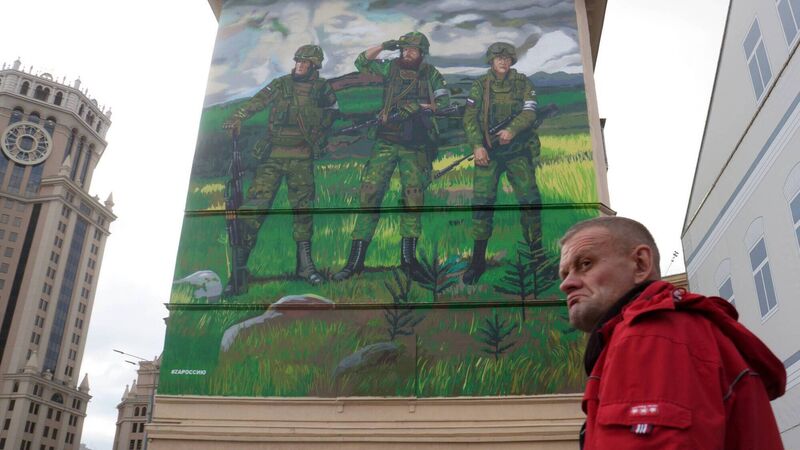
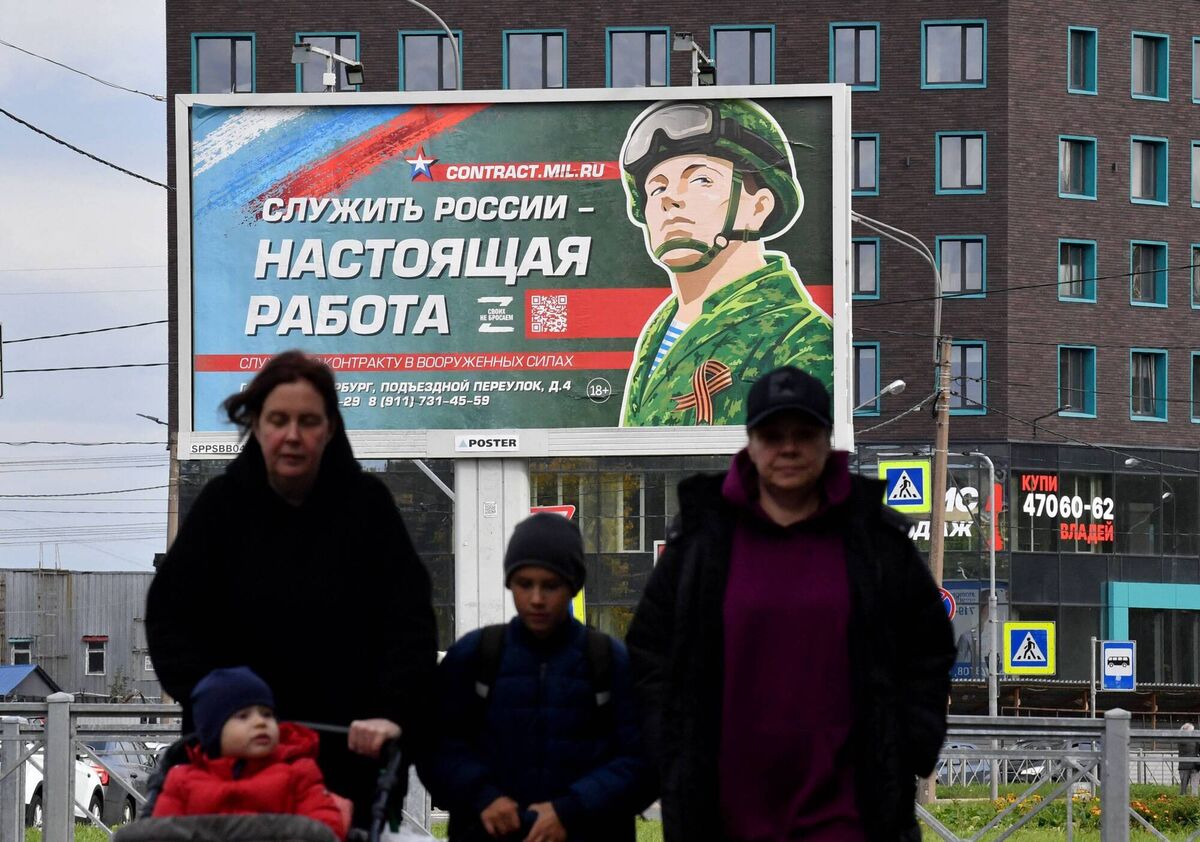
A massive pro-war mural showing three soldiers in camouflage with weapons, emblazoned with the words ‘For Russia’ with the letter Z, last Thursday in Moscow. President Vladimir Putin recently ordered the mobilisation of Russian army reservists after setbacks in Ukraine.
Russia has escalated its military and political campaign to capture Ukrainian territory, rounding up Russian army reservists to fight, preparing votes on annexing occupied areas, and launching deadly attacks.
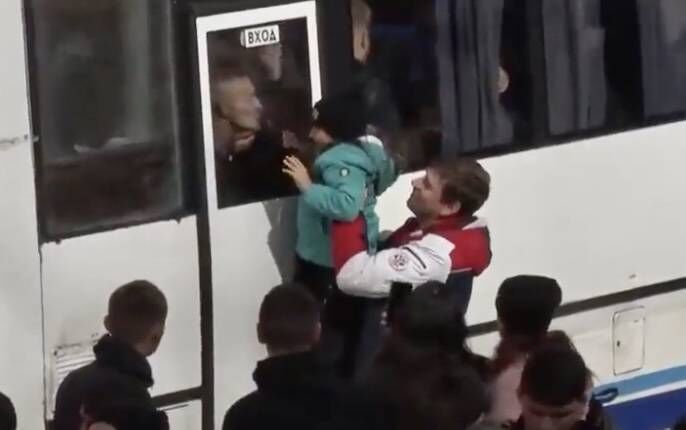
A day after president Vladimir Putin ordered a partial mobilisation to bolster his troops in Ukraine, dramatic scenes of tearful families bidding farewell to men departing from military mobilisation centres in Russia appeared on social media.
Video on Twitter from the eastern Siberian city of Neryungri showed men emerging from a stadium. Before boarding buses, they hugged family members waiting outside, many crying and some covering their mouths with their hands in grief.
In Moscow, women hugged, cried, and made the sign of the cross on men at another mobilisation point. A 25-year-old who gave only his first name, Dmitry, received a hug from his father, who told him to “be careful” as they parted.
Dmitry told Russian media company Ostorozhno Novosti he did not expect to be called up and shipped out so quickly, especially since he is still a student.
“No one told me anything in the morning,” he said. “They gave me the draft notice that I should come here at 3pm. We waited 1.5 hours, then the enlistment officer came and said that we are leaving now. I was like: ‘Oh great!’ I went outside and started calling my parents, brother, all friends of mine to tell that they take me.”
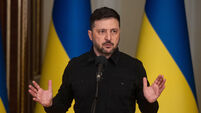
Ukrainian president Volodymyr Zelenskyy, in some of his harshest comments so far in the nearly seven-month-old war, lashed out at Russians succumbing to the pressure to serve in their country’s armed forces and those who haven’t spoken out against the war. In his nightly video address, he switched from his usual Ukrainian language into Russian to directly tell Russian citizens they are being “thrown to their deaths”.
“You are already accomplices in all these crimes, murders, and torture of Ukrainians,” Zelenskyy said, wearing a black T-shirt that said in English: “We Stand with Ukraine,” instead of his usual olive T-shirt. He said Russians’ options to survive are to “protest, fight back, run away, or surrender to Ukrainian captivity”.
Western leaders derided Putin’s mobilisation order as an act of weakness and desperation. More than 1,300 Russians were arrested in anti-war demonstrations earlier in the week after he issued it, according to the independent Russian human rights group OVD-Info. Organisers said that more protests were planned for today.
Putin’s partial call-up of 300,000 reservists was short on details, so much so that the Russian military announced on Thursday it had set up a call centre to answer questions.
In Washington, Brigadier General Pat Ryder, the Pentagon’s press secretary, said the US believes that it will take Russia time to train and equip the new troops and that doing so may not solve command and control, logistics, and morale issues.
Concerns about a potentially wider draft sent some Russians scrambling to buy plane tickets to flee the country, and Zelenskyy claimed on Thursday that the Russian military is preparing to draft up to a million men. A Kremlin spokesman earlier denied such claims.
German interior minister Nancy Faeser offered support to potential deserters. She told the that anyone who “courageously opposes Putin’s regime and therefore puts himself in the greatest danger” can apply for asylum in Germany.
In the Kremlin’s territory annexation campaign, pro-Moscow authorities in four Russian-held regions of Ukraine yesterday began holding referendums on becoming part of Russia — a move that could expand the war and follows the Kremlin’s playbook from when it annexed Ukraine’s Crimean Peninsula. Most of the world considers the 2014 annexation of Crimea to have been illegal.
Voting on the referendums in Ukraine’s Luhansk, Kherson, Zaporizhzhia, and Donetsk regions is scheduled to last through Tuesday. Foreign leaders have called the votes illegitimate and non-binding.
In Luhansk, billboards reading “With Russia Forever” and “Our Choice-Russia” appeared on the streets, while volunteers distributed ribbons in the colours of the Russian flag, and posters reading: “Russia is the future. Participate in the referendum!”.
Meanwhile on the battlefield, Russian and Ukrainian forces exchanged missile and artillery barrages as both refused to concede ground. Russian missile strikes in the southern city of Zaporizhzhia left one person dead and five wounded, Ukrainian officials said.
Officials in the separatist-controlled city of Donetsk said Ukrainian shelling killed at least six people. Kyrylo Tymoshenko, a deputy in the Ukrainian president’s office, said a hotel in Zaporizhzhia was struck and rescuers were trying to free people trapped in rubble.
The governor of the mostly Russian-occupied Zaporizhzhia region, Oleksandr Starukh, said Russian forces had targeted infrastructure and damaged apartment buildings in the city, which remains in Ukrainian hands.
The mayor of the separatist-controlled city of Donetsk, Alexei Kulemzin, said Ukrainian shelling hit a covered market and a minibus. Overnight, one person was killed during Russian shelling in Nikopol, across the river from the Zaporizhzhia Nuclear Power Plant, according to the Dnipropetrovsk regional governor.
While hostilities continued, the two sides managed to agree on a major prisoner swap. Ukrainian officials announced the exchange of 215 Ukrainian and foreign fighters — 200 of them for a single person, an ally of Putin’s. Denis Pushilin, head of the self-proclaimed Donetsk People’s Republic, confirmed that pro-Russian Ukrainian opposition leader Viktor Medvedchuk, was part of the swap.
Putin has repeatedly spoken about Medvedchuk as a victim of political repression. Media reports alleged that before Russia’s invasion, he was a top candidate for leading a puppet government the Kremlin hoped to install in Ukraine.
Among the freed fighters were Ukrainian defenders of a steel plant in Mariupol during a long Russian siege, along with 10 foreigners, including five British citizens and two US military veterans, who had fought with Ukrainian forces. Some of those freed had faced death sentences in Russian-occupied areas.
A video on the BBC News website Thursday showed two of the released British men, Aiden Aslin and Shaun Pinner, speaking inside a plane while en route home.
“We just want to let everyone know that we’re now out of the danger zone and we’re on our way home to our families,” Aslin said in the video, as Pinner added: “By the skin of our teeth.”
The non-profit Presidium Network, which is helping provide aid to Kyiv, said Aslin, Pinner, and three other Britons were safely home and reunited with their families Thursday.
The continuation of Russian missile attacks and the beginning of a partial mobilisation of Russians into the armed forces suggested the Kremlin was seeking to dispel any notion of weakness or waning determination to achieve its wartime aims in light of recent battlefield losses and other setbacks.
Ratcheting up tensions, a senior Kremlin official on Thursday repeated Putin’s threat to use nuclear weapons if Russian territory comes under attack.
Dmitry Medvedev, deputy head of Russia’s Security Council, said strategic nuclear weapons are one of the options to safeguard Russian-controlled territories in eastern and southern Ukraine. The remark appeared to serve as a warning that Moscow could also target Ukraine’s Western allies.
US secretary of state Antony Blinken responded Thursday, calling on every UN Security Council member to “send a clear message” to Russia that it must stop its nuclear threats.
Russia’s neighbours have been on edge about a possible threat from Russia. Estonia said training exercises started Thursday for nearly 2,900 reservists and volunteers, in an apparent counter to Moscow’s announcement of a partial military mobilisation.


CONNECT WITH US TODAY



Be the first to know the latest news and updates