Gorbachev and Reagan: the capitalist and communist who helped end the Cold War
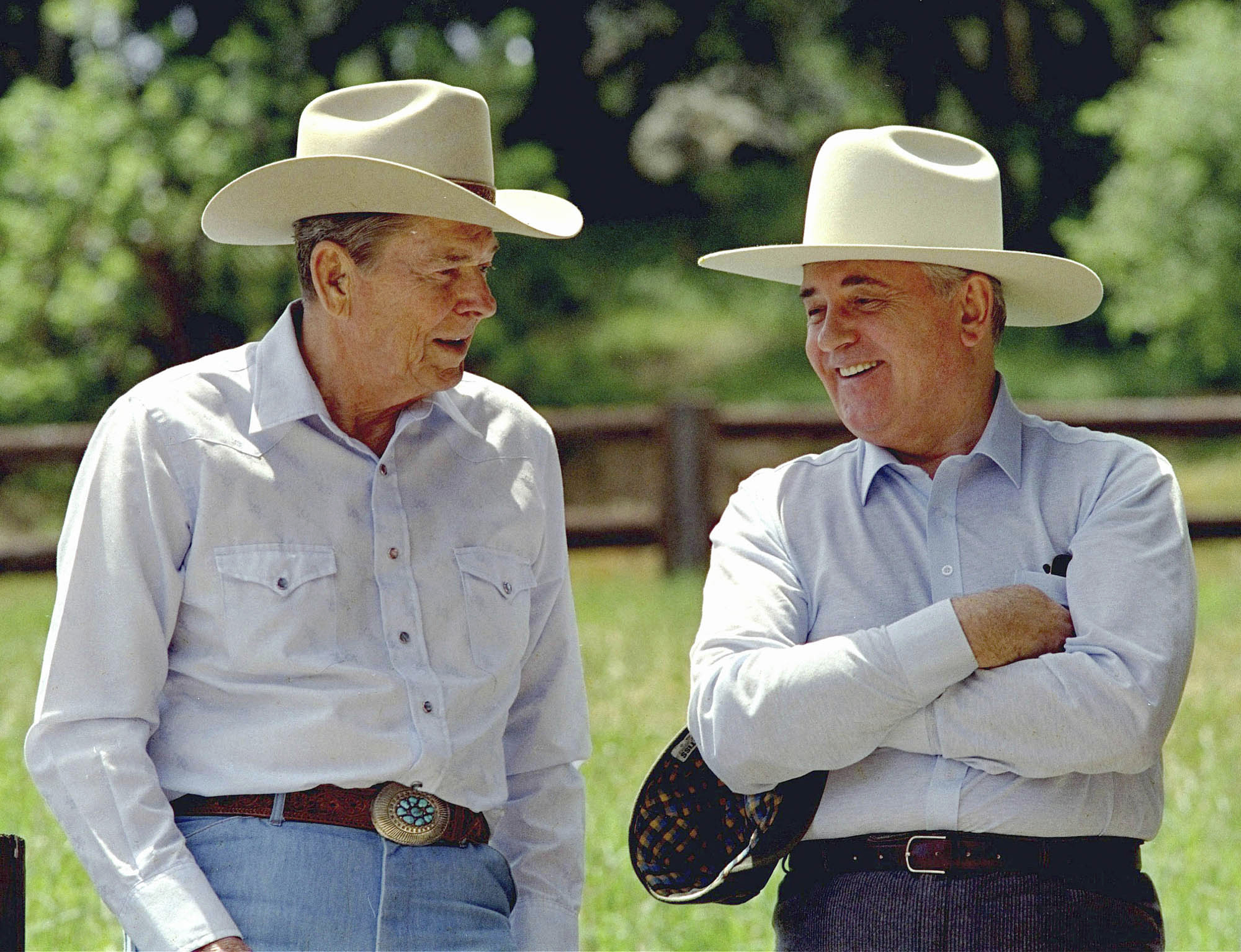
Former US president Ronald Reagan, left, and former Soviet president Mikhail Gorbachev don cowboy hats while enjoying a moment at Reagan's Rancho del Cielo north of Santa Barbara, California, in May 1992. Picture: AP
When Michael Reagan attended the 2004 funeral of his father, former US president Ronald Reagan, the man sitting behind him, he recalls, was the last leader of the Soviet Union: Mikhail Gorbachev.
âMikhail Gorbachev and my wife and I became friends over the years,â Reagan said from Los Angeles on Tuesday after learning of the Russianâs death aged 91.Â
âWhat I most remember is him telling me that every time my father and him met, my father would always end every meeting with, âIf itâs Godâs willâ, and Mikhail Gorbachev would say to me, âI would look around the room to see if God was thereâ.âÂ
Ronald Reagan and Gorbachev, capitalist and communist, were an unlikely pairing but their series of high-profile summits have been praised for helping to end the Cold War.Â
Together, they negotiated a landmark deal in 1987 to scrap intermediate-range nuclear missiles.
Former Reagan administration officials spoke on Tuesday of the leadersâ chemistry and shared a determination to pull the world back from the brink of a superpower war. They lauded Gorbachev as a Soviet leader who, unlike his implacable predecessors, was willing to constructively engage with Washington.
Reagan had branded the Soviet Union as the âevil empireâ but his political soulmate, British prime minister Margaret Thatcher, declared in 1984: âI like Mr Gorbachev. We can do business together.âÂ

The following year, Reagan and Gorbachev held their first summit in Geneva.
Ken Adelman, who, as Reaganâs director of arms control, attended the summit, recalled: âI was at lunch with him and he walks in and says, âThis is a new kind of Soviet leaderâ. I was kind of amused because he had never met an old kind of Soviet leader but he was absolutely right.âÂ
He added: âReagan saw himself as a great negotiator and considered his life as one of great negotiations. He was very sad that, as he said, he couldnât talk to all the Soviet leaders before Gorbachev âbecause they keep dying on me. What am I supposed to do?ââÂ

Adelman, 76, author of Reagan at Reykjavik: Forty-Eight Hours that Ended the Cold War, would not describe the men as friends but said they were always civil to each other.Â
âWhat did it was that Ronald Reagan showed great backbone at the Reykjavik summit in 1986 when he walked out without destroying SDI â the Strategic Defense Initiative â when Gorbachevâs top priority was to destroy SDI.
"So I think Gorbachev admired Reagan. Reagan certainly liked Gorbachev because he was a new type of Soviet leader, one that he could deal with, and they saw their futures were intertwined and their greatness was intertwined.Â
"That was certainly true when they came up with the Intermediate-Range Nuclear Forces Treaty, which was the first treaty that eliminated an entire class of nuclear weapons.â
Another witness to the impossibly high stakes negotiations was Jim Kuhn, then assistant to the president. Now 70 and based in Alexandria, Virginia, he remembers that Thatcher came to Camp David to discuss her meeting with Gorbachev and convinced Reagan he was different and willing to listen.
Kuhn said: âThe thing that made the difference most to Reagan was when Thatcher told him he never cut me off, he never interrupted me whenever I was making my point. That opened up Reaganâs mind about Gorbachev so he went in there with an open mind. He knew that that one summit could lead to another and maybe another and maybe there was some way to begin to scale down the nuclear arms race.â

The first one-on-one meeting in Geneva was supposed to run for 20 minutes but lasted an hour and a half, Kuhn continued, and Reaganâs first impression was positive.
 âHis words were, âThereâs a chemistry between the two of us, we listen to one another, we donât agree but maybe thereâs a way to continue. Weâve got a long way to go here and hopefully we can find some kind of a common ground.âÂ
âWe had worked it out that Reagan would, in the second session, take Gorbachev for a walk in Geneva down along the lake there. There was a small lake house and it was just the two of them meeting with interpreters and thatâs when Reagan told Gorbachev, âMr General Secretary, you can never win an all out arms race with the United States because we will always have the ability to outspend youâ.
âThat set the tone for the summits going forward. Gorbachev was very highly intelligent and prepared himself. He understood that things had to change and that Reagan was the kind of guy that he might be able to work with and one summit led to another and then another.âÂ
But Kuhn noted the leaders, whose wives âdidnât hit it off so wellâ, also had major disagreements, especially over human rights.Â
"Reagan would give Gorbachev a list of people that were being held against their will, being mistreated in the Soviet Union. It just used to make Gorbachevâs blood boil: like, why do they hit me with this?
âSo he would come back and attack Reagan, saying, donât lecture me on how to run my country or how we treat our people; youâve got people living on sidewalks and on grates and youâve got crime out of control.âÂ
In 1987, Reagan famously urged in West Berlin: âMr Gorbachev, tear down this wall!âÂ
Two years later, popular revolutions swept away communist governments in East Germany and the rest of Eastern Europe. Gorbachev and Reaganâs successor, President George HW Bush, met at a summit in Malta and hailed the end of the Cold War.

Ed Rogers, who was a special assistant to Reagan and deputy assistant to Bush, attended the Malta summit and believes Gorbachev deserves more credit. He said on Tuesday: âGorbachev was intellectually honest about what aspirations he had for the Soviet Union. He wanted a healthy, prosperous society.
âHe was intellectually honest about what the economic system had produced in Russia, in the satellite states that comprised the Soviet Union, and he knew that more of the same was undesirable.
"He was intellectually honest about human aspiration. He didnât turn the guns on people in Berlin. He didnât turn the guns on people that came to the embassy in Hungary. He decided the answer to the Soviet Unionâs problems isnât to shoot a bunch of innocent people.âÂ
Rogers added: âGorbachev did not crash the Soviet Union, he brought it in for a smooth landing. It was a huge geo political nonevent thanks to his honesty and decency.âÂ
Bill Kristol, who also served in the Reagan administration and is now a political commentator, tweeted: âWe Reaganites bristled when some gave Gorbachev credit (more than Reagan!) for the end of the Cold War and Soviet Union. But he mattered a lot. He may not have intended the outcomes, but was unwilling to use force to prevent them. And that was key.âÂ
At a White House meeting in 1987, Reagan remarked: âWe have listened to the wisdom in an old Russian maxim. And Iâm sure youâre familiar with it though my pronunciation may give you difficulty. The maxim is: Dovorey no provorey â trust, but verify.âÂ
Gorbachev said: âYou repeat that at every meeting.â Reagan replied: âI like it.â
âą The Guardian