Reflecting on public sector pay talks: A historical context
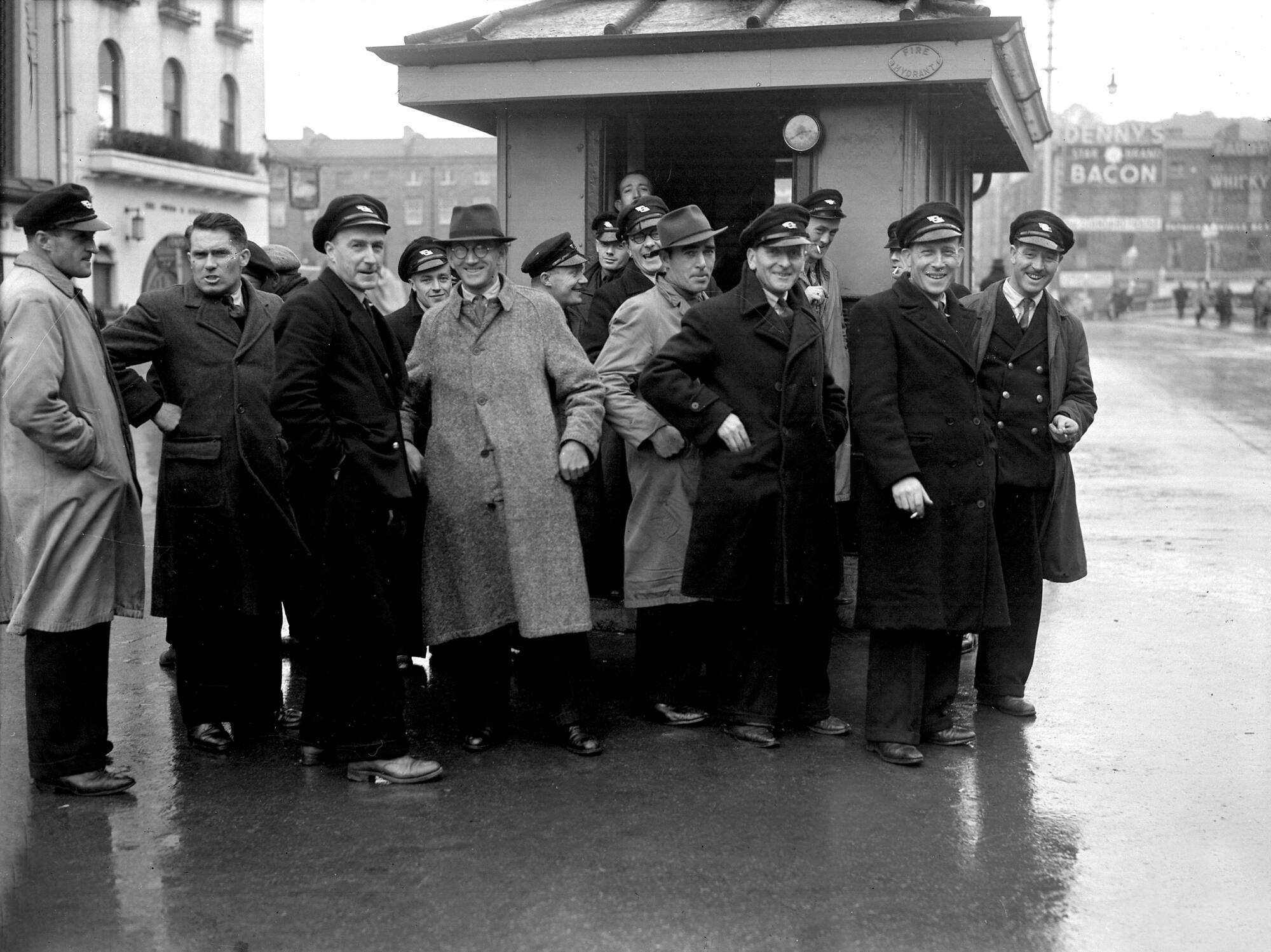
CIE employees gather at the busman's hut in St Patrick's St during a bus strike in 1947. Picture: Irish Examiner Archive/Ref 342D
Coordinated pay negotiations in Ireland date from the end of the Second World War. Coinciding with the establishment of the Labour Court in 1946, a system of wage rounds emerged.Â
The coordination in these rounds was, at best, minimal, with increases gained by wage leaders acting as headline-setting agreements setting precedents. By the late 1960s, this system had come under strain, mainly because of a sharp increase in strikes and wage increases being eaten up by increasing inflation.
Faced with government and employer dissatisfaction with the so called “free-for-all” pay rounds, government threatened to legislate on pay by publishing a Prices and Income Bill.Â
The bill can be seen as designed to prompt unions and employers to engage in a more coordinated approach to pay. Unions were not averse to such a move since they were concerned at wage increases chasing, and feeding, inflation. They were also aware of the success of trade unions in countries like Sweden and Germany, where wage determination was more coordinated.

The threat of legislation led to a series of seven National Wage Agreements (NWAs) between employers and unions lasting from 1970-78. Over the course of these agreements, the issues of taxation and the provision of enhanced public services came to the fore, and led two national understandings, in which government was an integral party to the negotiations and agreements that emerged.
 The national system of pay determination ended in 1982 when employers declined to be parties to a further national understanding despite the government and union desire to continue with the process.
When they ended, the national agreements were seen in negative terms with commentators, the last two agreements sometimes being referred to as “national misunderstandings” — NWAs had been promoted as the answer to strikes and inflation. However, the 1970s saw both strikes and inflation rise.Â
Arguably, the negative judgement was harsh. The limitations of any domestic policy to tackle inflation was made clear by the external impact of the two oil crises during the agreements — something shared now by the wider energy crises driven by the Russian invasion of Ukraine.
The recessionary period of 1982-1987 saw a return to a wage round system in the private sector but the retention of a more coordinated series of general agreements in the public sector. Unions continued to be interested in a more national approach to pay negotiations, but employers were largely uninterested.Â
However, in 1987, a Fianna Fáil government brokered a return to national agreements in the form of the Programme for National Recovery (PNR). The PNR was to be the first of eight agreements.Â
They were initially termed “consensus agreements” but by the early 1990s they had been elevated to the system of Social Partnership, which lasted until the financial crises of 2008 dissolved the basis for their existence.Â

The system enjoyed the support of most employers, most unions and successive governments during this time and became the bedrock of the Irish industrial relations system.
Some early criticism came from Fine Gael but when in power from 1993-1997, it strongly supported the agreements.Â
By 2003, the political consensus in favour of Social Partnership had begun to wane, most notably when the Fine Gael TD Richard Bruton strongly criticised public sector benchmarking and Shane Ross claimed it had made trade unions “too powerful”.Â
However, support among the governing parties was sufficient to see it persist until the financial crisis and even then it did not give up without a fight.
While employer commitment to Social Partnership began to evaporate with the onset of the recession, against all the odds, an agreement — the Towards 2016 Transition Agreement — was concluded in September 2008.Â
However, faced with the worsening financial economic situation, the agreement collapsed in December 2009. In December, Ibec withdrew formally, commenting its pay terms were wholly unsuited to the economic situation. In the same month, the government withdrew from negotiations with unions that were aimed at agreeing revisions to the Transition Agreement.Â

After its collapse in 2009, and as with the national wage agreements of the 1970s, social partnership became a virtual pariah — the policy “that dare not speak its name”. The private sector and public sector went different ways. Ictu and Ibec signed a protocol providing for future negotiations in the private sector.
Within the public sector, government adopted a twin-track approach. It implemented a series of unilateral measures such as a pension levy in 2009 and pay cuts in the Financial Emergency Measures in the Public Interest (Fempi) legislation.Â
Although its name might not be spoken, it is arguable that the process of social partnership continued to influence public sector industrial relations in a fundamental way. Relationships between parties that had underpinned social partnership persisted and, while Fine Gael in government might now disparage the process, the Fine Gael/Labour Party coalition government now espoused “social dialogue”, which to many appeared a form of social partnership light.
That coalition engaged in a twin-track approach to pay determination and public sector reform, namely legislation and collective agreements. The agreements, of which there were five, gave a degree of legitimacy to the unilateral government measures while providing for the eventual unwinding of these when no longer required.Â
Although roundly condemned by some prominent commentators in the early days, it is now evident these agreements provided a sophisticated approach to adapting to the financial crisis.Â
This adaptation was accompanied by remarkably few instances of public sector strikes, while allowing workers’ representatives to influence the way in which measures were implemented.Â
This contrasts with the widescale unrest in Britain at the moment and the growth of the “enough is enough” protests.
The process by which the current proposed agreement has been arrived at, with the involvement of the Workplace Relations Commission, is indicative of the extent to which the two systems of industrial relations (the UK and Ireland) have diverged over the last 50 years.
- Joe Wallace, a retired lecturer at the University of Limerick, is one of Ireland's foremost experts on industrial relations