Emma deSouza: Condemning symbols of sectarianism is to ignore the problems beneath
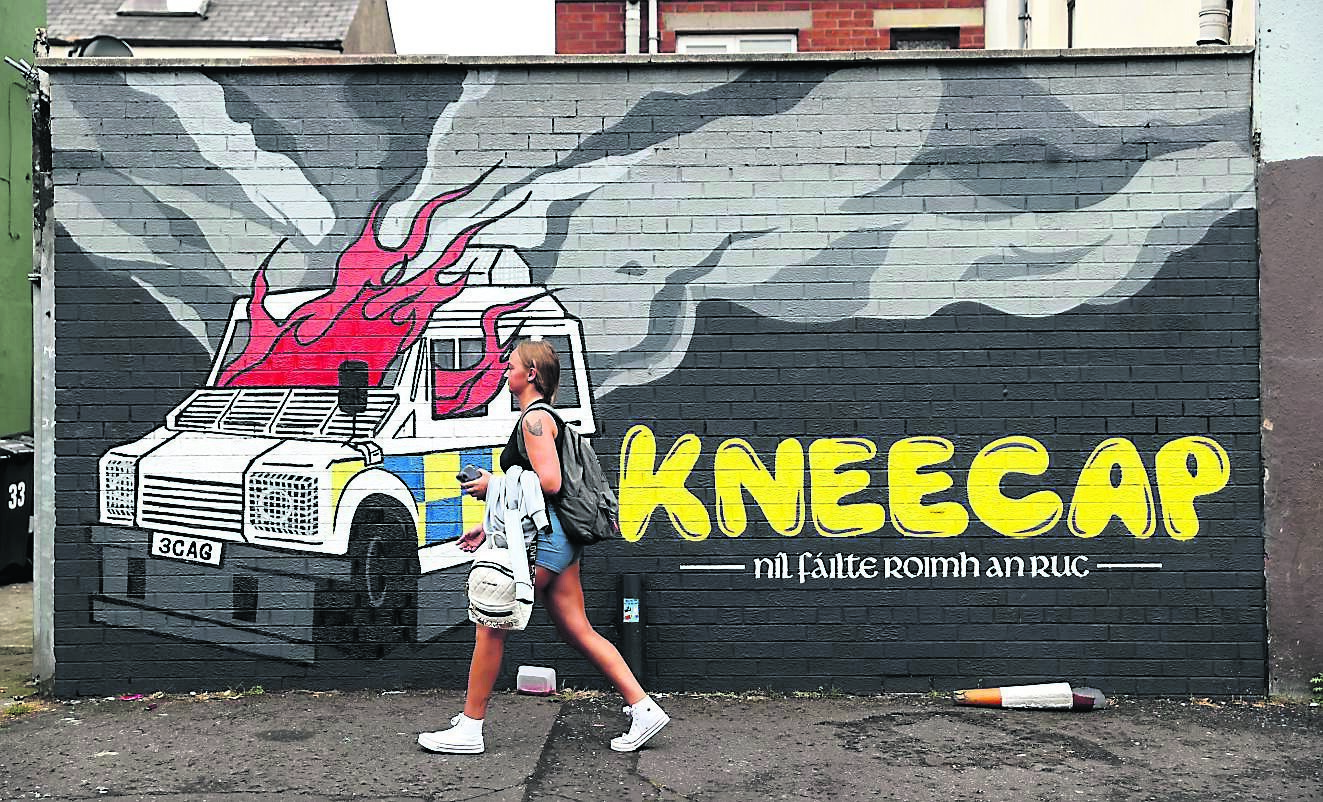
A person walks past Irish language rap group Kneecap's mural of a burning police Land Rover, on Hawthorn Street in Belfast. Picture: Liam McBurney/PA
Yet again, Northern Ireland is in the spotlight for a grim spate of sectarian incidents and the glorification of paramilitaries on both sides of the traditional ‘divide’.
From teenagers chanting “Up the ‘Ra” to loyalist paramilitary flags being sold on a footpath in Derry, politicians were out in force with words of condemnation — albeit at times employing a selectivity as to which incident to condemn.
But symbols, visual art, and music aren’t the root of the problem. Rather, they’re a reflection of a tangible threat posed by the looming presence of illegal paramilitary organisations — and not of some bygone era, but those which operate in a normalised capacity today.
Scenes of concertgoers singing “ooh, ah, up the Ra” captured at a Wolfe Tones show on Sunday sparked outrage across social media. In response, a DUP MLA has described Féile an Phobail — the large-scale community and arts festival which takes place annually in West Belfast — as a “hate fest”.
On the same day, flags representing the British army’s Parachute Regiment — the 1st Battalion of which was responsible for killing innocent civilians on the streets of Derry on Bloody Sunday in 1972 — were being sold alongside Ulster Defence Association (UDA) flags ahead of the annual Apprentice Boys march.
In June, similar UDA flags were placed on lampposts in Newtownards, opening marking territory. Meanwhile, a Larne FC player was suspended from the club for wearing a shirt appearing to display a pro-IRA slogan. All culminating in a grim illustration of just how far we have yet to go in grappling with the past and in building good relations across communities.
These incidents are not limited to a weekend or a few weeks over the summer. We operate within a perpetual cycle of institutionalised sectarianism which permeates across all factions of society. But while politicians are quick to words, they fail with actions.
Almost 1,400 people presented themselves as homeless to the Northern Ireland Housing Executive due to paramilitary intimidation in the last five years. In 2021, there were 1,067 sectarian incidents recorded by the police in Northern Ireland, an increase of 133 on the previous year. Sectarian crimes rose to 780 and there were 37 casualties of paramilitary-style assaults recorded.
In contrast, these acts of violence and intimidation show last weekend’s incidents for what they are — the unavoidable cultural bleed of a society in which the existence of paramilitaries, and their illegal activities, remains ingrained, normalised, even.
It’s estimated that there are more than 12,500 active loyalist paramilitary members in Northern Ireland, with both the UDA and Ulster Volunteer Force (UVF) actively recruiting and raking in around £250,000 a month from members’ payments alone.
The UVF was responsible for a proxy bomb threat in March which saw Foreign Minister Simon Coveney evacuated from a peace event in Belfast. This was followed by a threat from the group that actions against the Irish Government would be “escalated”, adding that there “is a very clear danger of violence” if the British government does not get rid of the Northern Ireland protocol.
Meanwhile, the UDA is believed to have been responsible for a major security alert targeting north-south train services in April. Both organisations are large-scale criminal gangs responsible for violence, drug dealing, and intimidation.
On the IRA, a 2020 assessment by the PSNI and intelligence agency MI5 concluded that the group is a fraction of the size it was during the Troubles, and while it still gathers intelligence — largely on dissidents and informers — it is not recruiting. Dissident republican groups such as the New IRA persist — the splinter group was responsible for the murder of journalist Lyra McKee in 2019.
On the third anniversary of her death, police came under attack after a crowd of dissident republicans launched petrol-bombs following a paramilitary-style parade.
The Independent Reporting Commission, established in 2015, reports that paramilitaries pose a real and present danger in Northern Ireland. The pervasiveness of their influence is so normalised that we watch ad campaigns on paramilitary control and intimidation not dissimilar to those advocating for safer driving, without a second thought.
And why wouldn’t we, as a society, be desensitised when umbrella groups such as the Loyalist Communities Council — which represents several illegal loyalist paramilitary groups — are propped up as legitimate political stakeholders in mainstream media?
The time for these organisations to disband has long passed. But when they are gifted public funding and regularly consulted by the Northern Ireland Office and political leaders, despite their criminal dealings, why would they?
The incidents over the past week are the reverberations following three decades of violence and entire generations of oppression, the impact of which will undoubtedly continue over the decades to come. This history, and inherent sectarianism it propagates, cannot be swiped away overnight.
Condemning the art, the flags, or the slogans while active paramilitary organisations operate with an ever-encroaching influence over our politics is like cursing the dripping cracks in the ceiling rather than the gaping hole in the roof in a rainstorm. And even once the roof is mended, you will still smell the damp for years to come.

CONNECT WITH US TODAY



Be the first to know the latest news and updates