Dorcha Lee: While honouring our past, we must be prepared to defend our future
With the EU set to move to much higher levels of defence spending, our rise in funding will need to be maintained, writes Dorcha Lee
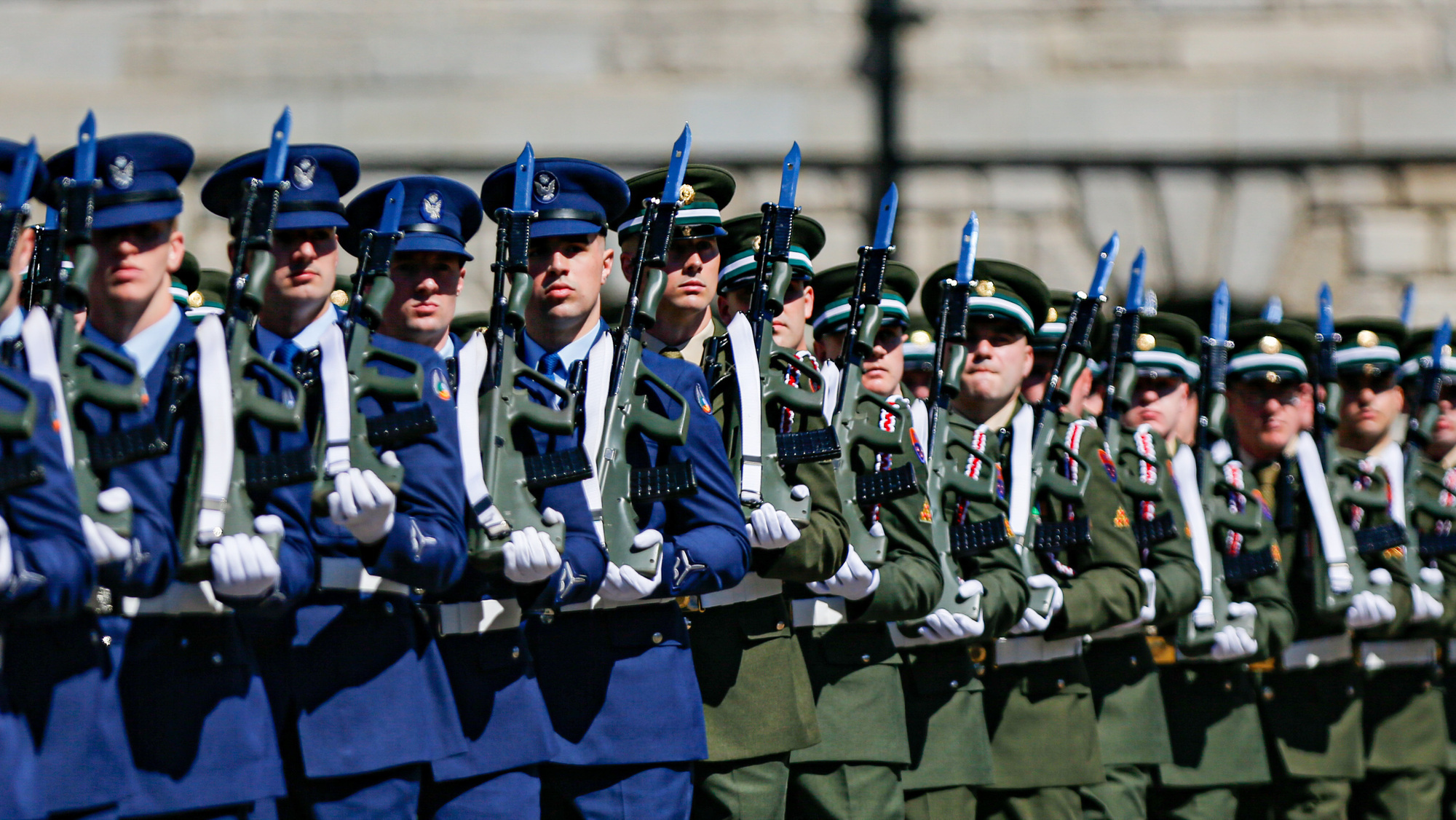
Members of the Defence forces on parade during the National Day of Commemoration Ceremony at Collins Barracks on Sunday, July 10. It was highly appropriate that the Government revealed its action plan for the future of the Defence Forces, in the same week as we commemorated Irish men and Irish women who paid the ultimate sacrifice in wars and in the service of peace.

Members of the Defence forces on parade during the National Day of Commemoration Ceremony at Collins Barracks on Sunday, July 10. It was highly appropriate that the Government revealed its action plan for the future of the Defence Forces, in the same week as we commemorated Irish men and Irish women who paid the ultimate sacrifice in wars and in the service of peace.

In June of last year, I wrote in this paper that the Defence Forces were in the last chance saloon.

I pointed out that, in the previous eight years, Irish defence spending fell, from 0.56% of GDP down to 0.27%, an annual decline of 0.035%. I noted that, if this level of decline continued, spending on defence would reach 0% by August 2028. The decline had, in fact, been steadily underway for the previous 40 years, at a slower pace, and no Irish Government intervened.

So, if looked at as a failing business, there were clearly only two options open to Government, invest in defence substantially, or close it down. In my article, I outlined the loss of national sovereignty and independence involved, if we let the Defence Forces go to the wall.

I also explained the kind of arrangements we would have to make should that take place. Without effective Defence Forces we would have to beef up the gardaí and convert them back to being an armed gendarmerie like the 19th-century RIC. Just to survive as a quasi-independent political entity we would have had to rapidly re-align with the UK, withdraw our support for the Northern Ireland protocol, and ultimately even slip-slide away from the EU itself.

However, in fairness to Defence Minister Simon Coveney, he did publicly say that this Government will provide additional funding for defence over the next four years.

This important reassurance, at the time, did not lessen the anger and despair among the serving military, entering the sixth year of the retention-in-service crisis. They were embittered already by watching their families struggling while the rest of the public sector was being looked after. Trust in government had long evaporated.

Finally, in February, against a background of low expectations, the release of the Commission on the Defence Forces Report came as a welcome surprise. It was not near as bad as feared. At last, the countdown to a clear government decision on defence had begun.

Then on July 10, the Irish public watched on TV the National Day of Commemoration ceremony at Collins Barracks Dublin. In the familiar 18th century Clarke’s Square, the Defence Forces once again laid on a flawless performance, reminding us of their professionalism and commitment to the highest standards. 

One hundred bayonets of the captain’s guard of honour caught the brilliant sunlight in an instantaneous flash of synchronisation. The timing was perfect. The cadet honour guard performed the much more complex reverse arms drill, used only to honour fallen comrades. The lump in the throat moment came when the No 1 Army Band played Lt Col Brendan Power’s arrangement of ‘Limerick’s Lament’.

Us veterans present watched with pride and reconnected with our own past. We knew that such precision of drill requires each participant to have an intense inner discipline and concentration, to the exclusion of all other distractions. It requires endless hours of rehearsal to get it just right.

Two days later, Mr Coveney made a public statement confirming the rise of €500m in defence spending, clarifying that this target would only be reached in 2028, the year I predicted as the apocalyptic Ground Zero for the Defence Forces, in my dystopian scenario. However, he had got a commitment from this Government that future inflation would be factored in.

The following day, Taoiseach Micheál Martin revealed the Government’s initial decisions on the commission’s report. It was not an implementation plan as expected by observers, but an action plan. This is not surprising given that the commission itself drew back, or were unable to agree, on critical issues that need to be addressed. More studies are required to fill out the agreed recommendations.

The most important decision was to restore the Defence Forces to its approximate pre-2012 level, by recruiting 3,000 personnel for the permanent Defence Forces and 3,000 for the reserve Defence Forces. The extra €500m will facilitate that but leaves little else available for defence-related equipment.

By 2028, it is expected that the retention-in-service problem will be resolved, but we will still be spending less than 0.5% of GDP on defence.

Next year, when Finland and Sweden join Nato, they will adopt the Nato target of 2% of GDP on defence, leaving only four EU states outside the alliance — Austria, Cyprus, Ireland and Malta. Almost certainly, pressure will increase for the EU to adopt the Nato defence spending target to achieve a level playing field in defence for all EU states. 

This has long been recommended by the European Parliament. Austria (0.83% of GDP) could plead, if it wished, an exemption from this commitment as it has no maritime area, and consequently only a small air space to defend. Cyprus is already at 1.77% of GDP, almost at Nato level, and Malta at 0.56% is already more than double the level of spending of Ireland in terms of GDP.

Without Finland and Sweden at our side, it is difficult to see how Ireland could indefinitely avoid paying its share of European Security and Defence costs.

I believe that the EU will adopt the Nato defence spending level sooner rather than later. I also believe that when this happens, an EU defence convergence programme will be put in place, to help the lower spending member states to reach the required target.

It was highly appropriate that the Government revealed its action plan for the future of the Defence Forces, in the same week as we commemorated Irish men and Irish women who paid the ultimate sacrifice in wars and in the service of peace.

However, while we must remember our past, we must be prepared to defend ourfuture.

  • Colonel Dorcha Lee (retd) is a defence analyst

More in this section

Revoiced

Newsletter

Had a busy week? Sign up for some of the best reads from the week gone by. Selected just for you.

Cookie Policy Privacy Policy Brand Safety FAQ Help Contact Us Terms and Conditions

© Examiner Echo Group Limited