Elaine Loughlin: Weeks of tough negotiations to get North's executive up and running
Try from €1.50 / week
SUBSCRIBE
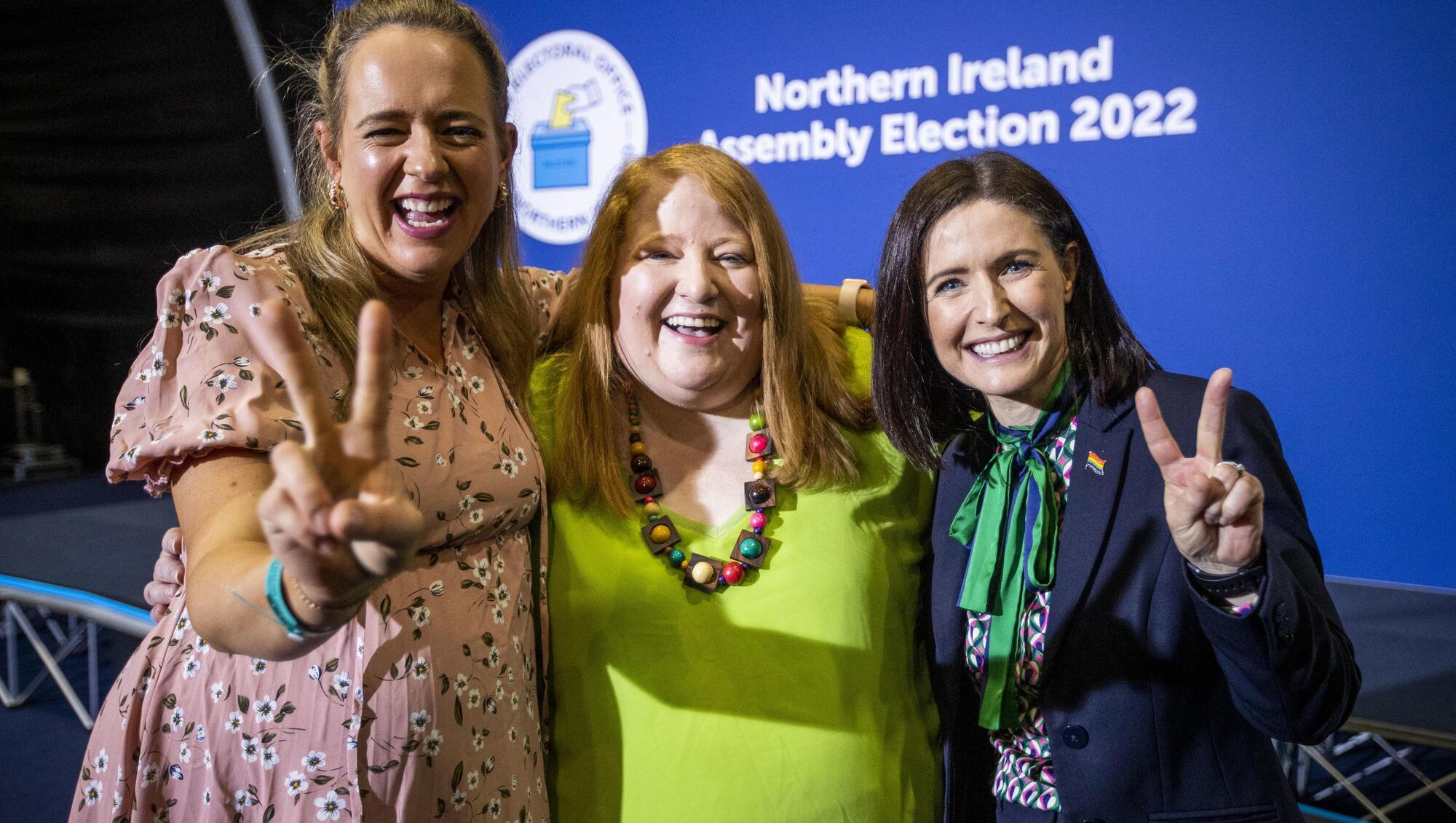
Alliance Party MLAs Kate Nicholl, party leader Naomi Long, and Paula Bradshaw celebrating at the count centre at the Titanic Exhibition Centre, Belfast. Picture: Liam McBurney/PA
Getting the Northern Ireland Executive up and running will take weeks of tough talks, with the DUP unwilling to enter power-sharing until significant changes are made to the Brexit protocol.
Describing it as a “terrible vista”, Sinn Féin president Mary Lou McDonald has accused the DUP of “political posturing” on the protocol, which will only cause suffering for families and workers as the cost of living soars.
Friday’s Stormont election saw a historic victory for Sinn Féin, which secured 27 seats to become the largest party and win the entitlement to nominate Michelle O’Neill as first minister.
However, the DUP has refused to take up its 25 seats at Stormont until the British government addresses concerns on the Brexit protocol.

Brandon Lewis, the North’s secretary of state, is to hold separate meetings with political parties in Northern Ireland today.
Parties have six months to hammer out a power-sharing agreement.
Mr Lewis said it was widely acknowledged that there were issues with the protocol, which unionists strongly oppose as they see it as equivalent to placing a border in the Irish Sea.
The DUP brought down the Northern Ireland Executive in February when former first minister Paul Givan resigned as part of his party’s call for action against the protocol.
However, Simon Coveney, the foreign affairs minister, yesterday said the EU “has been willing to show a lot of flexibility over the last 12 months to try and find a basis for agreement”.
He said he had already been in contact with the key EU negotiators, British foreign secretary Liz Truss, and EU commissioner Maroš Šefcovic, in a bid to come up with a solution that would get the executive back up and running again.

“What’s needed now is for us to work intensively over the weeks ahead so that we can allow an executive to be re-established on the basis of acceptance that both sides have worked towards maximum flexibility on the protocol,” Mr Coveney said.
“It doesn’t need to take months and months.
“I certainly hope that, by doing that, we can assist the parties in coming together because the last thing we need now in Northern Ireland is a collapse of the institutions and all the tension and polarisation that would flow from that.”
He said there was a “responsibility” on all politicians to “respect how the people have voted and to find a way of working with the parties to put an Executive and Assembly that can work back in place.”
Mr Coveney added that threats of unilateral action and unilateral legislation in Westminster were not helpful or needed at this time.
Asked about the concerns raised by the DUP around the Brexit protocol, Ms McDonald said: “Their political posturing means that people across society — workers, families and communities — will suffer. To me that is a terrible vista and is unacceptable.
“The DUP is an outlier. The DUP is on their own amongst the other parties in taking this stance.
“The rest of us realise that whatever our points of divergence or difference, all know full well that there is a widespread popular expectation, a correct expectation, that people roll up their sleeves and get back to work and start delivering on the bread-and-butter issues.”
She claimed that refusing to get the executive up and running would “not change the protocol on iota” and that DUP leader Jeffrey Donaldson knows this.
She said it was “essential” that Mr Donaldson makes it “crystal clear” that his party will go into an assembly with Ms O’Neill as first minister.

She claimed “a section of political unionism is only interested in the democratic process when they come out on top or they’re only interested in working together when it’s on their terms”.
Ms McDonald said the selection of a nationalist first minister would be symbolic but it “moves beyond symbolism” and is a test of “equality” and “commitment to power-sharing”.
“It’s very important that the DUP, which have emerged as the second-largest party, demonstrate respect and including by agreeing to serve in that joint office with a republican first minister,” she told Newstalk radio.
“I think that is more than symbolism for wider society because it sends out a very, very clear message to everyone from all communities of all political perspectives and none that equality and sharing power, parity of esteem, all of that good stuff that has its roots in the Good Friday Agreement that we are all committed to that, not just rhetorically, but in deeds as well as word.”
CONNECT WITH US TODAY
Be the first to know the latest news and updates
Newsletter
Sign up to the best reads of the week from irishexaminer.com selected just for you.
Newsletter
Keep up with stories of the day with our lunchtime news wrap and important breaking news alerts.
Newsletter
Sign up to the best reads of the week from irishexaminer.com selected just for you.
Saturday, February 7, 2026 - 9:00 PM
Saturday, February 7, 2026 - 11:00 PM
Saturday, February 7, 2026 - 9:00 PM
© Examiner Echo Group Limited