Mick Clifford: Government must raise its hand and admit who's to pay for third-level education
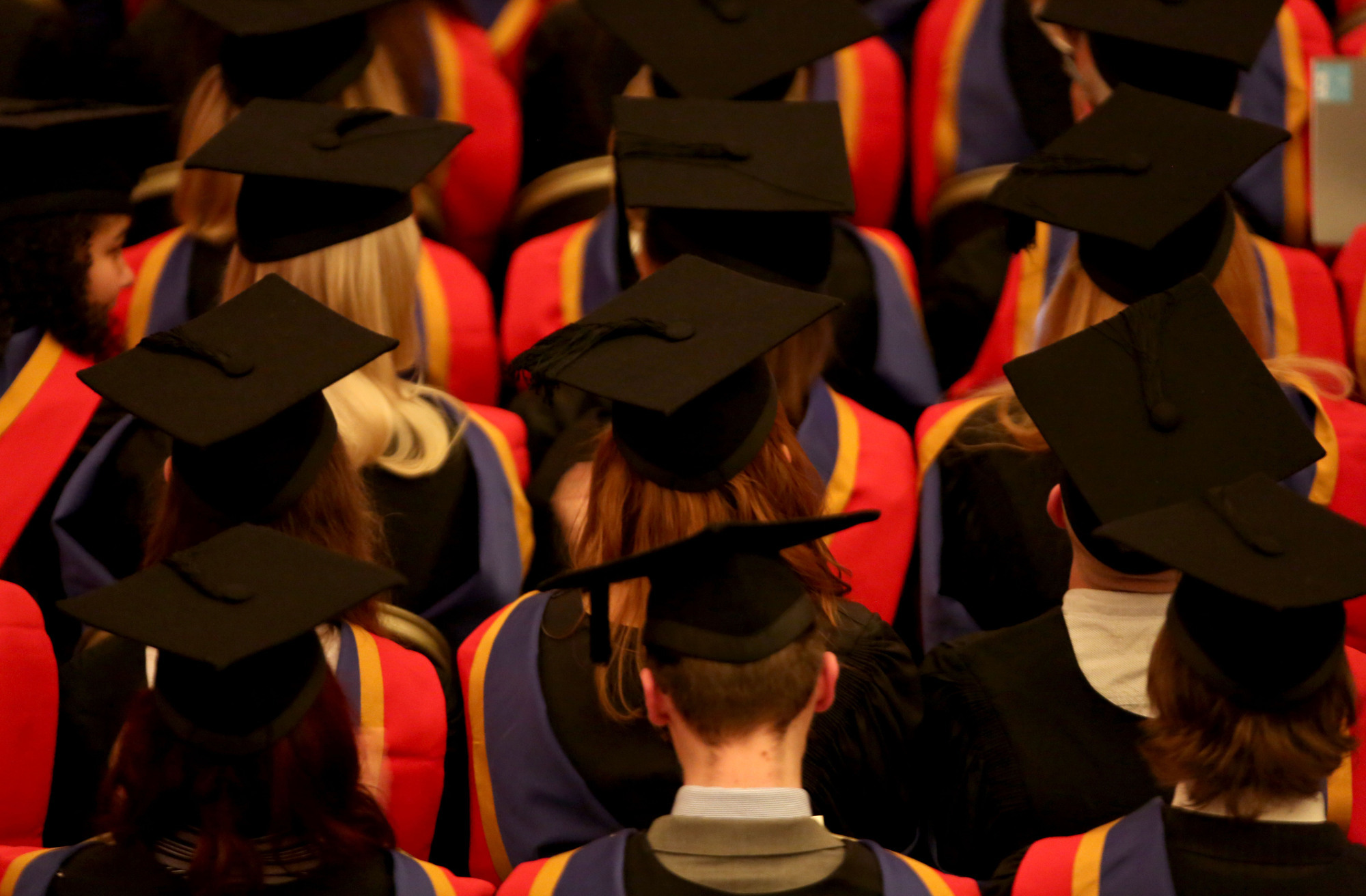
The Funding The Future plan promises to reduce the annual registration fee for third-level students.
Â
Who is going to pay for the increase in funding for third-level education? The truth that dares not speak its name among all political parties is that the cohort of society least likely to attend college will probably bear the cost for those who are most likely to attend.
On Wednesday, the Minister for Higher Education Simon Harris presented his plan. This will involve an immediate injection of €307m and the promise of a gradual decrease in the annual registration fee for students, which is currently €3,000.
Who could be against that? The third level sector is chronically underfunded and has been for decades. The Cassells report published in 2016 stated that €600m more per annum would be required by now, rising to an extra €1bn at the end of the decade.Â
Student bodies, and some politicians, have been adamantly opposed to the registration fee, claiming it is a barrier to accessing education. Now Mr Harris is doing what he can for “working families”, as he described them on Morning Ireland on Wednesday. He is riding to the rescue.
This money is destined to come from general taxation, yet there is no word of an increase in general taxation to source these funds. In a democracy that is mature and views its duties and obligations through a lens of fairness and sensible husbandry, there would be an increase in taxation for this purpose and it would be so identified. But the public doesn’t like new taxes and the body politic is not of a mind to persuade that new or increased taxes are required for a specific purpose. In any event, associating an increase in taxation with third-level education might elicit questions as to which sections of society are benefiting most from such a policy.
Instead, the money will have to be taken from other areas currently funded by general taxation. So what’s going to miss out? Will it be some of the programmes designed to alleviate disadvantage in the kind of areas where precious few ever make it to third-level? Or maybe it will involve shaving bits and bobs off other spending where it mightn’t be noticed in the Oireachtas or the media but will be keenly felt far from the centres of power. Certainly, the money won’t be taken from any area that is well resourced or capable of vocally defending its interests.
What of the declining registration fee? To what use will that money be put? Around half the students in the country are already exempt from the fee, so it won’t affect their access to education. There is a relatively small cohort whose income is just above the exemption threshold for whom it will arguably be beneficial to education prospects. But for many who now pay the fee, the reduction will just mean a few extra bob to spend elsewhere in their domestic budget.

For some who live beyond the main population centres, that might mean assistance in sourcing accommodation in a crazy market. For others, the extra money may go towards another annual holiday. More again might do the sums and reckon they can now afford to send their kids to private second-level schools, thus conferring greater advantage on their prospects of a good third-level education. Nothing wrong with any of that, except who exactly is footing the bill as the state takes an increasing role in funding a sector that is disproportionately represented by the better off?
It is worth revisiting how exactly the third level sector has arrived at this station. Prior to 1996, fees at the time came in around £2-3,000 per annum, which is well over €6,000 in today’s money. The system was flawed and included a tax-friendly element that was being abused. Instead of reform, the Government, in which the Labour party held the Education portfolio, opted to abolish fees. The premise for doing so was to widen access to those groups which suffer from education disadvantages. Many observers believed that the real political reasoning was to give some money back to voters so that they might remember Labour on polling day.
If the move was a genuine attempt to tackle education disadvantages then it was an abject failure. This was best illustrated in a study by Kevin Denny of UCD’s School of Economics in 2010. He examined whether the move had increased the number of students from the lower parts of the socio-economic gradient (SES).Â
He found that “the abolition of fees did not change the effect of the SES on university entrance which was effectively zero before and after the reform once one controls for exam performance. The only obvious effect of the policy was to provide a windfall gain to middle-class parents who no longer had to pay fees".Â
Will the proposed reduction in the registration fee this time around be any different? The element of society best represented in third-level is also the one most likely to vote. That reality has far more traction with politicians than any duty to level up the playing field. Despite plenty of hot air, pledges and promises, there remains major barriers to third-level for the poorest sections of society and it has absolutely nothing to do with fees.

The abolition of fees in 1996 also led to an overwhelming reliance on general state funding to resource the sector. With that, it was inevitable that the level of funding would, in the long run, deplete. During the austerity years after 2008, funding per student fell by up to 40%. Now, Mr Harris is coming to the rescue. There will be more money for colleges and there will be fewer costs for families who are in the relatively privileged position of having their offspring educated at third-level. And who will be paying for it? Well, who cares? seems to be the general attitude.
There is a case to be made for a third-level sector wholly funded by the exchequer. Such a system should only be contemplated after all genuine efforts are made to ensure that the student population is fully representative of society, including the cohort who endure education disadvantages. We are still a long way from that, as evidenced by the results.
Instead, those who grow up in disadvantaged areas do not have the opportunities that are afforded the rest of us. Their personal potential is not fully realised and the failure to do so renders them a great untapped resource for the country.
So without proper efforts to achieve genuine education equality, the shifting of the bulk of funding for the third level sector from families onto the state is just another political stroke, driven by votes rather than any attempt at striving for equality.