Mick Clifford: Excluding social housing bodies from remediation scheme is primitive
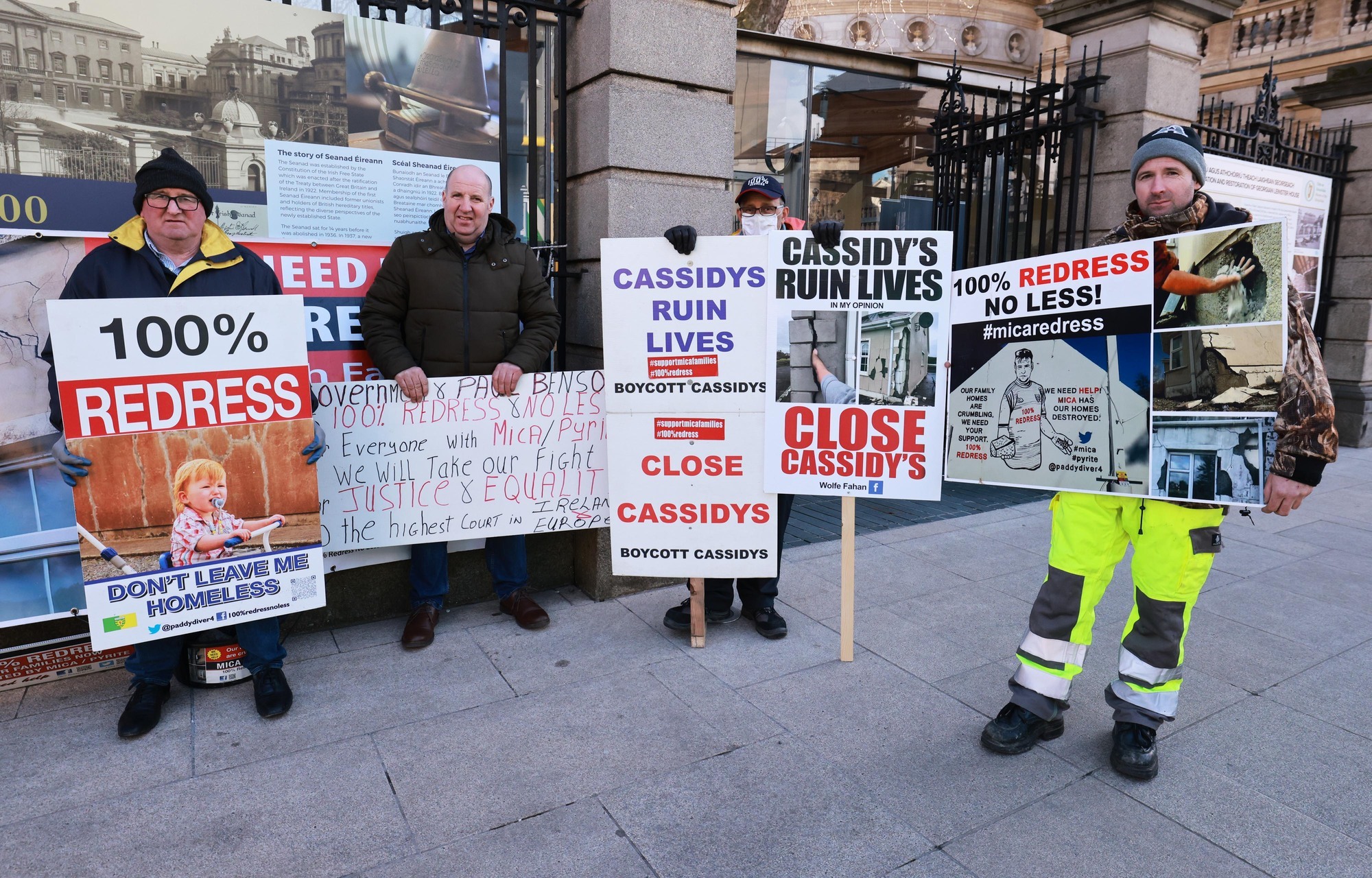
Victims of the mica scandal protesting outside the Dáil in February. Picture: Eamonn Farrell/RollingNews.ie
William Faulkner could have made a positive contribution to Darragh O’Brien’s working group on construction defects. The American writer’s most famous quote is: “The past is never dead, it’s not even past.”
And never a truer word has been uttered when it comes to cleaning up that past which we know as the Celtic Tiger years.
The working group is tasked with devising a compensation scheme for apartment owners where defects — most prominently but not exclusively fire safety defects — have been uncovered.
This is a major issue for the tens of thousands of people affected. They bought homes under the illusion that the State was ensuring that the builders would be kept honest.
The working group is examining defects that arose in buildings between 1991 and 2013. An Oireachtas committee has been told that this could amount to 100,000 units and the cost could be well in excess of €1bn. The full extent of it may never be revealed as some owners prefer to keep it quiet, take the financial hit, and sell on. For many that simply isn’t an option. And, following years of pressure, in the media and through the body politic, the Government finally took responsibility last year with the establishment of the working group.
Current estimates are that the average cost of remediation for apartments could hit around €35,000. How to cover that cost is a central tenet of this working group’s brief.
On Wednesday, the Irish Examiner is reporting that the group now appears set to exclude social housing bodies — both local authorities and approved housing bodies (AHBs) — from the compensation scheme, as well as investors.
This will have major consequences for AHBs in particular. Clúid, the biggest AHB in the State, housing 23,000 residents, will have spent €3m by the end of this year on remedial work. Another €21m is being set aside by Clúid over the next seven years to cover further defects, which are emerging all the time. In its submission to the working group, Clúid stated its belief that “any redress scheme proposed by the Working Group must include a provision of grants for remedial works”.
It went on: “While private landlords can avail of tax rebates, this is not possible for non-profit organisations, whose tax status is different.”
Clúid also made the point that it could not indefinitely fund remedial work and it needed access to a “redress scheme appropriate to our needs”.
“The safety and wellbeing of our current and future residents and, vitally, the delivery of social and affordable housing across the coming years depends on it.”
A further problem with any plans to exclude AHBs and investors is that their apartments are usually in the same developments as owner-occupiers. Excluding one group from a scheme would be a blow to economies of scale in the remedial work and in some instances would render the remedial work difficult if not impossible to carry out.
For this, the working group is referencing an Oireachtas housing committee report which first mooted the idea of a redress scheme. Safe As Houses was published in 2017 and authored by committee member and Sinn Féin housing spokesman Eoin Ó Broin. The report recommended: “Ordinary owners who purchased in good faith should not be liable for the costs of remediation caused by the incompetence, negligence or
deliberate noncompliance of others.”
The working group is now interpreting “ordinary owners” as meaning owner-occupiers. Ó Broin sees this as completely disingenuous.
“What’s clear is that the department does not want to provide access to redress funding for local authority and approved housing bodies because there are around 1,000 homes in Donegal and several hundred in Mayo with mica and pyrite so any inclusion of social homes for fire safety defects redress would set a precedent that they don’t want to address,” he said.
“It’s very disingenuous to use the Safe As Houses report as cover for this, because, as the author of the report, it was always clear to me that the local authority and AHB properties would have to be included.”
Ó Broin is not alone in this view. A spokesman for the Construction Defects Alliance, which represents affected apartment owners, said they would be concerned at any attempt to exclude social landlords — such as AHBs — or small landlords who might have one property as a form of pension.
“We think that would be harsh,” he said. “They bought properties in good faith and a lot of small landlords are people who bought an apartment as a first home and then found they can’t sell in order to trade up because of the defects.
“Housing associations and local authorities provided housing for people who can’t afford to house themselves and they are being forced to raid their own maintenance budgets to cover defects which actually penalises other tenants.”
A feature of compensation schemes set up by the government in recent decades has been attempts by State officials to keep the potential liability as low as possible.
This is their brief, and they understandably see themselves as acting on behalf of that mythical figure, the taxpayer. If only their colleagues, former colleagues, and predecessors in the permanent government had been as diligent when the initial scandals occurred, there would be no need for redress.
However, the apparent attempt to exclude some groups in this proposed scheme does appear to be primitive, bordering on the laughable. Purporting to suggest that the group is confined by the wording of an Oireachtas committee report does not stack up. Ó Broin, the author of the report, is adamant about what precisely was being conveyed in its recommendations. He and the Green Party’s Catherine Martin were the two politicians in the last Dáil who pushed to have a redress scheme set up, despite the government’s indifference. And now there are attempts to apply a Jesuitical interpretation to the committee report in order to minimise State exposure to a scandal that has its origins in the State’s failure to police the building industry.
The working group’s final report is due to be published in June.