Wheatfields for Ukraine's bread are now soaked in blood
"More and more often in the newsfeed, I see posts by young Ukrainian women declaring their love for their recently killed husbands."
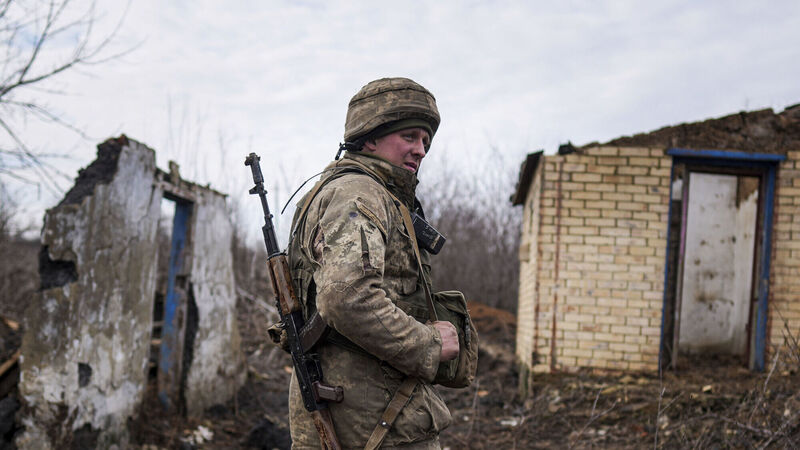
A Ukrainian serviceman stands at his position at the line of separation between Ukraine-held territory and rebel-held territory near Svitlodarsk, eastern Ukraine. Picture: Evgeniy Maloletka/AP

A Ukrainian serviceman stands at his position at the line of separation between Ukraine-held territory and rebel-held territory near Svitlodarsk, eastern Ukraine. Picture: Evgeniy Maloletka/AP

Before, my wife and I hardly ever ate bread.

In the Ukrainian countryside, there is a long tradition of having plenty of bread on the table and of eating it with butter and salt or dipping it in milk. Bread dipped in fresh cow’s milk was also given to little kids, and they loved it.


Since arriving in western Ukraine where, like hundreds of thousands of my fellow countrymen, my family has sought relative safety, we find ourselves eating much more bread than before.

Our boys have always loved fresh bread. They enjoy making and eating sandwiches. In our village shop, we would buy our favourite Makariv loaf, a soft, white, brick-shaped loaf. It was baked at the well-known Makariv bakery, which is 20km from our village.

I have been thinking about that Makariv bread for several days now, remembering the taste. Only now, as I remember, I sense the taste of blood on my lips, like when I was a child if someone split my lip in a fight.

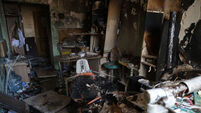
The Makariv bakery was bombed a few days ago by Russian troops. The bakers were at work. I can imagine the fragrant smell that surrounded them the moment before the attack.

In an instant, 13 bakery staff were killed and nine were injured. And the bakery is no more. Makariv bread is a thing of the past.

I have long since run out of words to describe the horror brought by Vladimir Putin to Ukrainian soil.

Ukraine is the land of bread and wheat.

It’s the time of year to prepare the fields for sowing, but this work is not being done. 

The soil of the wheat fields is full of metal — fragments of shells, pieces of blown-up tanks and cars, the remains of downed planes and helicopters.

And it’s all covered in blood. Every day the list of crimes grows longer as more and more of Putin’s actions are added to it: the shooting of young volunteers who were carrying food to the dog shelter in Hostomel; the murder of postmen who were delivering pensions to elderly residents in Sumy region; the killing of five people in an attack on the Kyiv television tower.

The list goes on and on.

We certainly don’t yet know about all the crimes that have been committed, but we will definitely find out about them all, and the list will be presented at a new Nuremberg trial. It doesn’t matter where it takes place. The main thing is that we know who will be judged.

International lawyers have already begun to collect evidence of crimes. Ukrainians are looking forward to the verdict on the murderers and war criminals. But for now, they must survive under the shelling of the Russian army.

They spend their nights in basements, in bomb shelters, in bathrooms. The latest advice circulating on the internet tells us that, in the event of a bombing raid, the safest places to be are inside your cast-iron bath or in interior corridors where there are no windows.

The people of Kyiv have grown suddenly much more attached to their metro, one of the most beautiful and deepest in the world.

The metro is no longer a form of transport. It is a haven, like something from an apocalyptic movie.

The station platforms are being turned into cinemas where films are shown for free: Children’s films in the morning and films for a wider audience later in the day. Large screens have already been hung or are being hung right now at 14 Kyiv metro stations.

A couple sits in an underground metro station used as bomb shelter in Kyiv. Picture: Aris Messinis / STF / AFP / Getty

There is a constant supply of tea, the internet is already there, but the connection is poor. There are not enough toilets, but people don’t complain about queuing for 40 minutes or more.

Everyone waits patiently. They are waiting for the end of the war and the beginning of the trial, a trial that the whole world will have to follow, as the whole world followed at Nuremberg.

And, in Russia, what do they think about the future court proceedings? I am afraid they don’t think about it at all. 

They are now busy buying dollars and euro. Sanctions on the banking sector have caused the value of the rouble to fall dramatically, provoking panic.

Panic is also observed on the Russian-Finnish border, via which many Russians are now trying to leave their homeland. They are those who are ashamed to stay in Russia, and those who could be drafted into the army, those who do not want to die or do not want to kill or do not want to be cannon fodder for the Kremlin.

Some captured Russian soldiers have asked for permission to remain in Ukraine for good.

“Jail awaits us if we return!” they say.

On the borders of Ukraine with Moldova, Romania, Hungary, Slovakia, and Poland, there are still queues of refugees. It is said that some Ukrainians are trying to leave the country using fake Russian passports.

I won’t judge them. Let time and history judge everyone. I am glad that at this most difficult of times, most Ukrainians have maintained their humanity and try to help each other.

In the last couple of days, I’ve started to dread opening Facebook. More and more often in the newsfeed, I see posts by young Ukrainian women declaring their love for their recently killed husbands. I know some of these women and have met their husbands. I cannot read these cries of despair thrown into the bottomless well of the internet without tears.

But I can’t not read them either. I want to see and hear everything that is happening now in my country.

Why are they bombing children’s hospitals and schools? Why destroy residential areas of Chernihiv, Borodianka, Kharkiv, and Mariupol? Why, after all, are they bombing bakeries and bread shops? I don’t have answers to these questions.

“You can’t understand Russia with your mind!” wrote the 19th-century Russian poet Fyodor Tyutchev.

I agree with him, but I still have a question: how can one understand Russia at all, if the mind does not help?

Andrey Kurkov is a Ukrainian novelist

Guardian

More in this section

Revoiced

Newsletter

Had a busy week? Sign up for some of the best reads from the week gone by. Selected just for you.

Cookie Policy Privacy Policy Brand Safety FAQ Help Contact Us Terms and Conditions

© Examiner Echo Group Limited