Tania Reut: 'We grew up in the war narrative. We didn't believe it could return'
Tania Reut: 'We grew up in the war narrative. We didn't believe it could return'

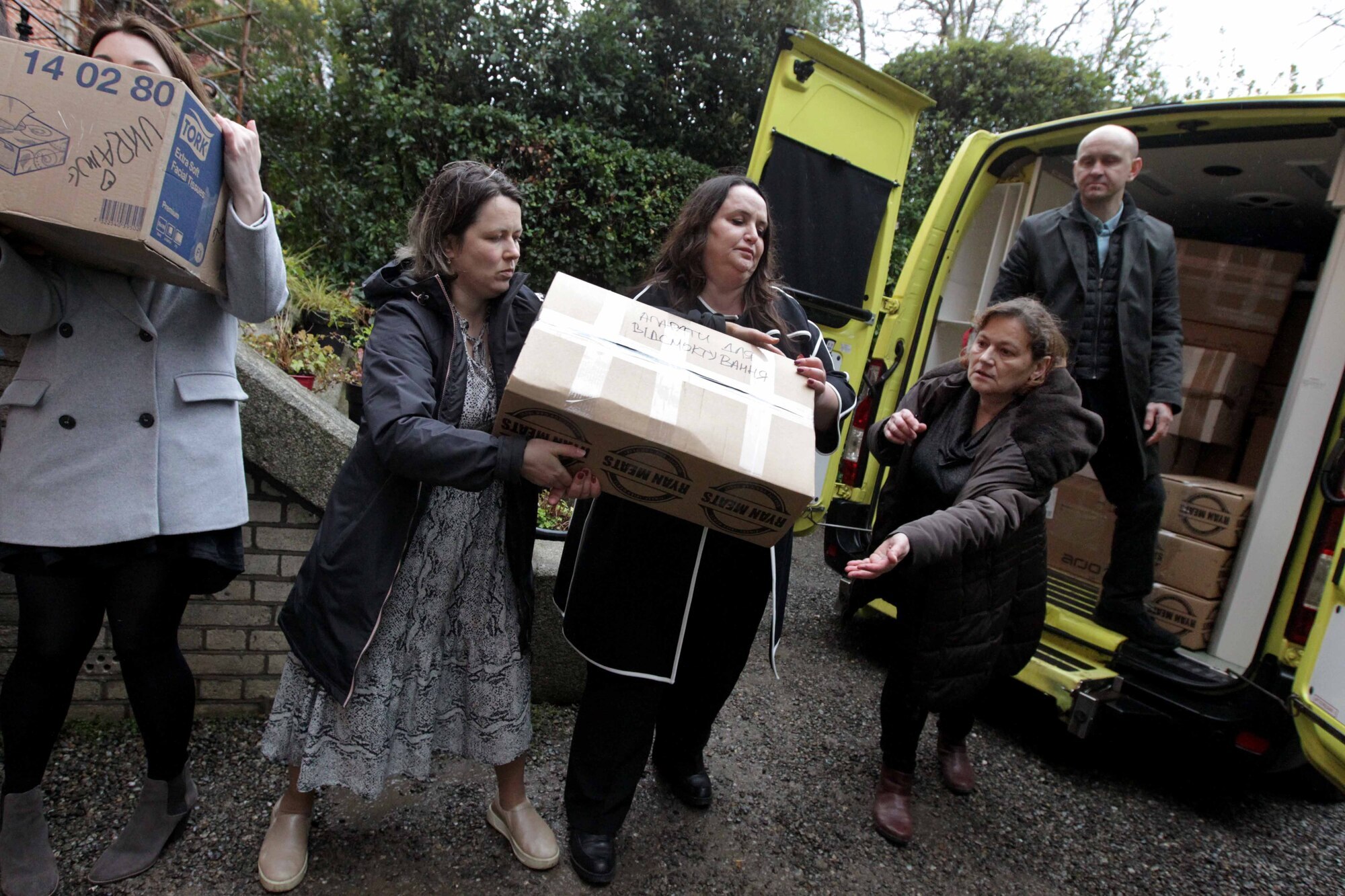
Ambassador Extraordinary and Plenipotentiary of Ukraine to Ireland Larysa Gerasko (centre), with doctors (from left) Kateryna Kachurets, Iryna Surzhenko, Nataliya Kononenk and Alex Boychak at the Ukrainian embassy in Dublin, where they are loading supplies for the Medical Help Ukraine campaign. The initiative was set up by a group of Ukrainian doctors in Ireland to urgently deliver medical aid to Ukraine. Picture: Mark Stedman
We grew up in the war narrative. We didn’t believe it could return.

We grew up thinking that the most terrifying thing in the world had happened in the 1940s and would never return. It is now being brought back by the very same people who built their political capital on the sufferings of the Second World War.

Vladimir Putin, helped by Alexander Lukashenko, has started the bloodshed. However, even when they are gone, the crack (or a crater) between the nations will take decades to heal.

For a week now, every day for me and my friends has looked something like this: We wake up, most likely early and most likely after a night of bad sleep. We immediately start reading and watching the news in bed. We might cry.

However, we are lucky. We have warm beds. There’s no shootings, explosions, or sirens outside our houses. Many of our friends or relatives of our friends do. So we try to get up and be useful.

Who are ‘we’? It’s not easy to give a name to the community of people from Ukraine, Belarus, Russia, Lithuania, Latvia, and some other countries in the region. The ‘Russian-speaking community’ sounds limiting and tone deaf, even though Russian is indeed a commonly used language of communication.

‘People from the post-Soviet countries’ might be insulting to many who don’t want to be defined by the legacy of the oppressive empire.

Community ties

So, there’s no good name for that community but it exists and the ties within it are quite strong.

Let me explain using my small group of friends here in Dublin.

We are a dozen of Ukrainian, Belarusian, and Russian women, who regularly talk on a messenger chat — normally about going out together or where to find a good hairdresser. This chat is a very different space now. Every morning Marina, who’s stranded in Kharkiv with her young son, gives an update on whether they have electricity, food, or how hard the neighbourhood has been bombed (their house is safe so far). We share helpline numbers, chip in to help volunteers there and in Ireland, or just talk about our friends and relatives in Ukraine. There are also jokes (and many photos of cats and dogs) for moral support.

Tania Reut: It’s not easy to give a name to the community of people from Ukraine, Belarus, Russia, Lithuania, Latvia, and some other countries in the region.

Some people in the group are involved in essential charity work organising supplies for Ukraine, including much-needed insulin and other medicine. Suddenly, previously informal connections became important links in a humanitarian logistics scheme in Europe.

If you scroll a few weeks back through our chats, there’s a lot of scepticism about the reality of the invasion. You might even call it denial. While the US and the UK were warning the world of the imminence of the attack, we were pretty sure Putin wouldn’t go that far. Yes, he is a bully and has been a bully in the region for years. But a full-scale invasion of Ukraine? We couldn’t imagine that.

Why couldn’t we?

People in Belarus, Russia, and to some extent Ukraine, grew up consumed by war and surrounded by the war narrative — the Second World War or, in the Soviet interpretation that remains dominating in Belarus and Russia, the Great Patriotic War. The difference is that for the Soviets it only started in 1941, while Europe (including Poland, our closest neighbour) had been already fighting Hitler for two years.

Prism of war

Those four years of war with Nazi Germany has defined the mentality of generations of our people. Almost everything we hear and learn is taught through the prism of the war. Burnt villages, millions of dead soldiers, the siege of Leningrad, hunger, and partisan resistance. As a school child in the late 1990s, I was taught how to use a gas mask and where to hide if there’s a missile siren. I remember having bad dreams, worried that if it happened I’d be separated from my mum and my brother.

Yet, it all felt like a distant echo of the past. The war couldn’t happen to us, so that knowledge, as much as it was terrifying, didn’t seem useful.

In the Soviet interpretation of the Second World War and the one that has been dominating in Russia and Belarus, the people of the USSR were never aggressors, always defending themselves and finally “liberating” Europe. That ideology has never been challenged by those in power in either country, even though the evidence of the crimes committed by the Red Army, the Molotov-Ribbentrop pact and the attack on Poland, and the human cost at which Stalin won the war have been described in literature and taught in schools, to some extent.

Despite that selective memory, the shared view, regardless of political stance, is that the Second World War inflicted tremendous pain on the people of the occupied lands. It’s a nightmare that ours and our parents’ generation were lucky not to witness.

This is why accepting that Putin might start a full-scale war and bomb Ukrainian cities was difficult. This is why the Kremlin and its propaganda has put a strict ban on the word ‘war’. Several prominent news outlets and TV channels have already been blocked for using the word.

You can’t start a war if, for years, you’ve been saying the war was the most tragic experience in your people’s history. That’s why it had to be an ‘operation’.

Suppressing opposition

In my native Belarus, Lukashenko was elected as the country’s first, and so far only, president in 1994. His grip on power since then has only been getting stronger as he changed the constitution and suppressed any opposition. Despite unprecedented protests against him in 2020, he held on to his chair with the help of mass repressions (there are more than 1,000 political prisoners in Belarus, and tens of thousands had to flee in 2020 and 2021) and Russian money.

Ironically, for decades Lukashenko’s main argument for monopolising power was “at least we don’t have a war, and we will if you try to remove me”.

Don’t trust dictators is an obvious piece of advice here.

In the current climate, protesting in Belarus means detention and criminal prosecution. The majority of Belarusians are against the war in Ukraine. Seeing our land being used to shoot missiles at Ukraine is painful for many people. Yet, despite those emotions there are discussions in our community about the collective responsibility of Russians and Belarusians. No matter how strongly many citizens in Belarus and Russia are opposing their regimes, it’s Ukrainian towns that are being hit by missiles right now.

The pain inflicted on our neighbours will affect our relationship for years to come. It will take decades and generations to restore Ukraine’s trust.

  • Tania Reut is a video journalist at Virgin Media and is originally from Belarus.

x

More in this section

Revoiced

Newsletter

Had a busy week? Sign up for some of the best reads from the week gone by. Selected just for you.

Cookie Policy Privacy Policy Brand Safety FAQ Help Contact Us Terms and Conditions

© Examiner Echo Group Limited