Infamous welfare cheats campaign trumpeted savings that were not real
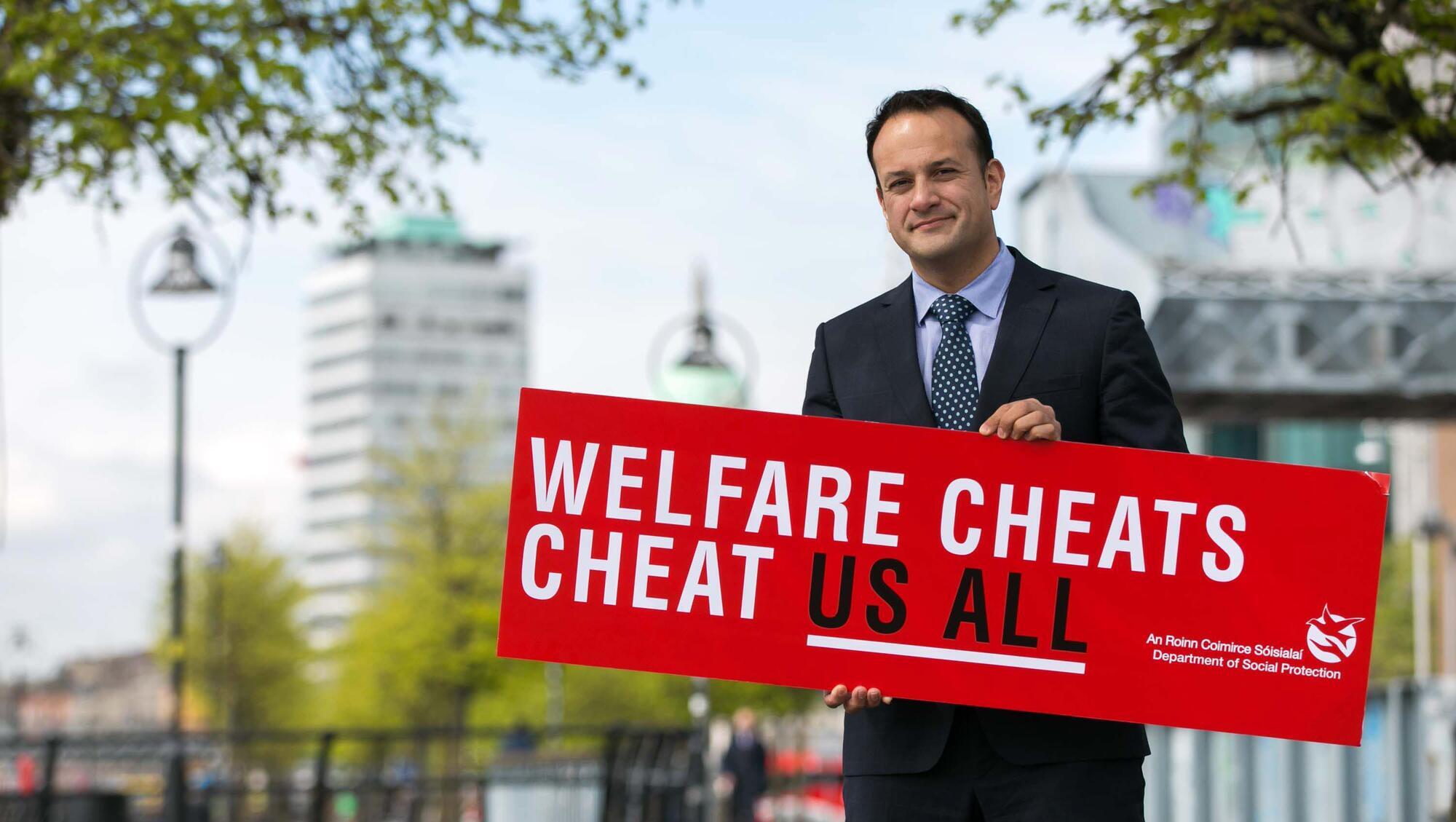
The infamous 2017 campaign, fronted by Leo Varadkar, claimed Welfare Cheats Cheat Us All and trumpeted that anti-fraud measures within the Department created €500 million in savings each year. Picture: Shane O'Neill Photography.
The Department of Social Protection, the State’s dispenser of welfare payments to those who need them, sets great stock in its fraud-prevention abilities.
The infamous 2017 campaign, fronted by Leo Varadkar, claimed Welfare Cheats Cheat Us All and trumpeted that anti-fraud measures within the Department created €500m in savings each year.
That €500m figure came back to me earlier this year when reading — the tale of how energy conglomerate, Enron, blew a gigantic hole in the US economy by going bust in late 2001.
Turns out the company had basically been inventing profits (many, many billions worth) for years by changing its accounting practices to focus on presumed future earnings, as opposed to reality.
The Department of Social Protection's approach to welfare fraud interception isn't directly comparable — they aren’t committing fraud for starters — but the fact is the €500m figure was and is, basically, nonsense.
Such savings are of the ‘control’ variety - that is, they’re the estimated prevented fraud that would occur if the Department wasn’t on top of things. How those estimates are formulated is another story.
Nevertheless, the Department’s point stands - without its watchful eye, those seeking to abuse the system would run riot.
It has made similar arguments in order to justify the existence of the much-maligned Public Services Card in recent times - that copious amounts of benefit fraud are prevented by the existence of the card, which has been found to breach Ireland’s data protection laws.
The word used in a recent cost-benefit analysis to describe the savings the PSC has contributed - to such an extent that the Department estimates the card has now earned more than it cost - is “counterfactual”.
Intangible in other words.
Meanwhile, the summer of 2020 produced stories of Department welfare fraud inspectors staked out at Dublin Airport to ensure that people on the pandemic unemployment payment weren’t leaving the country.
And the Irish Examiner has previously reported on the dubious practices of claims investigators in the cases of single mothers, ransacking apartments and going through underwear drawers “with a fine toothcomb”.
Regardless, despite the vigilance of the Department with the highest budget of any State service - an immense €23.3 billion for 2022 - benefit fraud does still happen.
We know this because occasionally people are prosecuted for such infractions.
This week saw one such case hit the headlines, noteworthy for apparently being the “largest and longest-running case of welfare fraud in the history of the State”.
Corkman Donal O’Callaghan’s offence was a remarkable one.
For 33 years the 57-year-old claimed the joint pensions of his deceased parents. His mother died when he was 15 in 1979. He was a very young man when the fraud began in 1987.
He carried on the subterfuge for those 33 years with never a hint of suspicion.
How he was caught was nearly as remarkable, borderline macabre. His father, who died in 1987, would have been 100 in 2020, a milestone that ordinarily commands a small financial gift from the President.
After claiming that he was indeed still living with his parents and that his father did indeed wish to claim his centurion’s bonus, things unravelled rapidly thereafter for Mr O’Callaghan.

A few months later gardaí managed to locate the graves of both his deceased parents. He’s now facing three years in jail and has acknowledged that he has a gambling problem.
Leaving that aside, however, the man managed to make a fraudulent claim more than 1,700 times, to the tune of more than €500,000.
With such an advanced fraud-prevention system as the one we have, how was a youngish man able to impersonate not one but two pensioners once a fortnight for more than three decades?
You would have to take the case of Mr O’Callaghan as an anomaly to some extent - as his crime was so improbably audacious most people would never even contemplate it.
Then again, how did he manage to evade detection for so long?
A spokesperson for the Department of Social Protection said that it “recognises that this case is one of the most serious incidences of fraud” detected in some time. They added that the fraud was only discovered following a Departmental investigation.
They said that DSP has control processes in place for pensions “to detect fraudulent encashment”, and that deaths are monitored also, but that generally pensions “are low risk in relation to suspected fraud” representing just 1% of cases in 2020.
Be that as it may, that bizarre case should at least be a lesson in humility for the Department.
Best not to trumpet massive notional fraud savings when the real thing is happening under your nose.
CONNECT WITH US TODAY



Be the first to know the latest news and updates