Cianan Brennan: PAC stands solid in the eye of the storm
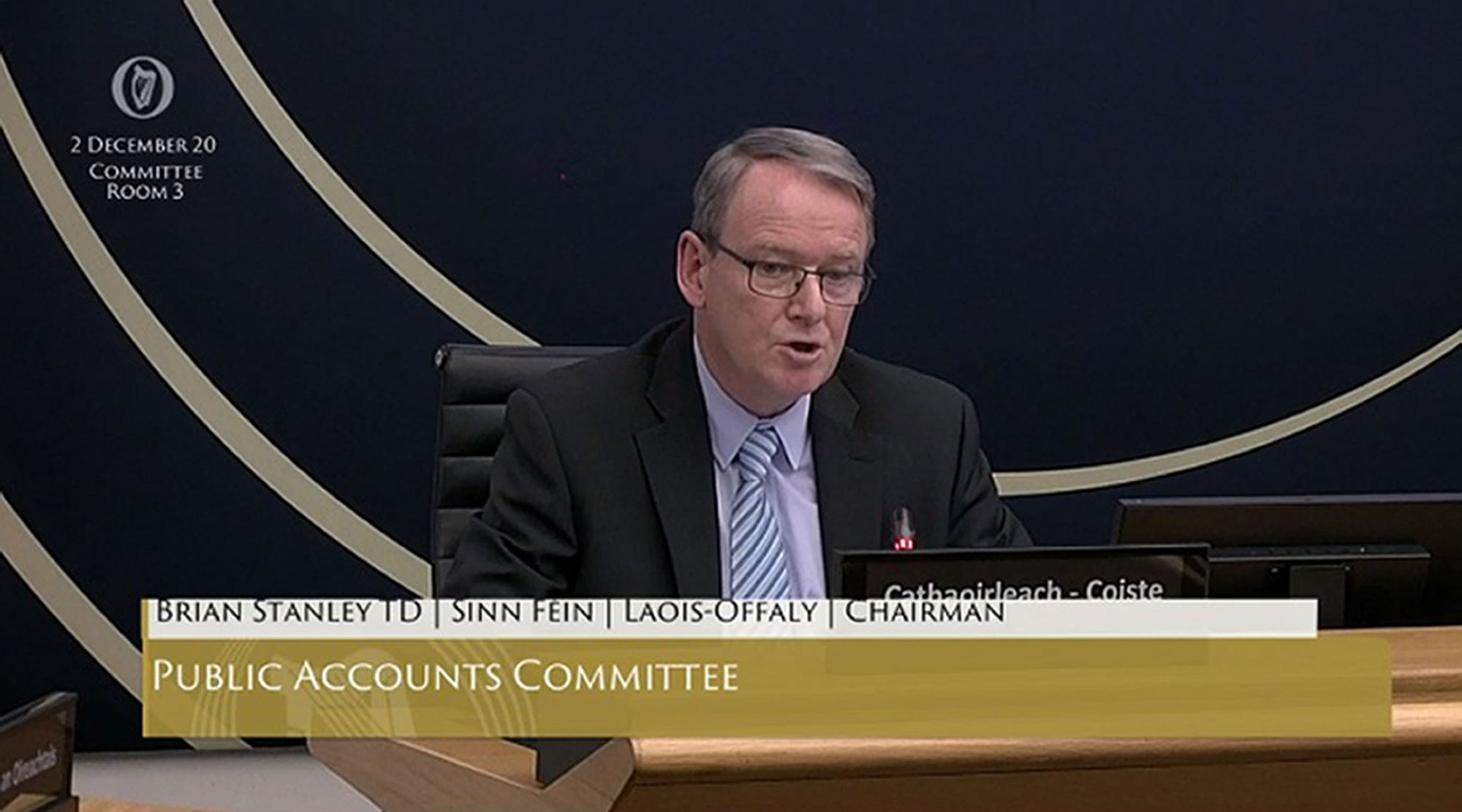
Sinn Féin's Brian Stanley has fared well as chairman of the Public Accounts Committee, despite posting a controversial tweet suggesting that Great Britain was a nation of “slow learners” when it came to dealing with the IRA.
The 33rd incarnation of the Public Accounts Committee got off to something of an inauspicious start in September of 2020.
Already delayed for seven months after the election in February by a combination of drawn-out Government formation talks and Covid-19, the new PAC, Dail Eireann’s only standing committee, hit the ground running with a will to perform, only to be stymied by a former incarnation and some ill-advised pronouncements on the part of its new chair.

The first two months of its existence saw endless back and forth between the committee and the Oireachtas regarding Standing Order 218 - a new Dáil rule stemming from a Supreme Court decision in 2019 concerning former Rehab chief executive Angela Kerins.
That decision by the highest court in the land upheld an appeal by Ms Kerins that she had been treated beyond the then PAC’s remit in terms of questioning of her salary and assorted other lines of interrogation at a relentless seven-hour meeting in 2014, and that said treatment had ruined her career and almost seen her take her own life.

The case was a seismic one - the courts are not in the routine habit of overruling the legislative arms of the State - and led to a simple mantra from the Oireachtas. “Never again.” Standing Order (a rule of the Dáil - each parliament has a fresh book of them) 218 basically means that the PAC is constrained in its questioning to already-filed public accounts.
“We’ll be debating history,” as now former member Marc MacSharry said at the time. The issue has never been resolved, although to a seasoned PAC-watcher, there hasn’t been too much noticeable controversy regarding it in the hearings from the past year. The response has generally been to probe current events, but in a softly-softly manner so as not to get called out for behaving disreputably.
Chair and Sinn Féin TD Brian Stanley’s brief flirtation with implosion-by-Twitter last December - after he suggested that Great Britain was a nation of “slow learners” when it came to dealing with the IRA - dominated the agenda in December of 2020.
Mr Stanley, a well-liked father figure of the now largest opposition party in the Dáil, seemed a logical choice to chair its most prestigious committee. His Twitter faux pas, which turned out to be one of many, led to calls from all sides for him to resign the chairmanship.
He endured a torrid PAC session in early December where all and sundry members of the supposedly non-partisan committee called on him to reflect on his sins (with the notable exception from the Government benches of Marc MacSharry as it happened). In the end Mr Stanley was stood down from his role as TD for a week until the brouhaha calmed down, and then continued in his role.
And he hasn’t done badly. Nor has his committee. The PAC has dealt with a lot of issues in the past year, and has actually managed a few tangible results, most notably with regard to RTÉ and the issue of bogus self-employment at the broadcaster.

Through simply sticking to its guns and not allowing itself to be fobbed off, RTÉ finally had to admit to the committee that it had been forced to make a settlement with the Revenue Commissioners regarding the ignoble practice of farming full-time employees out on self-employed contracts. More on that below.
Across 2021, PAC had spirited and often-constructive interactions with redress fund Caranua, NAMA, the OPW, National Broadband Ireland, the State Claims Agency, the National Paediatric Health Development Board, the Department of Transport, the Irish Prison Service, Horse Racing Ireland, the HSE, and more.
Sometimes the witnesses were forced to say things they didn’t want to. Sometimes they arrived with an agenda which duly made its way into the national press (no other committee trumps the PAC when it comes to soundbite headlines). But at all times the PAC as a sum of many parts did its utmost to do what it was supposed to, and it should be commended for it.
That doesn’t mean there weren’t issues with the committee in 2021. They were myriad.
For starters Covid took a hand, as it did with all Oireachtas committees, and reduced the length of hearings - already hampered by being held via Zoom - to just two hours. A two-hour committee meeting is bread and butter to a civil servant proficient at winding down the clock, as with just five minutes of speaking time TDs struggle to make an impact.
And more often than not resort to the forgettable fodder of parochialism (the much-missed MacSharry, a veteran of two PACs, found an interesting way around this, by using his time to read questions into the record for written answer).

Then there is the problem of inexperienced representatives. Fully eight of the PAC’s 13-strong membership (62%) are first-time TDs. Committee interrogation is a genuine skill, involving focus, preparedness, and a barrister’s knack for cross-examination. It is no coincidence that two of the best questioners on PAC, Imelda Munster and Catherine Murphy, are committee veterans and members of the previous committee.
Marc MacSharry has something of a buffoonish reputation, but as another committee veteran he was one of PAC’s best and most dependable performers prior to his replacement after losing his party whip - one of the poorest political outcomes the (non-partisan remember) committee has seen - not least because his replacement, 24-year-old James O’Connor, is yet another first-timer who took seven weeks to make his first speaking contribution.
And there is the issue that, frankly speaking, many of the TDs on the committee don’t seem to take seriously. Absences from hearings are routine. Local matters frequently dominate. Perhaps most damning is the fact you can count on the fingers of one hand those deputies who show up to discuss committee correspondence.
It is always the same ones, and they, by default, are the ones driving the committee’s agenda. And they are assuredly not from the Government benches.
Still, though, after a year’s bedding in there is much to be positive about in terms of where the PAC has come from and where it is going. RTÉ is up next for a grilling on January 20 (having cancelled an appearance in November as the Director General was literally too busy).
Expect sparks to fly.
In February 2021, chief officer David Gunning of the National Paediatric Health Development Board - the body with governing responsibility for the National Children’s Hospital build in Dublin’s Inchicore, arrived to PAC with a grenade in his pocket.
This particular hearing had been delayed from the previous November at the NPHDB’s request while it got its duck in a row regarding the cost and timelines relating to the hospital, which was last budgeted at €1.7 billion in 2019.
In his opening statement, often a bland recital of a body or Department’s recent achievements, Mr Gunning opted for a firing squad with BAM, the lead contractor on the hospital with whom the development board is at loggerheads, the intended victim.
He said that the new hospital, whose first intended completion date from back in 2015 was 2020 at a cost of €650 million, had shown a “lack of advancement” due to “under-resourcing” on the part of the contractor.
He said that hundreds of millions of euros worth of claims had been taken against the NPHDB by BAM, and said that the project was at least 10 months behind schedule (BAM waited a day and then pushed back firmly on the idea that it was solely responsible for the delay).

The committee bit back however. It wanted to know how much the hospital was going to cost, and when it was likely to be completed. The NPHDB was less forthcoming with information it wasn’t willing to release. All would be revealed within a month Mr Gunning said (it wasn’t), although he did concede that mid-2024 at the earliest is as optimistic as you can get in terms of when the hospital will open.
Following that appearance the NPHDB has firmly shut its mouth citing “commercial sensitivity” and said no more, despite multiple requests for clarity on the situation, a situation Brian Stanley bemoaned as “just disrespectful at this stage” in early December.
What happens next no-one knows, though if the board has its way you feel the hospital will actually be a going concern before anyone knows how much it cost. And maybe not even then.
The State broadcaster appeared at PAC in April 2021 hoping to discuss its seemingly never-ending financial plight and the need to redesign how it is funded - and tied itself in knots regarding a controversy in terms of how it treats freelance workers who, well, weren’t doing a freelance job.
RTÉ had admitted earlier that month that more than 80 of its workers - some of them quite senior - had been reclassified as having “attributes akin to employment” following a 2018 review of its staff, and thus had been offered permanent contracts, a fact that had led to two further reviews by the Revenue Commissioners and the Department of Social Protection.
This led to an interesting question from Sinn Féin’s Imelda Munster - if all these workers had been misclassified, there must surely be a PRSI payroll deficit which RTÉ would have to make up with the Revenue. Three times Ms Munster asked, three times she was rebuffed (“I am not aware of an indication of a bill in respect of moneys due to them,” was the exact phrase used by RTÉ’s financial controller Fiona O’Shea).
Then, in the dying moments of the session, chair Brian Stanley asked the question again. And this time the answer was in the affirmative. “RTÉ takes its responsibility for paying taxes very seriously and has made an initial payment to the Revenue Commissioners,” Ms O’Shea said, with a straight face too. Quite the about turn. What inspired it isn’t known.
Despite thus leaving RTÉ open to accusations of being a de facto bogus self-employer, Director General Dee Forbes gave a tetchy denial at the same hearing, stating “RTÉ has a number of relationships with its staff”.
Meanwhile, in the following months PAC did its job and finally extracted out of RTÉ the size of the payment to Revenue (€1.2 million). And that is unlikely to be the end of it. The broadcaster is back at PAC in January.
The Office of Public Works has made just one appearance before the current incarnation of the PAC - in November 2020, and it was a fairly unremarkable two-hour affair, apart perhaps from one statement (more on that below).
That hasn’t stopped the keyholders to the State’s property portfolio from featuring in PAC discussions and correspondence ad infinitum over the past 12 months (they’re due to be back in early next year).
There is only really one thing at issue - accusations of gross financial mismanagement in terms of the country’s property assets (with perhaps the most current example being the new build of a Garda command centre at Military Road in Dublin which is set to be too small to hold all the gardaí due to transfer to it - a fact which prompted the PAC to rule officially that the build is “no longer fit for purpose”, a fairly staggering pronouncement on an as-yet unfinished €87 million project).

However the main reason the OPW is sending letters to the PAC every other month is to update it, per the PAC’s own recommendations, on the situation with a €10 million rental overpayment on Miesian Plaza, the headquarters of the Department of Health in Dublin. That contracted payment resulted from the OPW using the wrong measurement standard when calculating the floor space in the building, something the agency’s chair Maurice Buckley described at the time as being like “scoring an own goal having been three goals ahead”.
The correspondence twixt committee and OPW has gone, to paraphrase, thus: “we would like to meet the landlord”, “we have met the landlord”, “we have met the landlord again”, “we are talking about having another meeting”, “the landlord won’t meet in person”, “we have met them over Zoom”, “we are going to meet them again”. On and on it goes, roughly 10 letters in all since March 2019.
Given the OPW willingly signed the offending contract with Larry Goodman’s Remley Developments, it’s hard to see how it will ever get the money back. And so the farcical series of updates continues, and shows no sign of ever ending.
The Health Service Executive was set to be a focus of the 33rd PAC from the outset given the organisation’s problems with procurement - specifically, in spending millions on goods and services (at least €15 million in 2018) without any public oversight or competition.
Then Covid happened, and the health service spent an immense €1.1 billion on emergency procurement, with an emergency EU directive invoked to make the giant splurge exempt from public procurement requirements.
The subsequent scrutiny of the mad months at the HSE of March and April 2020 represent something of a marriage of the print media and the political accountability powers of PAC. In December 2020, the first reported that the HSE had spent €14 million on emergency ventilators from China for critical Covid patients - machines which were never used.
The PAC referred the issue to the Comptroller and Auditor General, the State’s accountant, and eventually at least three official probes into Covid procurement and ventilator procurement in particular were commissioned (with another from the C&AG still in train).

Once the ventilator scandal broke, the HSE twice cancelled PAC appearances - once in February 2021 on foot of the third wave of Covid-19, and again in May where the reason given for the deferment was the devastating cyberattack carried out on the executive’s computer frameworks.
The appearance did eventually happen in September 2021. By that stage the gargantuan nature of the HSE’s Covid procurement write-offs had become clear, with more than €600 million in PPE lying unused and in storage at the end of 2020.
The HSE's CEO Paul Reid vowed before PAC he wasn’t “letting up” in his pursuit of companies who had promised much and delivered little at the health service’s time of greatest need. He cut a bullish figure at the same time.
“What I would not stand for at that time was people not taking quick and rapid action,” he said.
If the aforementioned Standing Order 218 was supposed to forcibly clip the PAC’s wings, it had little impact in the case of one of the State’s most senior civil servants, who got quite the salary hike in February of this year.
Robert Watt, formerly the pugnacious secretary general of the Department of Public Expenditure and Reform for just under a decade, emerged as the frontrunner for the same role in the Department of Health at the start of the year.
This may have been not unexpected given Mr Watt’s seniority. What came as a curveball was the fact his salary would be hiked to the tune of €81,000 (in the end Mr Watt waived the increase until such time as the economy recovers).
The civil servant and PAC had already crossed swords back in September 2020 when, in the context of the €10 million Miesian Plaza rental debacle, Mr Watt had insisted that such public sector foul-ups were indeed punishable despite no-one having ever been held to account for the same mistake.

In due course, Mr Watt was selected as the most qualified of the 23 candidates who went for the job, while the PAC first as a collective called for the recruitment process to be halted before joining forces with the Oireachtas Finance Committee to investigate the matter from start to finish.
The joint committees’ final report on the matter - published last month and which saw some of Ireland’s most senior politicians submit to interview - was damning, describing Mr Watt’s behaviour as displaying “an utter disregard” for transparency, and calling for Ministers’ power to set civil servant salaries to be reviewed.
Not that the ruling has slowed Mr Watt down in his new role - after the resignations of several senior Slaintecare officials in September, the much-delayed reform process for the health service is set to be driven by a new board to be co-chaired by HSE CEO Paul Reid and, you guessed it, Robert Watt.