Dominic MacSorley: International community must not turn its back on Afghanistan
It’s a critical time and humanitarian aid is the absolute minimum that we can provide
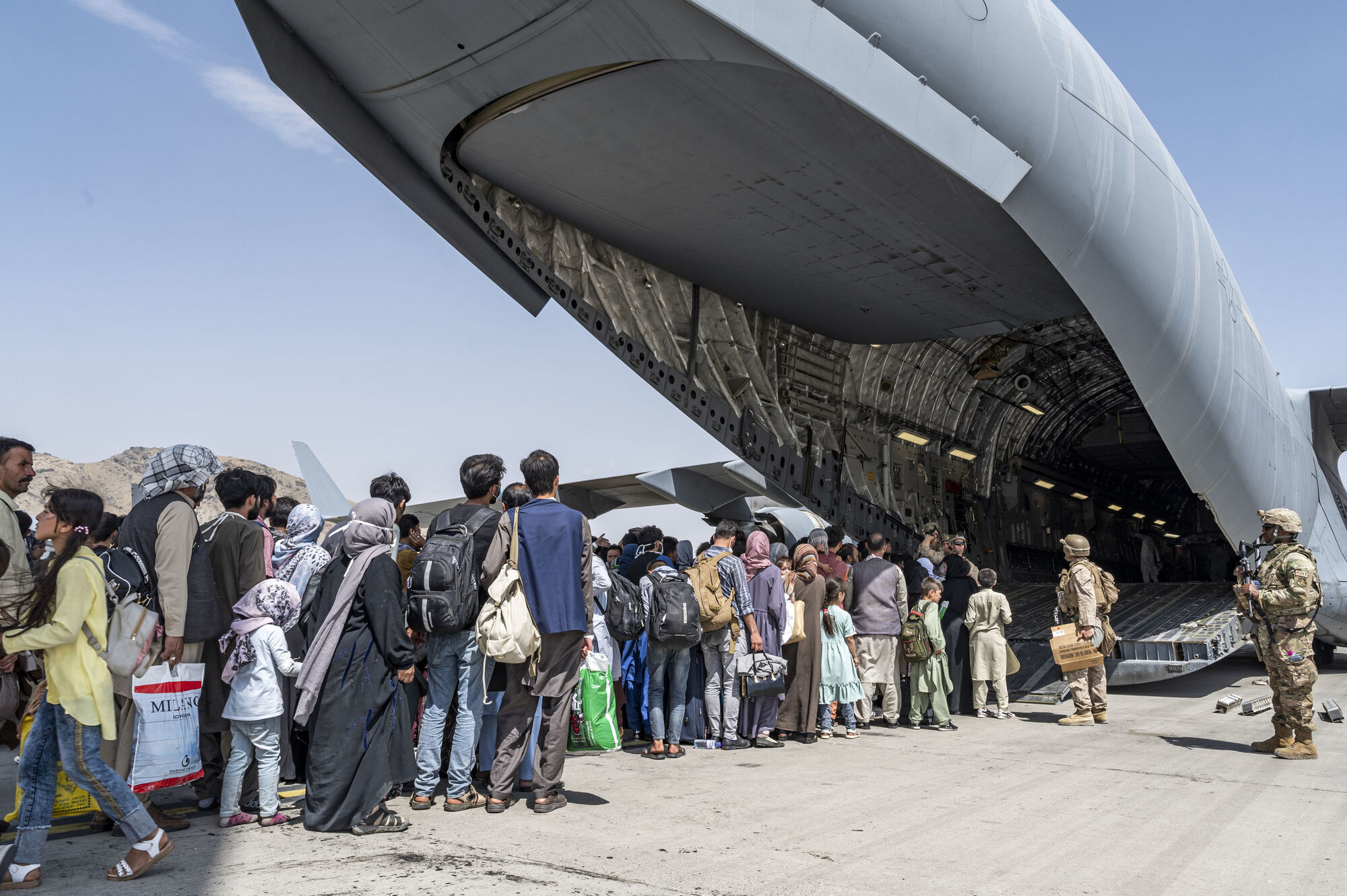
US airmen and marines guide evacuees aboard a US Air Force C-17 Globemaster III in support of the Afghanistan evacuation at Hamid Karzai International Airport in Kabul, Afghanistan. 	Picture: Senior airman Brennen Lege/US air force via AP

US airmen and marines guide evacuees aboard a US Air Force C-17 Globemaster III in support of the Afghanistan evacuation at Hamid Karzai International Airport in Kabul, Afghanistan. Picture: Senior airman Brennen Lege/US air force via AP

Now is not the time for the international community to turn its back on the people of Afghanistan. The people of Afghanistan need the support of the international community now more than ever.

Throughout the decades of failed military interventions, humanitarian organisations have stayed, working with communities who have been ravaged by years of conflict, climatic disasters, poverty, and persecution.

Over half of the country’s population lives below the poverty line.

At the start of 2021, 18m people were dependent on humanitarian assistance, with more than 3m children at risk of acute malnutrition. The human toll of the conflict, drought, and Covid-19 this year has been immense, particularly for women and children.

While the focus of the world has been on the airlifts and evacuations out of Kabul, the work of NGO staff goes on, albeit under emerging polices and regulations.

The need for adaptation is not new. Volatility is inherent to humanitarian work and effective humanitarian action requires adaptation all the time.

Concern has been working in Afghanistan for 23 years, supporting the most vulnerable communities, and has to adjust and adapt continuously.

Whether it is in Somalia, South Sudan, Afghanistan, or any other context, to be a humanitarian is to stay and deliver, even when administrations change or conditions become more difficult. 

Guiding our staff are the international humanitarian principles of humanity, impartiality, neutrality, and independence, principles that are ever more important in times of acute crisis and central to how we navigate and negotiate access.

These are never easy contexts to work in; insecurity and uncertainty have been a daily reality in Afghanistan for Concern staff and the communities with whom we work. In the aftermath of 9-11, I spent weeks with our teams on the ground at what was a deeply challenging time. What struck me above all was the resilience and humanity of the Afghan people and the commitment of the men and women who work with Concern.

At the height of the most recent conflict, our work across three provinces was suspended and staff were forced to shelter at home. Today, our provincial offices are open and staff are cautiously back at work under assurances that they and other NGO staff will be safe.

However, we know the situation remains volatile, and negotiations continue at local levels to determine what degree of freedom of movement we have, and in particular, to ensure the safety and security of our female staff.

This is a very fast-moving situation but, at this time, it is critical to remember that principled, accountable, properly targeted humanitarian assistance can be delivered in Afghanistan and has been for many years. That must be at the forefront of our minds because, while the world waits, observes, and adjusts to the new reality, millions of people are in need of essential services, protection, and seeds ahead of the critical winter planting season.

Although we have seen much news coverage of Kabul since the weekend, more than half the entire country is already in need of humanitarian assistance. Over 80% of Afghanistan is in serious drought, leading to a decimation of the critical wheat harvest. At the same time, the disruption of conflict and Covid-19 has resulted in rapid inflation of basic food prices at markets. More than a third of the population is now facing crisis levels of food insecurity.

Faced with a multitude of such severe crises, what the Afghan communities now need most of all is the reassurance that the international community is not withdrawing support and abandoning them.

Humanitarian funding to Afghanistan prior to these latest dramatic events was already seriously inadequate. The United Nations-led annual Humanitarian Response Plan for the country is only 38% funded, leaving a shortfall in funding of $793m. It is impossible for the humanitarian community to provide the most basic level of assistance without adequate funding to meet the increasing needs.

In responding to the new reality in Afghanistan, it is essential that the right of disaster-affected people to access humanitarian assistance is prioritised first and foremost. That is the absolute minimum the people of Afghanistan deserve.

Humanitarian response organisations — international, national, and local — have established a long record of accomplishment of meeting the most urgent needs in Afghanistan under the most severely challenging circumstances. They must be supported to continue to do so.

We will stay in Afghanistan and remain committed to reaching people in need of assistance.

We urge the international community to also stand with the people of Afghanistan at this critical moment.

  • Dominic MacSorley is chief executive of Concern Worldwide, currently responding to the Afghanistan crisis. 
  • To donate, visit concern.net

More in this section

Revoiced

Newsletter

Had a busy week? Sign up for some of the best reads from the week gone by. Selected just for you.

Cookie Policy Privacy Policy Brand Safety FAQ Help Contact Us Terms and Conditions

© Examiner Echo Group Limited