Síona Cahill: I don’t know what 'normal' is but if it’s anything like life before Covid, I don’t want it
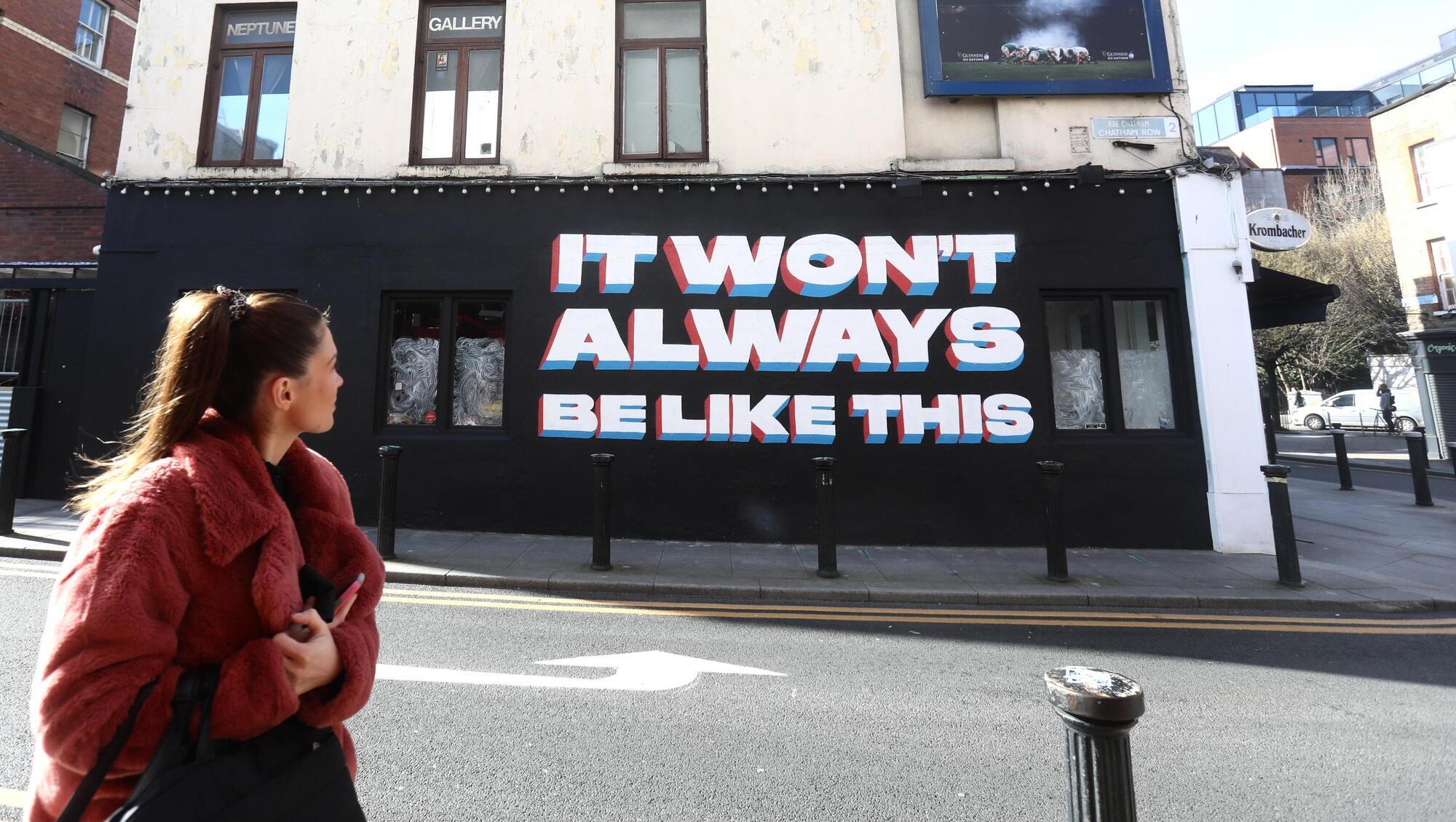
'It won't always be like this': The title of Inhaler's album, released in March, took on new meaning as a mural by artist Emmalene Blake on Chatham Row near Grafton St, Dublin. Picture: Leah Farrell/RollingNews
Everyone is talking about getting back to normal and ‘returning’ to work. Normal? I don’t want a bit of it. Normal wasn’t so great in the first place.
Normal was bumper-to-bumper before daylight landed. Normal was fast-paced, always busy, full-on and — for many people — unsustainable. A health pandemic certainly didn’t address any of that, but one way I don’t think we should go is backwards.
There was a temperature change between strangers — people just being nice and saying hello on the street through their masks. There were teddy bears in city street windows, and young fellas dropping groceries off to the elderly.

People were sending postcards and checking in on neighbours. We all got a bit obsessed about local amenities, gardens, and litter — as if we had only just put our glasses on and looked around us for the first time.
Each of us did our best to keep our heads above water and make the most of the unknown days and weeks in front of us. There was fear, stress, and anxiety, but we allowed space for it, more so than usual. More so than normal.
A quiet and an unquiet have sat uneasily beside each other for the last 18 months.
The quiet I’ve adjusted to. The quiet reduced appointments and expectations. It didn’t demand your physical presence at every function. It tended to house plants, wore softer clothes, and enjoyed the lack of constant performance for everyone else’s benefit.

There has also been the unquiet. This is the always-on battle of your work life being right there waiting at your own kitchen table, or on the emails app at the palm of your hand. It is the feeling of being trapped in your own house, a space that wasn’t designed with an office in mind. Deadlines rolled in regardless of caring responsibilities or difficult family dynamics.
Where we stole back time from commuting, we were still running out of it and in a near-constant state of exhaustion. Survival mode in movies looks so much sexier. Our heads are fried from all the uncertainty and the worry about ourselves, our family, the future.
Despite unending restrictions, lockdowns, and hospitalisations, many people’s response was pretty cool and it’s good to celebrate that. They demonstrated a sort of... soundness. It was patience.
Maybe it was even more than a little empathy. But it wasn’t equally spread around, and that’s always the rub.

The capacity to impulse-purchase, banana-bake, or Deliveroo our way out of tough mental situations, on an endless loop for the last few months, has not been the same for everyone, nor did it work for everyone.
While we may have all plunged into this together, we haven’t been coming out of it the same way. We’ve changed — but the expectations of society and the economy haven’t — and here we’ve reached an impasse.
We’ve been forced to adapt and learn and change the way we do things. It’s impossible for things to be the same, despite our rush to get back to the past.
I’m not fine. I’m a shell of a woman. Like most, I’m keeping a sunny disposition on Instagram and doing my best at work. I don’t think anyone is actually fine.

The most important thing for us all isn’t to return to normal, it’s to acknowledge that, actually, no one stood still for 18 months. We didn’t put lives on hold, we weren’t paused: We missed things. There’s a difference. From enforced self-isolation in box rooms, we counted each hour, each day.
We streamed films and we Zoom-quizzed and we celebrated two birthdays without hugging. Whatsapp groups went from buzzing to silent at different times, as we separately mounted personal hurdles or went to ground when needed.

There is nothing normal after an experience like this. We didn’t stand still for 18 months: We lived differently and we lost people close to us. There was good, bad, and ugly to it all. I know that I need to move forward by acknowledging what’s happened and what is happening, and not just act like it’s a bad hangover and I can go on as before. Normal wasn’t safe or sound: It was just what we accepted and knew.
Meanwhile, I think I’ve forgotten how to socialise. I’m still a little uncomfortable with more than two people over to my house and, on occasion, I’ve hidden in the bathroom, away from friends. You don’t bounce back from all of this overnight, and we shouldn’t expect ourselves to, either.
People might even feel ashamed to think of themselves as overwhelmed by it all, and the prospect of family and social gatherings is the furthest from where their heads are at.

Summer 2021 has been a halfway house between vaccination rollout announcements, rows about indoor dining, and crowds going back to matches while partners are left sitting in cars outside maternity units.
As we ‘reopen’, who gets access to what and when seems to be determined by the loudest voices rather than on a real needs basis, while Government gaffes around political silly season don’t help the messaging to an already addled public.
The usual societal expectations and economic imperatives quickly forget, and quickly set aside patience and empathy for hurrying back to the pace of busy lives fulfilled by chaotic calendars.
As we get ‘back on track’, or whatever the newest phrases are, we’ll forget, once again, to turn around to see who needs a support, a hand upwards, or a message just to say hi.
'Normal' might sound tempting because it’s familiar and certain, after all this time. But we can do so much better than normal. Now’s our chance.

• Síona Cahill (29) from Co Longford is a campaigner, activist, and frequent radio contributor on current affairs