Access to abortion in Ireland still depends on doctors’ daily moral courage
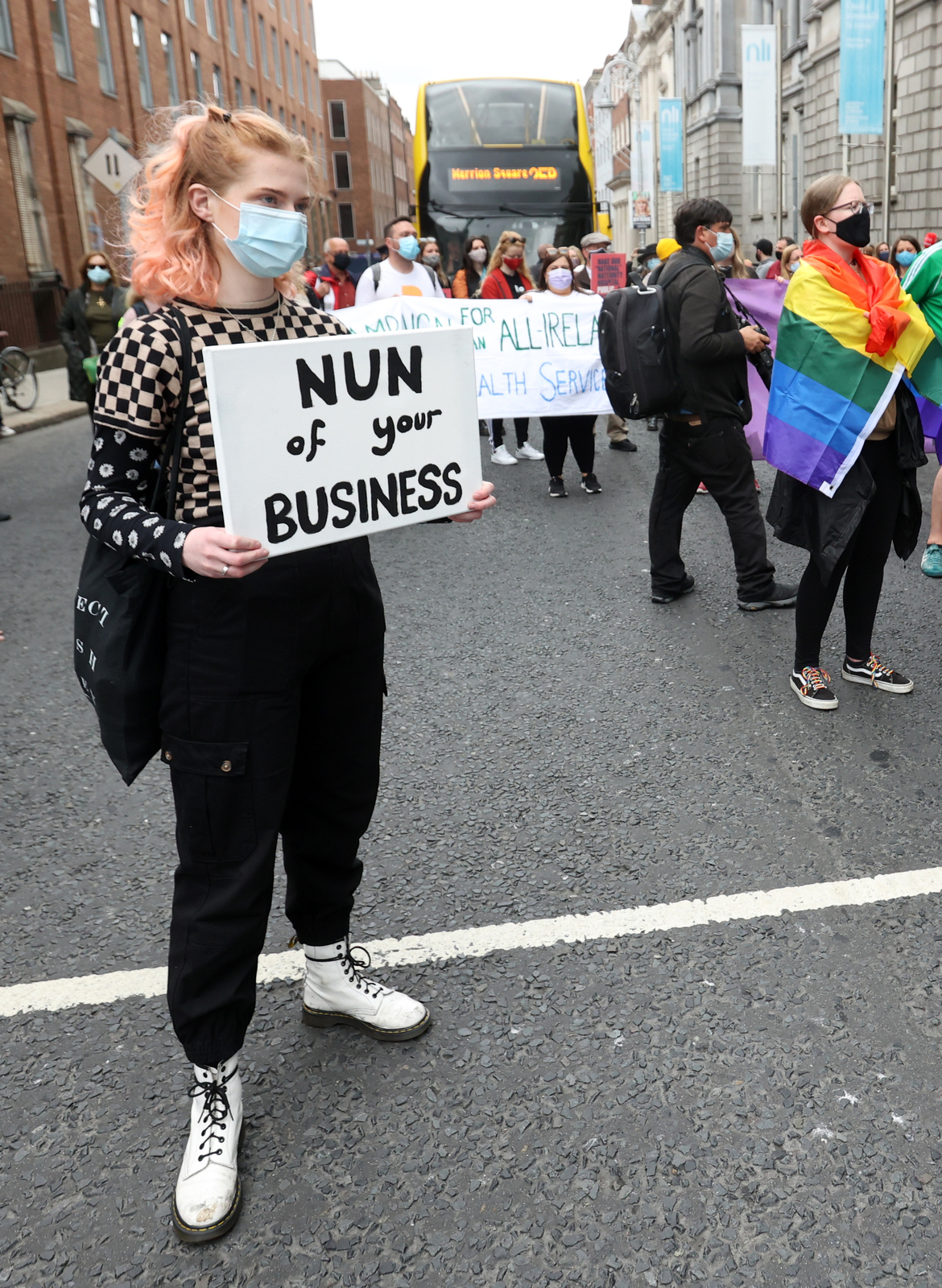
Doctors reassuring the public of clinical independence at the new National Maternity Hospital are obliged to take women's concerns seriously — the recent past should be enough evidence for anyone 
Access to abortion in Ireland still depends on doctors’ daily moral courage

Protesters campaigning against the Catholic Church owning the new National Maternity Hospital protesting outside Leinster House in Dublin last month. Picture: Sam Boal/Rollingnews.ie

Public disquiet over Catholic influence on reproductive healthcare is at the heart of the National Maternity Hospital (NMH) dispute.

On one side, Ministers, hospital consultants and St Vincent’s Healthcare Group (SVHG) maintain that religious medical ethics and institutional ethos can be constrained by company law. 

On the other, feminists insist that relationships between religious influence and medical care are dangerous and complex.

The NMH provides care that is not compliant with Catholic social teaching, including abortion. Supporters of a swift move from Holles Street to Elm Park say that the transfer will not compromise that position. 

The Religious Sisters of Charity will not staff or supervise the hospital; they will not own SVHG by the time the NMH joins. 

They have made no ‘gifts’ to the state, but their shares, and their property at Elm Park will be transferred to a charity with a lay board, called St Vincent’s Holdings. 

The Vatican approved this transfer last year. Under the Mulvey Agreement, a ‘reserved powers’ arrangement will protect the NMH's clinical independence.

A ‘golden share’ provision will ensure that the arrangement cannot be amended in future without Ministerial consent.

Why is this not enough for feminists? 

Recent history is part of the answer: The Sisters of Charity ran Magdalene laundries and industrial schools and arranged illegal adoptions; they contributed to redress for the industrial schools but refused to do so for the laundries.

Feminists are demanding a break with the status quo, in which key public services depend on the state’s capacity to negotiate with these kinds of Catholic charities.

The government’s inability to purchase the hospital site, over apparent religious objections, recalls older battles between church and state. 

NMH consultants’ apparent indifference to religious involvement in hospital governance produces uncomfortable echoes of the hospital’s darker history as the place where symphysiotomy was revived, single girls were spirited from Dunboyne to have their babies, and Éamon de Valera worked while arranging illegal adoptions.

There is a long tradition in Ireland of doctors whose practice has tested the bounds of prevailing Catholic thought. 

There is also a collective living memory of dismissive, harmful and cruel treatment in Irish maternity hospitals, notionally justified by reference to Church teaching. 

We all remember senior anti-choice obstetricians publicly and confidently insisting that they could always offer care in the woman’s “best interests” despite mounting evidence to the contrary. 

We know from recent history that women have died and been injured, while the state looked on. Clinical autonomy has not always meant safety.

Doctors working at the NMH today might be forgiven for wondering how they find themselves grappling with these long-standing issues. 

Are they to be held accountable for the progress of Irish secularisation while delivering reproductive care with 90-year-old infrastructure? 

No. However, they are obliged to take women’s concerns seriously.

For feminists, the relationship between Catholic ethos and reproductive medicine is about more than the physical presence of nuns or priests in a hospital building, and about more than the text of official agreements. 

It is about how the state and the medical profession have habitually, and informally, responded to religious demands for deference. From this perspective, the proposed governance arrangements for the NMH pose more questions than they answer. 

If the transfer goes ahead, the NMH will join SVHG, which is owned by St Vincent’s Holdings. The Memorandum of Association for each St Vincent’s company requires the directors to uphold the 'core values' of the Sisters of Charity. 

St Vincent’s nominees would dominate the new NMH board. In the United States and in Australia, Catholic hospitals with similar governance structures have denied women access to legal abortions. 

In 2019, the Day Report noted that the Irish courts have not determined the scope of a religious entity’s constitutional rights to govern its own affairs. 

In the event of a future conflict between a religious charity’s ‘core values’ and women’s demands for healthcare, will women be protected?

 Protesters campaigning against the Catholic Church owning the new NMH: It emerged in 2017 in a report by 'The Times of Ireland' that the religious order that runs SVHG, the Sisters of Charity, would retain ownership of the hospital. Picture: Sam Boal/Rollingnews.ie
Protesters campaigning against the Catholic Church owning the new NMH: It emerged in 2017 in a report by 'The Times of Ireland' that the religious order that runs SVHG, the Sisters of Charity, would retain ownership of the hospital. Picture: Sam Boal/Rollingnews.ie

It is difficult to say, because we rarely see frank and detailed public discussion of how Catholic medical ethics actually affect Irish maternity care today; abortion is one example. 

The NMH currently employs some willing and effective abortion providers. However, nine Irish maternity hospitals do not offer full abortion services. Of these, at least four are affected by conscientious objection. 

An article in the journal Contraception this year described how Irish hospital doctors providing late-term abortions are vulnerable to criticism and exclusion, including by colleagues. 

A 2020 article in the British Journal of Obstetrics and Gynaecology reported that Irish fetal medicine specialists are affected by colleagues’ conscientious obstruction. 

This has delayed terminations in cases of fatal fetal anomaly and generated unsupportive working environments. 

These examples show that religious issues are more complex than any individual doctor’s own beliefs; they are bound up in wider cultures of compromise and accommodation.

Access to abortion in Ireland still depends on doctors’ daily moral courage. 

NMH consultants are asking Irish women to rely on that courage; to wait and see, trusting that doctors will always be able to advocate and negotiate on women’s behalf in any conflicts that might emerge in a new maternity hospital part-governed by a Catholic charity. 

They are asking women to trust decades into an unknown future, in which pro-choice doctors and politicians may eventually be in shorter supply.

Some consultants’ interventions have been surprisingly paternalistic; suggesting that feminists are scaremongering and unwittingly risking the hospital’s future. 

This is not new. 

Women are often accused of risking others' wellbeing on a whim when they ask the health services for transparency and accountability. 

Vicky Phelan: Women who campaigned around CervicalCheck were accused of scaremongering. Picture: Instagram.

Ask those who campaigned around the CervicalCheck scandal, challenged defences of the practice of symphysiotomy, or lobbied for home births.

Irish women are no longer content with doctors who can navigate religious prohibitions creatively; they want to know that access to health-preserving care will not be delayed, restricted, or denied for any religious reason.

They want to know that hospitals will not interpret the law conservatively in order to comply with collective religious ethos. 

They want to know that doctors will not need to bargain with, persuade or evade religious colleagues. 

They want to know that doctors have reflected on the religious dimensions of their own training and on their own institutions’ compromises with religious power.

In the wake of a Repeal campaign in which doctors were made leaders, women are surprised that more obstetricians have not demanded robust separation of religious and medical interests. 

Until consultants address women’s concerns openly and in detail, this dispute is unlikely to evaporate. Honest reckoning and planning now may reap dividends in the future.

  • Máiréad Enright is Reader in Feminist Legal Studies and Leverhulme Research Fellow at Birmingham Law School

More in this section

Revoiced

Newsletter

Sign up to the best reads of the week from irishexaminer.com selected just for you.

Cookie Policy Privacy Policy Brand Safety FAQ Help Contact Us Terms and Conditions

© Examiner Echo Group Limited