From a bizarre hijacking over Belarus to strategic bombers off Belmullet
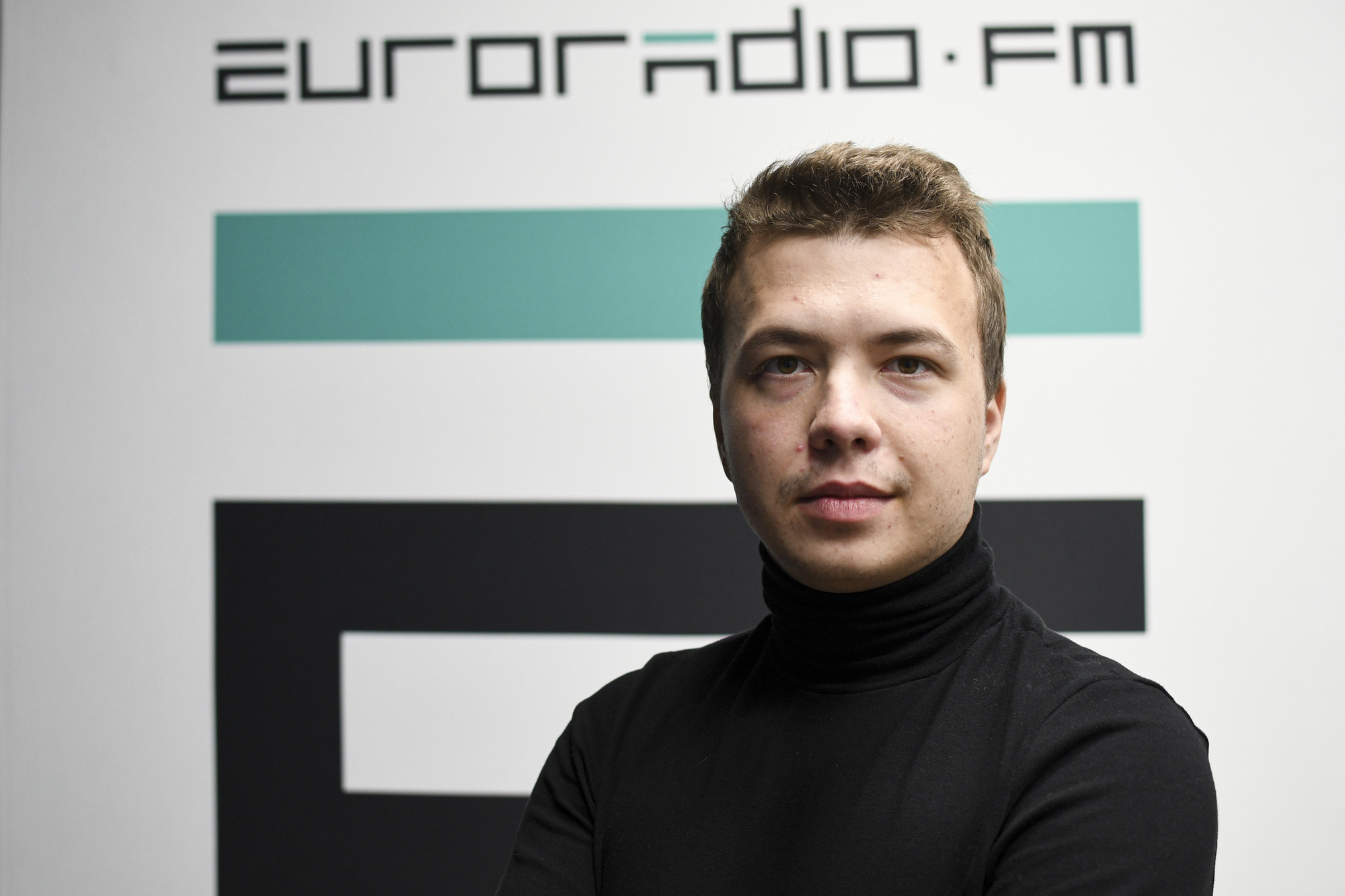
The forced diversion of a plane to Belarus in order to arrest Belarus journalist Roman Protasevich has been denounced as piracy, a hijacking and terrorism. Picture: Euroradio via AP
It’s not often that the diversion of a Ryanair flight gets worldwide attention. However, Ryanair Flight FR 4978 from Athens, to Vilnius, on Sunday last (23 May) became the first ever openly state-sponsored hijacking in history.Â
Forced to land at Minsk, in Belarus, it resumed its journey to the Lithuanian capital, minus a prominent Belarusian opposition journalist, his girlfriend and three security agents, who remained in Minsk.

Events in Belarus are not happening in isolation. To understand what has happened here requires exploring the Belarus link with Russia, and with Russian strategic interests in Ukraine, Crimea, the Baltic States, the Arctic Circle, and down the North East Atlantic area, where Russian Air Force strategic nuclear bombers frequently fly past, a few miles west of Belmullet.
In Belarus, the current protests against the Lukashenko regime started as a reaction to the Presidential Election held on the 9th August last year, where President Lukashenko was declared the winner with approximately 80% of the popular mandate. The Opposition claimed that the elections were neither free nor fair.Â
They demanded that the results of the election be set aside and that fresh elections be held. Opposition spokespersons claim that about 7,000 people were arrested and several hundred have been injured by police action.Â
International media have verified the brutality of the police towards the protesters. The protests in Belarus were not isolated events in the region.Â
Over the past three years or more, pro-democracy protests have taken place in over a hundred different cities, in Russia and the Russian Federation. Belarus is very dependent on Russia especially for subsidised gas and oil.Â
Nevertheless, Lukashenko had tried to keep some space between Belarus and Russia. He had resisted repeated attempts to form a closer economic union with Russia, which Putin has been calling for.Â
Lukashenko had also forged ties with the EU and even NATO. As recently as March 2020, UK Royal Marine Commandos (special forces on a par with the Irish Army Ranger Wing) have been training the Belarusian forces and participating in military exercises in Belarus.

The Opposition leadership fled to Lithuania and Poland. For the moment Putin backs up Lukashenko. However, Putin could accept the replacement of Lukashenko, and even a more democratic Belarus, if it stays close to Russia.Â
However, Putin will not stand idly by and watch a democratic regime in Belarus join with NATO and the EU. Moreover, a successful ‘velvet’ revolution in Belarus could spark off uncontrollable demands for increased democracy in the Federation and the overthrow of Putin himself.
There is also another consideration. The Russian enclave of Kaliningrad, between Lithuania and Poland, has long been seen as a potential flashpoint between Russia and the West. In the event of an emergency the main land approaches to Kaliningrad from Russia lie across Belarus.
Late last year, Swedish Defence analysts revised their assessment of Russian military activity in the Baltic, along the Arctic Circle and down the North East Atlantic. They have concluded that Russia has the capability to cut communications between the US and Europe in times of tension.Â
Moreover, Irish defence analysts have long been concerned about the vulnerability of gas platforms off the Mayo coast, and the frequent flights of Russian bombers potentially carrying nuclear warheads in Irish controlled air space, off the west coast.Â
The greatest threat has now been identified as the possible cutting of transatlantic cables. These cables carry 85% of communications between the US and Europe, including most of the internet.
The Swedes are so concerned that, just before Christmas, they announced an increase in the defence budget from 1.1% of GDP to 1.5% of GDP (Ireland’s is only 0.27%) and an increase in the armed forces from 60,000 to 90,000 personnel, over the next four years.
The weakest link along the North East Atlantic is the west coast of Ireland, as Ireland has no interceptor jets or combat naval ships to protect its sector. Moreover, the Continental Shelf is at its shallowest off the west coast of Ireland, with correspondingly easier access to the transatlantic cables.
There are three significant contexts which have a bearing on the present situation. First, and more immediate, is the impact of the change of administration in the US. The Trump administration was pro-Russian to an inexplicable degree and overly critical of NATO.Â
President Biden and his Secretary of State, Anthony Blinken, have moved to reassure NATO countries of continuing US support against Russia. The Biden/Putin relationship is poor, especially after Biden publicly called Putin a ‘killer’.

Secondly, the EU will be weakened for a while by Chancellor Merkel’s retirement and if President Macron loses the Presidential election next April. Opinion polls currently show him slightly behind Marine Le Pen.Â
Either way, despite Brexit, the EU is unlikely to progress further down the road to common defence. It will remain stuck in the CSDP (Common Security and Defence Policy).
Thirdly, if Brexit leads towards the breakup of the UK, over the next eight to 10 years, it may weaken the defence of the North East Atlantic. An independent Scotland may not invest in defence to the extent the UK does now.Â
Will a united Ireland join NATO or follow a policy of an underfunded military neutrality?
In the meantime, Russia continues to enhance its military capabilities on land, at sea and in the air, on cyber and even in space.
In April, Russia built up its forces opposite Eastern Ukraine and in Crimea from 30,000 to over 100,000. In early May it declared the exercise over, reduced some of its units but left the tanks and heavy equipment of the 41st Army behind in the Border areas, to facilitate the Zapid 2021 exercises in September.Â
It looks like these joint exercises, with Belarus, will take place in the same sensitive border areas.Â
This defence analyst considers the April build-up a rehearsal for a possible Russian military intervention in the Ukraine. Since 2014, Ukraine has blocked the waters from the Dnieper River flowing into the North Crimea Canal, cutting off 85% to 90% of Crimea’s water supply.Â

Two million, mainly pro-Russian Crimeans, are facing unparalleled water shortages. Putin is facing the Duma elections on the third Sunday in September. A Russian military intervention cannot be ruled out to get the water flowing again to Crimea, and to boost Putin’s Party (United Russia) at the polls in September.
To keep NATO on its toes, expect more Russian strategic bomber flights cruising South past Belmullet, before the year is out.
- Colonel Dorcha Lee (Retd) is a defence analyst.