Nursing home residents are in the eye of a terrifying storm with no real plan
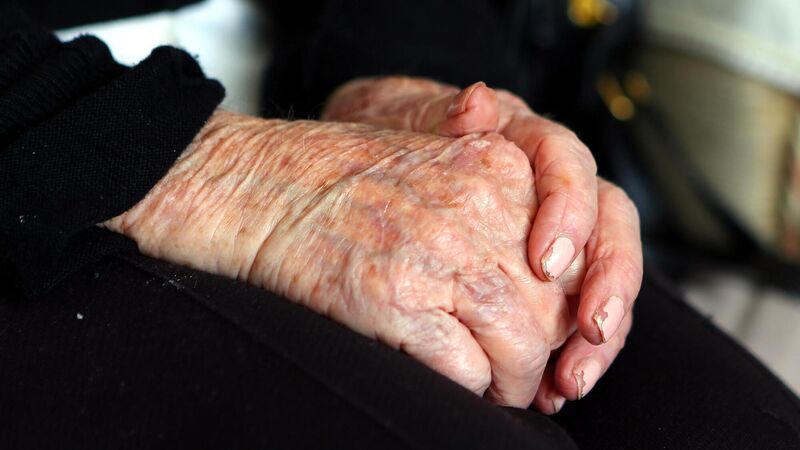
The Irish has government operated one of the most restrictive visiting systems in Europe, endorsing complex, dense visiting guidance in which residents are often viewed as passive recipients of care. File Picture: PA
With multiple outbreaks of Covid-19 reported in nursing homes, 32,000 residents and their families once again find themselves in the eye of a terrifying storm.Â
The lack of strategic planning to ensure sensitive communication care and crisis support is provided during outbreaks is evident.Â
Care Champions, a family-run group, report many families are struggling to contact overwhelmed nursing homes or comfort their relatives, even from a distance, during the final days of their lives, some only granted entry when the dying person is no longer aware of their presence.Â
Others report relatives have died alone, having endured months apart from family due to restrictions, an unnecessary separation according to the Irish Association of Social Workers (IASW), which has repeatedly called on government to review visiting guidance and to provide appropriate support during outbreaks, support which recognises residents’ fundamental rights to family life.
Studies show the negative impact of visiting restrictions on residents, confirming something we all know innately - connection with family is vital to our well-being.
 Window visits and technology, unsuitable for people with communication difficulties, are no substitute for private visits.Â
Residents share worries about care or abuse with family members, who instinctively protect, motivated not by professional requirements, but by love for the person.Â
The consequences of the removal of that irreplaceable support over such a prolonged period cannot be overstated, particularly within a sector, which as HIQA and the IASW have repeatedly warned, fails to adequately protect the rights and welfare of residents.
Six years after Aras Attracta, we have neither a safeguarding authority or legislation and social workers do not have a legal right of entry to private nursing homes to investigate concerns.Â
Responding to criticism of HIQA’s role in Oaklands Nursing Home in Listowel, Mary Dunnion Chief Inspector wrote in the , "Due to limitations on our legal powers, we had to wait until the management of and safety of care in a nursing home had deteriorated to a significant level until we could cancel its registration… people should not be subjected to significantly deteriorating care and service quality to the point their very lives are at risk because of legal limitations."
Worryingly, the HSE has acknowledged that at least 1000 concerns relating to institutional abuse in care settings across Kildare, Wicklow and Dublin were not assessed by social workers before residents were cocooned into those services in 2020.Â
Social workers continue to receive concerns related to institutional abuse and a wider social work investigation commenced following the alleged rape of a cocooned resident during lockdown. In this context, social workers have advocated for safe alternatives to cocooning to increase the protective presence of families in nursing homes.
While ‘cocooning’ has been presented by government as an unavoidable consequence of protecting life, in reality, it is a policy choice.Â
This same philosophy proved unacceptable elsewhere. In 2020, preparing for winter, countries such as the Netherlands, Germany, Wales and Scotland sought visiting solutions which aligned with public health advice.Â
Using a variation of visitor pods, infection control measures, rapid testing, and visitor education, regular and safe indoor visiting was achieved, reflecting research which finds no link between managed visiting and infection rates during periods of low community transmission.

By comparison, the Irish government operated one of the most restrictive visiting systems in Europe, endorsing complex, dense visiting guidance in which residents are often viewed as passive recipients of care.
Plain English versions were not produced for residents and families, while fundamental rights to family life are diluted as something to be measured on the basis of subjective compassionate grounds, one of which recommends that visits are granted in ‘’circumstances in which a resident is significantly distressed or disturbed and although unable to express the desire for a visit there is reason to believe that a visit from a significant person may relieve distress.’Â
Social workers rejected this entirely, stating that as family connection is essential for well-being, waiting for signs of significant distress before sanctioning visits is both ethically and morally unacceptable.Â
Visiting can either be safely managed or it cannot, subjectively testing human need for love and connection is one of the most unpalatable outcomes of the pandemic.
The discretionary guidance advises that residents can decline visits, but no advice is given should a nursing home fail to grant them. In response, social workers voluntarily provided a resource to support Care Champions, outlining how families and residents could challenge visiting refusal.Â
Proving knowledge is indeed power, Care Champions subsequently reported dozens of nursing homes reversed refusals and agreed to visits.
It is important to note that political will, rather than public health advice delayed investment in visiting spaces.

Funding was finally announced on 11th December, one day after an report on a letter from the IASW to Stephen Donnelly repeated social work concerns about visiting.Â
By then, some nursing homes had already developed safe spaces, with some constructed by family members.Â
It shouldn’t take voluntary efforts or reports or family builds to secure visiting rights.Â
The government must listen to family run groups and develop resident councils in nursing homes to ensure the unfiltered voices of residents are heard. Accessible information must be provided to families and residents to ensure that they can exert rights and challenge visiting refusal.Â
The HSE can no longer ignore the clear body of evidence which shows care settings are not all uniformly safe places and must resource safeguarding teams to provide increased training in nursing homes and respond to backlogs and incoming concerns. Legislative reform and the establishment of a safeguarding authority is essential.
Having ignored multiple meeting requests from the IASW, the Minister for Health must engage and ensure social work expertise is represented in strategic planning.
Social workers are clear, almost a year into the pandemic, we can no longer simply empathise with family distress, we must respond to it.Â
In April 2020, The IASW developed a liaison model, proposing the temporary redeployment of social workers to provide crisis support and communication care to families and residents in nursing homes in crisis.Â
Used in some innovative HSE nursing homes to positive feedback from families and care staff, it ensures all resident and families have the same equitable access to social work support, as is available to Covid-19 patients in the majority of our hospitals and hospices.Â
If visiting is unsafe, the liaison social worker supports families and residents to feel connected from a distance, by ensuring words of comfort, audio and video messages, music, spiritual comfort and other family choices are shared with residents.Â
This model was identified for inclusion in The Economist Intelligence Unit in its forthcoming global aging report, as the only international project which focuses on rights of residents and families.Â
Of more importance, the model responds to what matters most to residents and families – feeling connected with those they love.
Surely, something worth investing in.