Comment: A lot has been demanded of schools this year
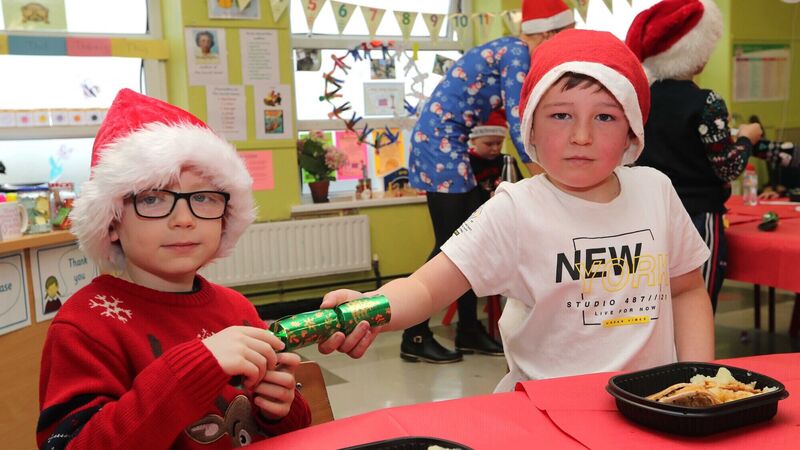
James O'Keeffe and Reece Kearney Fitzgerald at Scoil Iosagain's Annual Christmas Dinner in Farranree, Cork. Photo: Jim Coughlan.
As we draw to the end of what can only be described as a surreal experience for school leaders, Covid-19 continues to loom large. In March, this pandemic unceremoniously changed the reality of school leadership.
At the best of times, the role of school principal is not an easy one. Many advertised positions clearly have no stampede of enthused candidates competing to take the job. Principals would say that the current workload makes the job almost impossible.
One could work around the clock and still not manage the demands on a school leaders’ time. Already a very busy role, it now also requires the need for principals to become custodians of personal protective equipment and sanitizers, of social distancing and building ventilation (yes all those open windows and doors, with children and teachers in chilly classrooms, clad in masks and jackets).
Principals have added new skill sets to their portfolio, now becoming contact tracers and lay public health experts as they work tirelessly to keep schools open.
A lot has been demanded of schools this year. There are good reasons as to why schools remain open during the pandemic.
Schools provide a safe environment for fostering resilience and exposure to public health messaging and health promotion, which are essential in times like these. Schools have been impressive in meeting the challenges.
Teachers and principals have been deeply vigilant in their care for students. Principals have also ensured that teachers are vigilant in their own self-care because they know very well that the biggest threat to schools remaining open has been staff availability.
Like others, teachers and principals are also making sacrifices in this pandemic with many teachers not able to visit their at-risk loved ones, such as elderly parents, while they are teaching in schools. As schools closed for the festive season, teachers were themselves paying for rapid Covid-19 tests in the hope that they would be able to meet their families over the holidays.
Perhaps the greatest challenge for school principals is the pressure they experience in trying to keep their communities safe when Covid-19 cases emerge in their schools. The application of the national guidelines to individual schools and communities is where the implementation becomes more complex.
Principals find themselves in difficult situations, grappling with public health decisions that they feel ill-equipped to make. While principals and boards of management are comfortable to make decisions relating to education, having to make a public health call is a completely different matter.
It is even more stressful with the significant pressure to keep the school open. It is obvious that recent decisions to close by boards of management of some schools were not made lightly.
These decisions are even harder to make when concern for the local community puts the school at odds with the national approach of ‘schools open at all costs.’ The pressure to protect children and their communities places school leaders in the quintessential “Catch 22” that they cannot win.
The types of moral dilemma they grapple with include questions like “what if I don’t close the school and transmission grows, or students or community members become dangerously ill, even die as a result? Is the school then negligent in not making the tough call to close the school?
Important letter of thanks & of advice from our Chief Medical Officer to parents & guardians of children in advance of Christmas. For the first time since the arrival of #Covid19, there are glimmers of hope ahead. But it is so important we hold firm in the coming days & weeks pic.twitter.com/ONTtj6FdN9
— Simon Harris TD (@SimonHarrisTD) December 17, 2020
What if I do close the school? Do I risk the imposition of a reversal of the decision and the implicit public reproach?” Either decision takes courage.
At least while schools remain open, parents can make the choice whether to send their children to school. The pressure of facing these questions and being the one to make these decisions is something that many of us would prefer never to have to deal with.
School leaders know that education must go on during this pandemic. If we have learned anything, we have at least learned that all of us in the community need to play our part.
While not front-line workers in the traditional health sense, principals and teachers like many others have continued to work in challenging situations, often in crowded and small classrooms to ensure continuity and care for the nation’s children.
It is easy to hurl from the ditch. It is one thing to have an opinion on what schools should do, it is quite another to be the person who carries the weight of protecting the wellbeing of so many people in the school every day.
It is a tough job, with an already unsustainable workload; the levels of stress, frustration, and anxiety for the wellbeing of those in their care have weighed heavily on them this year. School leaders have kept our schools as safe as could be hoped for up to now.
The third wave of this pandemic is already showing itself to be fast and virulent. Our schools and their leaders need our trust and support.
School leaders, now more than ever, need our gratitude, our confidence in them and our respect for their dedication in these disrupted times.
- Professor Patricia Mannix McNamara is Head of the School of Education at the University of Limerick.