US Elections: When green was more important than red, white and blue
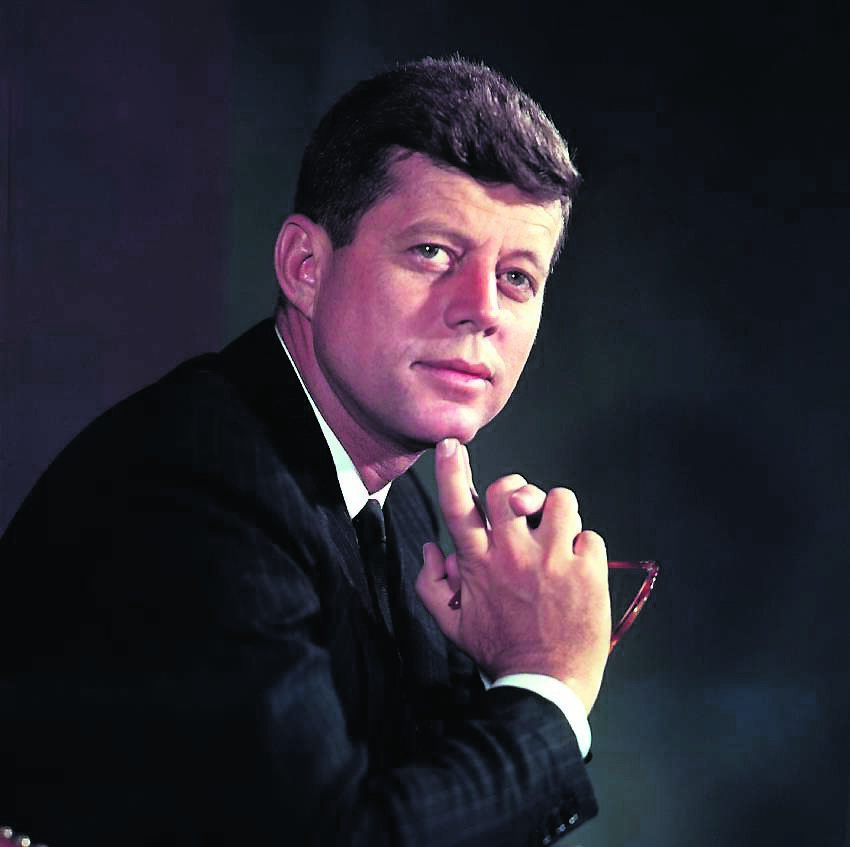
The late US President John F. Kennedy.
Names such as Al Smith, Jimmy Walker, and Samuel Burchard will mean little to all but the keenest observers of US political history.
Yet these names, now faded into public obscurity, have been pivotal in the volatile history of US presidential elections and political earthquakes.
Irish-Americans, whose influence has waned over the generations as new voting blocs became more coveted by would-be political leaders, were once a force to be reckoned with.
Without Irish-Americans — men like Stephen Grover Cleveland, Woodrow Wilson, Franklin Delano Roosevelt, and John Fitzgerald Kennedy — may not have earned the right to walk down Pennsylvania Avenue in Washington DC and into number 1600.
It may be difficult to imagine now, but New York and Illinois were once swing states, as opposed to the Democratic bastions they are today.
By and large, New York and Illinois were run by Democratic Party machines largely overseen by shrewd and plotting Irish-American Democrats, as were the police and fire departments.
If you wanted New York and Illinois in your column, you had to play ball with the men who ran them.
Therein lay a further problem for would-be candidates — how to tread a delicate line between courting Irish-American voters and keeping them sufficiently at bay so as not to upset cohorts such as white Anglo Saxon Protestants, or WASPs.
Get too close to Irish-American voters by bowing to their whims, and you could be accused of being an agent of Rome, or too friendly to Catholic influence.
Ignore them, and you could kiss the likes of New York, Illinois, Massachusetts, and Missouri goodbye.
Men like Grover Cleveland and Franklin Roosevelt knew how to play the game, Jack Kennedy had to call in favours from old friends to get over the line, and Woodrow Wilson found out the hard way that you ignore Irish America at your peril.
It was the moment that the 1884 general election turned on its head, and put a Democrat in the White House after 24 long years in the political wilderness.
Republican nominee James Blaine was on course to win the election for the Republican Party, continuing a run that had begun with Abraham Lincoln in 1861.
With the South in the pocket of Grover Cleveland, James Blaine was counting on New York, which would easily put him over the line with other Northern bastions of Republican politics since the Civil War just 20 years earlier.
The name of Samuel Burchard would go on to haunt Blaine for the rest of his life.
Just days out from the election, the Reverend Burchard spoke on Blaine’s behalf at a campaign event. It was supposed to be a warm-up for the main act.
Unbeknownst to Blaine, who was not even listening to Burchard’s speech as he was concentrating on perfecting his own remarks, the religious figure blasted Grover Cleveland’s Democrats.
“We are Republicans, and don’t propose to leave our party and identify ourselves with the party whose antecedents have been rum, Romanism, and rebellion,” he bellowed.
The remarks were ignored by reporters at the time, but a shrewd Democrat operative spotted an opening and made sure the remarks were amplified in the press in the days that followed.
The incendiary remarks enraged Irish-Americans, who saw it as an attack on their Catholic faith and supposed love of alcohol. The insinuation was that they were more loyal to the Pope than the US, a familiar anti-Irish trope and a religious dog whistle, similar to what Muslims in the US must contend with today when it comes to Islamic law.
Blaine’s campaign would not recover from the self-inflicted wound, with Irish-Americans turning to Cleveland in their droves, handing the critical swing state of New York to the Democrat, thereby putting him over the top in the electoral college numbers and launching him into the White House.
Cleveland won New York by fewer than 1,200 votes, with the Irish-American bloc seen by historians as the crucial factor, and Democrats were back in the White House after 24 long years.
Not many will remember the first Irish-American candidate for the presidency of the US.
But Al Smith was a New York political powerhouse, and he stood in the way of Franklin D Roosevelt in 1932.
He was the Democratic candidate for president in 1928, but his Catholic faith and Irish heritage meant he was anathema to an electorate suspicious of so-called Roman influence.
While Smith is not exactly an Irish name in the vein of Murphy or McCarthy, it should not have actually been his last name either.
His grandfather was an Italian immigrant on his father’s side who had changed his name from Ferraro, meaning “blacksmith” in his native tongue, to the more English-sounding Smith, when he arrived on American shores.
Never close to his father, Al Smith instead doted on his mother, whose people were Mulvihills from Moate in Co Westmeath. Al Smith embraced his Irish heritage rather than his Italian one.
His own Democratic strongholds of the South were mistrustful of his background, and Herbert Hoover would win in a landslide for the Republicans in 1928, carrying 40 states compared to Smith’s meagre eight.
However, the once hugely popular Governor of New York did galvanise an Irish-American voting bloc that Democrats would need in 1932 if his successor Franklin Roosevelt was to win the election.
The so-called ‘Happy Warrior’ was foe, then friend, then foe, then friend again to Roosevelt, who had to cajole and appease Smith repeatedly during and after their battle for the Democratic party nomination for the White House in the 1932 election.
Mayor of New York in 1932, the notoriously corrupt Irish-American Jimmy Walker, was an Al Smith ally.
Despite Smith being able to successfully fend off any whiff of corruption himself, his relationship with Walker was strong due to Walker’s embrace of social welfare programmes and his condemnation of the Ku Klux Klan.
Then governor of New York, Roosevelt was faced with a political dilemma as he worked for the Democratic nomination for president in 1932, where his main rival for the nod was Al Smith. Prosecute Walker, and Roosevelt would surrender thecould count the Irish-American votegoodbye in the State, and thereby the nomination.
Roosevelt’s presidential bid could fall to be president could be over at the first hurdle — and Al Smith and Jimmy Walker knew it.
If he did not prosecute, Roosevelt would have been ridiculed by the national press as weak on corruption and unworthy of the highest office in the land, if he secured the Democratic nomination.
In the book, Once Upon a Time in New York: Jimmy Walker, Franklin Roosevelt and the Last Great Battle of the Jazz Age, author Herbert Mitgang wrote: “Suddenly, Governor Roosevelt found himself facing down the kingmakers and corrupters within his own party in the city of New York. Would Roosevelt show that he was capable of independent behaviour — or would he cave in for political expediency?” Roosevelt would indeed prosecute, took on the knaves and thieves who had blighted the city’s politics, and went on to secure the Democratic nomination.
Smith would relent, and showed his loyalty —
albeit very reluctantly —
to the would-be president when he instructed his ally Walker to resign as mayor of New York, lest it become a thorn in Roosevelt’s side in his quest for the White House.
“Jim, you’re through. You must resign for the good for the party,” he Smith instructed Jimmy told Walker.
New York would go in the column of Roosevelt in the 1932 general election, and he won in a landslide over incumbent Herbert Hoover.
New York kingmaker Smith, by way of Westmeath, would be reborn after 1932 after a period of dark depression, and would leave an indelible mark on New York and US politics.
Jack Kennedy has long been the darling of the Irish-American voter, but he had to call in all the favours in 1960 when facing Republican nominee Richard Nixon.
Despite being young, handsome, and offering a new vision for America, JFK had an image problem for some voters — he was Catholic and he was Irish. Southern voters and White Anglo-Saxon Protestant (WASPs were mistrustful of any candidate who was not like them, and Kennedy had to persuade a population still clinging to old prejudices.
According to his presidential library, he faced the issue head-on during the nomination process for the Democratic ticket, long before the general election would be held where he would take on the Republican nominee.
Kennedy entered the West Virginia primary, a state in which Catholics constituted less than 4% of the electorate, and where polls had him behind by 20 points.
In a speech before the American Society of Newspaper Editors, he said: “Are we going to admit to the world that a Jew can be elected mayor of Dublin, a Protestant can be chosen foreign minister of France, a Muslim can be elected to the Israeli parliament — but a Catholic cannot be president of the United States? Are we going to admit to the world — worse still, are we going to admit to ourselves — that one-third of the American people is forever barred from the White House?”
Kennedy won the West Virginia Democratic primary by 93,000 to 61,000 and declared: “I think we have buried the religion issue once and for all.”
If that was truly his belief, he was naive to think so. Having secured the Democratic convention, he would subsequently face more hostility in the general election.
According to Kennedy’s presidential library, a group of 150 Protestant ministers met in Washington and declared that Kennedy could not remain independent of Catholic Church control unless he specifically repudiated its teachings.
He would face down these slurs by speaking at the Greater Houston Ministerial Association, winning acclaim for the response that appeased many sceptical voters.
However, he would require the political might of Chicago mayor and hugely influential Irish-American Richard Daley on election day, calling in favours to carry Illinois, a crucial state if JFK was to win the White House.
Daley would turn out the vote — how legally he did so is open to debate, even today — and Illinois would go in the JFK column.
Recent studies suggest JFK would have been elected without Illinois, and that the Daley factor was overblown, but the Kennedy campaign’s courting of the colourful Chicago mayor showed just how muscular the Irish-American machine could be.
His presidential library says: “Kennedy won the presidency in one of the closest elections in American history — by a margin of 118,000 votes out of 69m. There is solid evidence that religion helped Kennedy in several urban and industrial states but was, at the same time, a significant factor in his loss of Ohio, Kentucky, Florida, and Tennessee — and in his very close win in Texas.
“More than a half-century after his presidency, JFK remains the only Catholic to have held the highest office in the land.”
Irish-Americans waited in the long grass to punish Democrat Woodrow Wilson after the conclusion of the First World War, intent on withdrawing their loyalty to a man who they had hoped would be sympathetic to the question of Irish independence during his presidency.
With ancestors from Strabane, Co Tyrone, and passionate speeches decrying empires refusing to allow smaller nations to chart their own destinies through self-rule, Irish-Americans were hopeful when it came to Woodrow Wilson.
His first public utterances about Ireland in 1910, before his presidency, referred to self-governance for Ireland, free from British rule.
Yet Wilson refused to budge on the Irish question from 1912 to 1920, constantly skirting around the issue, lest he offend US allies in Britain.
Irish-Americans, horrified at events in Ireland leading up to 1916, put their displeasure on the back burner during that year’s election in favour of immediate pressing concerns at home, such as child labour and eight-hour working days.
In 1920, Irish America would turn on the man they had supported for the past eight years, rejecting his attempts at post-war international reconstruction, while helping usher in a new era of Republican domination.
Any small chance of an unprecedented third term for Woodrow Wilson was gone, as was the chance for a new Democrat candidate to continue his legacy during the 1920s.
Robert Schmuhl, Professor Emeritus of American Studies and Journalism the University of Notre Dame, whose expertise includes America’s role in the 1916 Easter Rising, wrote: “When the US Senate failed to ratify the Treaty of Versailles on November 19, 1919, President Woodrow Wilson suffered much more than the defeat of a major policy initiative he was instrumental in formulating.
“The Senate vote, the first time a peace treaty was ever rejected and primarily a consequence of idealistic obstinacy and Irish-American pressure, helped return the Republican Party to the dominant position in American politics, a place it occupied until Franklin D Roosevelt and the Democrats swept to victory in 1932.”

CONNECT WITH US TODAY



Be the first to know the latest news and updates