Dick Roche: So many factors still at play for candidates US election
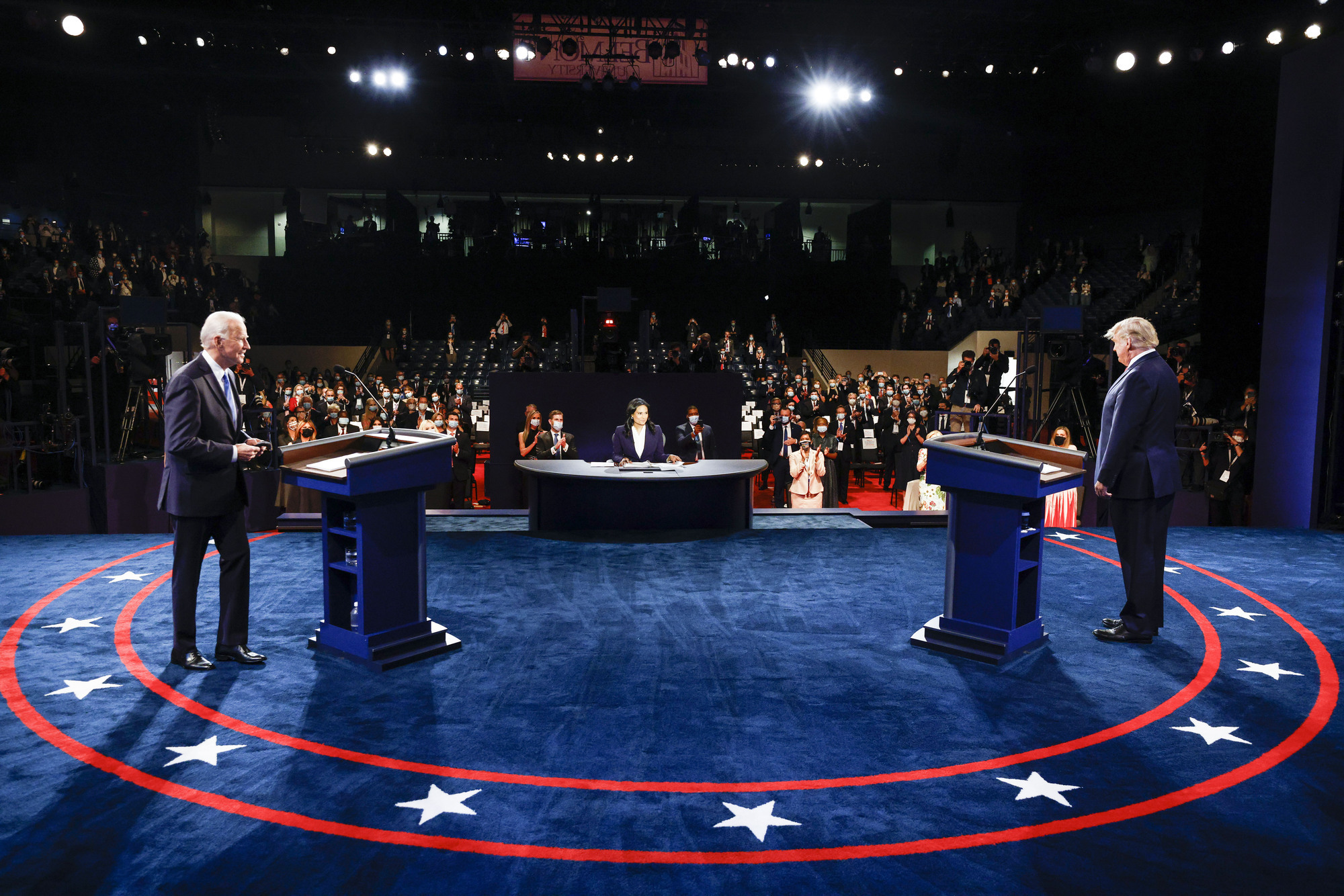
President Donald Trump and Democratic presidential candidate former Vice President Joe Biden participate in the final presidential debate last week. Picture: Jim Bourg/Pool via AP
When the final US presidential debate took place last Thursday, more than 50m Americans — one third of the expected turnout in the election — had already voted. The comparative figure at the same point in the 2016 presidential election was 5.9m votes cast.
A significant majority of early voters are registered Democrats. Republicans are expecting their voters to turn out on election day.
Results from opinion polls also look grim for Donald Trump. The RealClearPolitics (RCP) average over 11 polls taken between October 8-22 shows Joe Biden ahead by an average of 7.9 points.
Turning things around will be hard, but not impossible. At this point in the 2016 election, Hillary Clinton was averaging 7.1 points ahead. In the election itself, she won almost 3m more votes than Trump.
While US voters elect members of the US Congress, state governors, and a raft of other officeholders, they do not elect their president or vice president. Both offices are elected by 537 electors who form the US electoral college.
States are allocated votes in the college equal to the number of seats they have in the Senate and the House of Representatives. Washington DC has three votes.
All but two states allocate their electoral college votes on a ‘winner takes all’ basis. When the electoral college met in December 2016, Trump received 304 votes to Clinton’s 227. Seven college electors voted for neither candidates.
Winning 270 votes in the electoral college is the key willing the US presidency. Because the majority of states are either solid Democrat or solid Republican, possible swing states are the key battlegrounds.
Trump won in 2016 because of narrow victories in key swing states converted into an electoral college majority. Michigan, Wisconsin, and Pennsylvania, which he took by less than one point each, were critical. Winning those three states gave Trump 46 electoral-college votes and the keys to the White House.
As at October 22, the RealClearPolitics polling average (RCP average) puts Joe Biden ahead in all three states by 7.9, 4.6, and 5.1 points respectively. In five other key states — Georgia, Florida, North Carolina, Arizona, and Iowa — the RCP average shows Biden enjoying leads of between 0.8 and 2.4 points. In Ohio and Texas, Trump heads Biden by 0.6 and 4.0 points respectively.
Biden is ahead in states where Clinton had slim majorities in 2016 and is holding all traditional Democrat strongholds.
Turning things around will be a major challenge for Trump.
A number of factors tipped the US pollsters in the wrong direction in 2016.
Voters in the lower socio-economic levels turned out in higher numbers than expected, upsetting pollsters’ predictions.
'Shy Trumpers' — people who were unwilling to talk about their voting intentions for fear of being ridiculed — was another factor.
Hostility towards polling also played a part — people who are distrustful of media tend not to cooperate with pollsters, thereby throwing poll projections.
The latter two factors are, if anything, stronger than in 2016, and could be exaggerating Biden’s lead.
Another factor that caused difficulties in 2016 was the level of voter commitment. Post-election analysis showed that Clinton supporters stayed at home.
Where the balance lies between the enthusiasm Trump generates amongst his base and the loathing he generates elsewhere is hard to gauge. One thing looks certain — apathy is not an issue this year.
The biggest difference between 2020 and 2016 is the circumstances in which the election is being held. Almost 8.2m Covid-19 cases and 220,000 pandemic-related deaths have been recorded in the US by the middle of this month. The pandemic is a major campaign issue.
How the pandemic impacts on the electoral process, however, is a separate matter.
Vote-by-mail (VBM), which has been promoted as “the only safe way” to run an election during the pandemic, has been at the centre of a political brawl for the last 12 months.
Setting aside the arguments for and against VBM, the challenge of grafting a VBM system on to the complex and highly partisan US electoral framework, with its 8,000 individual electoral jurisdictions, different election law in every state, and where there is no central federal authority, is daunting.
The handful of US states that use all-mail elections have taken years to set up their systems. Attempting to achieve in months what has taken years elsewhere is fraught with risk, as demonstrated in the New York primaries earlier this year.
In-mail voting is significantly more complex than in-person voting. It involves more actions by the voter, requires detailed planning by election officials and third parties, and requires skilful administration. A lot can go wrong. As a result, there are more spoiled votes with VBM than with in-person voting.
In the 2016 US presidential elections, 23.7% of all votes were cast by mail. Almost 1%, or over 318,000, of those votes were rejected.
In the 2018 midterms, the rejection rate rose to over 1.42%, with over 430,000 votes not counted. National Public Radio calculated that over 558,000 VBM ballots were rejected across 29 states in this year’s primaries.
All the signs point to record turnout in this election. Changes made in the last few months will allow 75% of US voters to use VBM. Surveys taken earlier in the year suggest that up to 52% of all voters could use it.
If 45% of US voters use VBM and the rejection rate remains at the 2018 level, close on a million mail votes would be rejected. That would hurt the Democrats most because its supporters are more disposed to use VBM and because key cohorts of Democrat voters have been more likely to have their in-mail votes rejected because of voter error.
The factors that undermined Clinton’s polling advantage in 2016 still exist, and could be exaggerating Biden’s poll lead. How the pollsters factor high levels of lost votes into their work is not clear. Rejected VBM ballots could shave more points off Biden’s lead in key states, making the election closer than it seems.
If there is no clear-cut winner on election night, rejected VBM ballots will become a major issue.
In battleground states, every VBM ballot will be scrutinised and every error challenged, automatic recounts could be triggered in many states and multiple bitter court cases will follow.
As happened in 2000 when the election hung on 537 votes cast in Florida, the 2020 election could well end up in the US Supreme Court.
On this occasion, the number of votes in dispute could run into hundreds of thousands, opening the way for multiple challenges.
It would be the ultimate irony if vote by mail, which has been championed by the Democrats, becomes President Trump’s lifeline.

CONNECT WITH US TODAY



Be the first to know the latest news and updates