Cautious approach in Budget an indicator of underlying issues
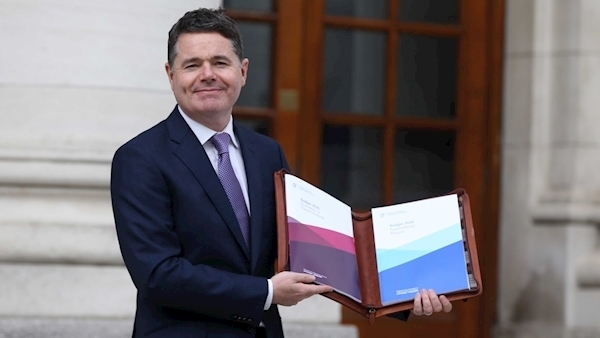
A huge national debt, as well as the twin threats of Brexit and a global slowdown, ensured Pascal Donohoe was never going to get involved in a giveaway, writes Neil Gibson

Cautious approach in Budget an indicator of underlying issues

A huge national debt, as well as the twin threats of Brexit and a global slowdown, ensured Pascal Donohoe was never going to get involved in a giveaway, writes Neil Gibson

To many, Budget 2020 was a bit dull. A cautious and restrained budget may seem at odds with an economy that is more than 50% larger in GNP terms than it was five years ago and is one of the world’s fastest-growing developed economies.

That said, its tone won’t have been a major surprise. As expected, Finance Minister Pascal Donohoe pointed to the twin threats of a global slowdown and Brexit as reasons to avoid any large-scale giveaways.

Budget 2020 is proof that a booming economy no longer guarantees an upbeat and self-congratulatory budget. Minister Donohoe correctly pointed to the risks facing the economy and the fact that even after five years of impressive growth, the economy is only just breaking even and in itself is worrying.

Looking at the infrastructure and public policy needs and the challenge of tackling climate change, it is reasonable to surmise that the era of widespread tax cuts and giveaways is gone for good. And speaking as an economist, that’s probably no bad thing.

Most economists would approve of restraint at the peak of the cycle, but of course economists don’t have to get elected. The sobering reality is that despite all of Ireland’s well-documented growth, it is just about able to balance the books, and with a net debt of close to €180bn there is very little capacity to deal with future slowdowns.

If Ireland can’t pay off debt at the peak of the cycle, that tells us something about its economic foundations that we shouldn’t ignore.

Public expenditure has risen strongly in line with revenue — what comes in goes out and that’s despite the messages of restraint and welfare savings as more people are back at work.

A growing population, the legacy of underinvestment in infrastructure, well-documented shortfalls in health spending and a growing recognition of education’s relative spending deficit has reduced the minister’s ability to limit his adherence to so-called ‘counter-cyclical’ economic policy.

Counter-cyclical policy essentially suggests that governments should spend more when consumers and businesses are not, i.e. in a time of slow growth, and spend less when the economy is growing rapidly. Not an easy sell for a politician.

Tax increases, especially in a booming economy, are always a tough call. The linking of tax to beneficial spending plans is becoming more common.

The ring-fencing of carbon tax receipts for spending on climate change measures was a really good example of this. This is often easier for individuals to accept and tougher for businesses to argue with, but it does run the risk of creating a very fragmented tax and expenditure system. It can also reduce the flexibility needed for an economy to adjust to unforeseen circumstances which is dangerous ground.

The harsh reality is that more tax will be required in the event of another slow-down which many are predicting. Cuts in what we currently spend is another lever Government has at its disposal.

Neither will be popular as we learned during the last economic downturn. All of this is before we get to tackling the climate change and the emissions crisis in a meaningful way.

So maybe the cautious and restrained tone of the Budget makes a lot of sense for a lot of different reasons. Giveaways will not be the reward for Ireland’s success and we should all probably try to get used to that.

When the dust settles after a budget the analysis often focusses on the individual. Who is better or worse off and by how much?

Understandable, but there is growing recognition that money is not the only barometer of success. What of our healthcare, housing and education systems, our safety and increasingly, what of the health of our planet?

We are all being asked to think in a less inward way, to look at the bigger picture, the community and world around us. With that in mind it makes sense to see an escalation in carbon taxation and an investment in improving public service quality, even if it means individuals will not have more money in their wallets at the end of the week.

That’s not an easy transition but it’s the right move for us all to start tackling what the Minister himself called “the defining challenge of our generation” — climate change.

Still, for the next few months and much beyond realistically, we will all be bracing for Brexit impact and the focus of Government will remain squarely on that challenge.

Budget 2020 was a clear indication that in spite of the country’s positive economic position, the budgets of old, punctuated by tax cuts and giveaways, have likely been left in the history books, in favour of a more modest and cautionary approach with risk mitigation at its core.

Given the times we are in, it’s hard to argue with that approach.

- Neil Gibson is chief economist with Ernst & Young

More in this section

Revoiced

Newsletter

Sign up to the best reads of the week from irishexaminer.com selected just for you.

Cookie Policy Privacy Policy Brand Safety FAQ Help Contact Us Terms and Conditions

© Examiner Echo Group Limited