A perfect storm of problems is brewing
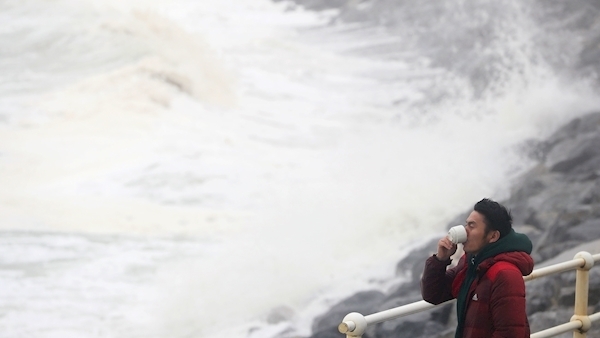
Since Ireland’s record wet summer of 2009, the country has had a major weather event every eight months, from extreme cold to heatwaves. Expect more, says
Despite Hurricane Lorenzo’s limited impact on Ireland — there was flooding in Donegal — the tail-ends of hurricanes are reaching Ireland more frequently.
In the last three years, Hurricane Ophelia, a category 3 hurricane and a record north and east in the Atlantic, struck Ireland, causing loss of life and considerable damage. It followed a very unusual path, in that it did not head across the Atlantic, as most hurricanes and tropical storms do, but turned northwards, towards Ireland and north-west Europe.
In 2018, Hurricane Helena, a category 2 hurricane, followed roughly the same path, but had mostly dissipated by the time it reached Ireland and was barely noticed.
And in 2019, Hurricane Lorenzo, a category 5, set a new record, being so far north and east. Again, it followed roughly the same path towards Ireland and, again, had mostly dissipated before it reached us.
The suggested reason for this change is increasing sea surface temperatures near the Equator, spreading further northwards than usual. The high sea surface temperatures drive the formation of hurricanes and the paths that they follow. To put the recent three events in perspective, and especially Ophelia, the previous hurricanes that caused fatalities and significant damage were ‘Debbie’, in 1961, and ‘Charley’, in 1986.
This recent sequence of hurricanes hitting Ireland seems to be part of a trend of extreme weather that started with the record wet summer of 2009. Since that summer, Ireland has experienced every type of weather disaster applicable to our climate and has had a significant weather event, on average, every eight and a half months.

There has been extensive river, estuarine and coastal flooding, extensive coastal erosion, extreme cold spells, a heatwave and drought, major storms, and even weather-induced fodder crises.
No part of the country has been spared. It is impossible to entirely estimate the cost, but €2.5bn to €3bn would not be unrealistic. This figure is based on insurance costs, non-insured costs, loss of production, and others.
New records have been set. 2009 produced the highest rainfall total for a summer, beating the previous record, which went back to 1892, by 160mm. That was recorded at Valentia Observatory.
That is astonishing: typically, weather and climate records are broken by small margins, not by huge leaps. 2009 produced not just the wettest November on record, at many meteorological stations around Ireland, but the wettest month ever recorded. This is true of Valentia Observatory, going back to 1866, and the meteorological station in Galway, going back to 1881.
Record low temperatures were set in November and December 2010, one of the main contributing factors being the loss of Arctic sea-ice, which made it easier for extreme cold air to escape southwards. The sea-ice is being lost because of rising air and ocean temperatures.
More recently, Ireland came very close to breaking the all-time high temperature record, in the summer of 2018, and it is only a question of time before it does.
Now, there is an increasing threat from ex-hurricanes in the north-east Atlantic, which are breaking all previous records, in terms of strength and location.
No period since at least 1900 is comparable to the dramatic sequence of weather disasters that has affected Ireland since 2009.
This tells us quite clearly that climate change is here and has been for some time.
The recent ‘Intergovernmental Panel on Climate Change’ report (September 2019) makes it very explicit how much of the climate is changing due to human causes.
Carbon dioxide levels will exceed 410 parts per million by the end of 2019, as more and more carbon dioxide is pumped into the atmosphere, with no sign of a global downturn in output of either this or the two other main greenhouse gases.
This report focusses on two aspects of direct concern for Ireland. The first is the escalation in the rate of sea-level rise, particularly over the last half-decade.
This has been driven by increasing loss of ice in both Greenland and Antarctica.
In the latter case, annual ice loss has accelerated six-fold, from 40 billion tons per year in 1979-1990 to 252 billion tons per year in 2009-2017.
Fortunately, these figures represent only a tiny fraction of the overall ice mass in Antarctica. However, these changes to the major ice masses on the planet, and the ongoing loss of glacier ice from many locations around the globe, have led to a revision upwards in likely sea-level rise this century, with the maximum value rising from 0.98m to 1.1m. For the 20th century, global average sea-level rose by around 0.15m and this new high value would be on top of that.
This 1.1m sea level rise would have very significant implications for Ireland.
Firstly, most of the major cities and towns in Ireland are either on the coast or on estuaries. Many already have flood problems and considerable flood vulnerability. This vulnerability will increase as the century progresses, unless significant flood protection works are put in place, at a huge cost to the exchequer.
This does not include most of the coastline of Ireland. In areas that are low-lying and made up of unconsolidated rock and sand, where erosion is ongoing, this rate of erosion could increase significantly. Here, the only option will be strategic retreat.
The second aspect is concerned with global storminess, in particular the hurricane, typhoon, and tropical cyclone component (these are the same type of event, but just have different names in different parts of the world) and other extreme weather events that have increasingly become a component of the world’s weather system.
Ireland’s recent experience of extreme weather events, and major hurricanes and exceptionally stormy winters, is not unique.
So the budget should be an opportunity to push Ireland towards a more sustainable future. The approach should be to incentivise people, through grants and support, to change to a more sustainable lifestyle, not to penalise through taxes.
This requires a huge change in the minds of politicians in their approach to increased sustainability. As it stands, Ireland won’t meet its international commitments towards greenhouse gas reductions, as we have been unable to decouple economic growth from greenhouse gas growth.
In addition, of course, each individual must try and do the best they can, as Ireland, with a population of five million, produces the same amount of greenhouse gases as the poorest 400m people in the world.