Bolton was odd choice for foreign policy team
The sacking of Trump’s national security advisor removes one obstacle in the way of the president making a new deal with Iran. However, many more remain, writes
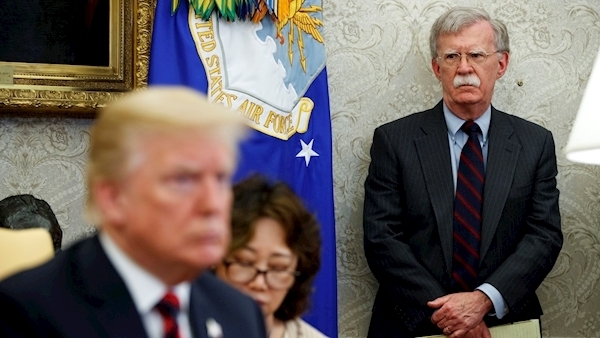
John Bolton was always an odd fit to be US president Donald Trump’s national security adviser: a conservative hawk who advocated for regime change in North Korea and Iran, supported the Iraq war and favoured a tough stance toward Russia.
The mustachioed hard-liner’s efforts to add bite to the bark of US foreign policy met stiff resistance from a White House leery of foreign entanglements and came to an abrupt halt on Tuesday when Trump announced he had fired him.
Trump said he and others in the administration had disagreed strongly with many of Bolton’s suggestions.
But Bolton, 70, can lay claim to one clear victory during his tenure.
Hanging on a wall in his West Wing office was a memento of that achievement: a framed copy of Trump’s order last year to pull the United States out of the 2015 international nuclear deal with Iran.
Right next to it hung a cartoon mocking the agreement, which was designed to make it more difficult for Iran to develop a nuclear bomb in exchange for international sanctions relief.
The Trump administration said the accord secured by President Barack Obama and other world powers did not go far enough in curtailing Iran’s activities.
Bolton’s choice of decor reflected his disdain for the deal and his relentless focus on trying to isolate Tehran and cripple its economy by reimposing tight sanctions.
Bolton became national security adviser on April 9, 2018 and the next month Trump abandoned the Iran deal, meeting a promise he had made as a presidential candidate, which other wary West Wing advisers had persuaded him to put off.
Bolton changed that dynamic quickly. In an interview with Reuters last year, he said he reassured Trump that his instincts were right and that he could ignore the pleas and warnings of moderates and European allies to stay in the deal.
“It’s not the end of the world,” Bolton said he told Trump in arguing for withdrawal from the pact. “The Western alliance is not going to fall apart.”
Bolton was widely believed to have favoured a planned US air strike on Iran earlier this year in retaliation for the downing of a US surveillance drone, an action that Trump called off at the last minute.
He argued for driving Iranian oil exports to zero and against Trump’s desire to meet Iranian President Hassan Rouhani.
“Bolton has been ‘Dr. No’ when it comes to talks with Iran,” Cliff Kupchan, a former US State Department official now at the Eurasia Group political risk consultancy, wrote in an analysis.
While Iran’s Supreme Leader Ayatollah Ali Khamenei probably would not allow a meeting at this month’s UN General Assembly, Kupchan said: “There’s upward pressure on the chance of a meeting. If it does happen, we’d see more downward umph on the oil price.”
US oil prices fell more than 1% on the news of Bolton’s departure, with investors betting that it increased the odds of the United States easing sanctions on Iran and reduced the odds of any possible US military strike.
With Bolton’s support, Trump abandoned the 2015 multilateral agreement under which Iran agreed to limit its nuclear program in return for the easing of economic sanctions.
Trump has since restored US sanctions and moved in May to try to cut Iran’s oil exports, historically its main source of foreign exchange and government revenues, to zero.
Trump argued the 2015 agreement did not do enough to keep Iran from obtaining a nuclear weapon and he criticised it for failing to address Iran’s ballistic missile program and support for regional proxies.
Iran says its nuclear program is only for peaceful purposes, such as power generation, and not to make bombs.
At a briefing, Treasury Secretary Steven Mnuchin said he, Trump and Secretary of State Mike Pompeo were “completely aligned on our maximum pressure campaign.”
Administration officials believe pressure will eventually force Iran to yield to their demands for, among other things, much more intrusive inspections of nuclear sites.
Asked at the same briefing if he could foresee a Trump-Rouhani meeting this month, Pompeo replied: “Sure.”
“The president has made very clear that he is prepared to meet with no preconditions,” Pompeo added.
A former senior Trump administration official described Pompeo and Mnuchin as “softer” on Iran than Bolton and said that meant there was a chance for a Rouhani meeting if the Iranians dropped their demand for a full lifting of sanctions first.
Other current and former US officials said there had never been much doubt that a meeting, at least from Trump’s point of view, was conceivable but that the odds of either side being willing to compromise were low.
The problem has never been imagining talks between the two sides,” said Phil Gordon, a former Obama State Department and White House official, saying Trump had shown through his talks with North Korea that he “loves to be at the centre of things.
“The problem, instead, is envisaging a deal that both sides could actually agree to. It is hard to see the Iranians accepting current US conditions, which include ending uranium enrichment forever, even more intrusive inspections, constraints on ballistic missiles and a complete change in Iran’s regional policy,” he added.
“So to get a deal, Trump would have to significantly lower the bar, which would be hard to sell domestically and in the region,” Gordon said.
“Bolton’s departure may remove one obstacle to that, but there are plenty still in the way.”
In Washington’s community of foreign policy veterans, Bolton has been a super-hawk for decades, whether as a tough-talking US ambassador to the United Nations under President George W. Bush or as a prominent analyst on Fox News.
Critics call him an ideologue and a warmonger who retaliates against dissenting views, while allies say he is an intellectual and a shrewd operator committed to ensuring the supremacy of US power.
Over the years, Bolton has advocated for regime change in a number of countries, including North Korea, opposed direct negotiations with both and said the United States should stage pre-emptive attacks against their nuclear facilities.
He played a central role in the hardening of US policy toward Venezuela’s socialist government over the past year, pushing other countries to help speed up a transition of power in the South American nation.
Bolton did appear to soften some of his bellicose positions, at least in public, after becoming national security adviser, saying he was happy to follow the president’s lead.
That kept him temporarily in good graces with Trump, who has made improved ties with both North Korea and Russia a centrepiece of his foreign policy, and who does not like being overshadowed by his staff.
While Trump has spoken admiringly of Vladimir Putin, Bolton never did that, and accused the Russian president of lying about Moscow’s involvement in the 2016 US presidential election campaign.
Bolton opposed easing of a wide range of sanctions on Russia and was instrumental in Trump’s decision to withdraw last month from a 1987 accord that banned intermediate-range missiles because of what Washington charged was Moscow’s deployment of prohibited nuclear-capable cruise missiles, an allegation Russia denied.
John Bolton was always an odd fit to be US president Donald Trump’s national security adviser: a conservative hawk who advocated for regime change in North Korea and Iran, supported the Iraq war and favoured a tough stance toward Russia.
CONNECT WITH US TODAY



Be the first to know the latest news and updates