Time to vote gender bias out of Constitution
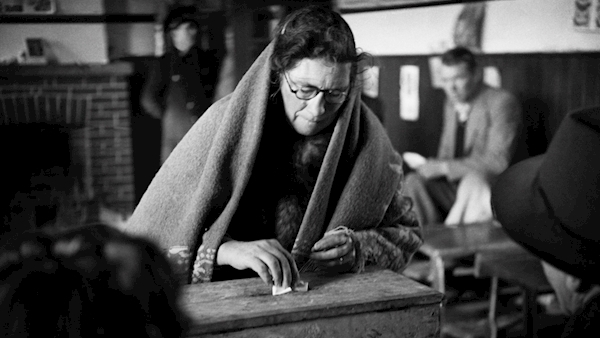
With a referendum on Article 41.2, says the Government and public can continue to address gender inequality and the issues associated with it head on.
With the recent Justice and Equality Committee discussion on the referendum on Article 41.2, we have a moment to reflect further upon the article’s origins and the society that produced it.
It is important to understand our past in order to fully appreciate why we must continue to press for this crucial referendum.
Written in 1937, Article 41.2 is seen by many as sexist and outdated. It declares that “the State recognises that by her life within the home, woman gives to the State a support without which the common good cannot be achieved” and “the State shall, therefore, endeavour to ensure that mothers shall not be obliged by economic necessity to engage in labour to the neglect of their duties in the home”.
This idea was sexist and marginalising at the time, and its presence in the Constitution is unacceptable now. A referendum is essential to further address issues of gender inequality within the State.
In order to understand how such a gendered view of women could be written into the Constitution we need to examine the society in which the Constitution was produced.
It is important to keep in mind that many people, men and women alike, in 1937 Ireland held these values extolled by Article 41.2 that women were the carers of the home and should not be compelled to seek work elsewhere.
For example, historian Caitriona Clear’s important work on women and household work highlights the importance with which women saw their role and work within in the home. The work of Caitriona Beaumont, Linda Connolly, Maryann Valiulis, Margaret Ward, amongst others, has demonstrated that women did object to the article at the time of its writing, too.
Even when women gained the right to vote in 1918, many politicians embedded women’s gender in their newly acquired citizenship rights, just as 41.2 would do in 1937.
This was not solely an Irish phenomenon, too. A speech by British prime minister David Lloyd George encapsulates this gender bias, as he told a women’s meeting in December 1918 that their participation in the national election was crucial to the welfare of their gender and the family:
It was fortunate for women... that they had a vote at this election. No election ever held was so charged with the fate of women as this election. The health and lives of their children would be decided at it. Their own health and lives, and the whole status in life of the womanhood of this country would be decided
These comments demonstrate that many of the societal expectations of women did not immediately change with increased political rights.
In the United States, Canada, England and Wales, and across the border in Northern Ireland, it was a cultural tradition that women were homemakers and did not hold a job outside marriage. Therefore, while Ireland was the only State to codify such an ideal in its constitution, such a paternalistic gendered belief was not exceptional to this jurisdiction.
In a 1937 election speech in Kildare, de Valera extolled this gendered ideal’s inclusion in the Constitution: “Everyone knows that there is very little chance of having a home in the real sense if there is no woman in it; the woman is really the home-maker...
The duties of the woman performed, of looking after the children and educating them, is work of fundamental importance to the State
Such comments shed light on the societal expectations of women which understood their work in the home as for the welfare of their children. Therefore, Article 41.2 was set up to protect women in the home, but in practice it was to ensure she completed her motherly “duties”.
With the conflation of mother and woman directly in the Constitution of the State, this stereotype became legislatively protected.
State consideration for women’s welfare only went as far as her needs as a married mother. For instance, state widows’ pensions introduced in the 1930s provided enough means for a widowed mother to maintain her child in their home rather than looking for work outside the house.
However, once the children reached age 14 or 16 all government support to the widow was withdrawn. With no more child dependents, the widow was compelled to find her own source of income.
In many cases this job hunt was likely after years away from working outside the home due to the societal convention that a woman cease outside work once married.
An applicant decades out of work would not be very appealing to an employer. Therefore, this constitutional protection of the mother in the home did not allow for complexities of difficult life in 20th-century Ireland, ignoring those who did not fit the mould of the nuclear family.

Orla O’Connor of the National Women’s Council of Ireland noted that the referendum raises issues relating to the failure of previous governments to address significant welfare issues such as inadequate access to childcare and the lack of support to families, particularly low-income families and single mothers and fathers.
Gender inequality informs many of these issues, particularly relating to pay, maternity/paternity leave, and familial care. With a referendum on Article 41.2, the Government and the public can continue to address these issues head on.
Following a year in which the Irish people voted to remove constitutional constraints on female bodily autonomy and we are celebrating the centenary of women gaining the vote, it is time to address these challenges.