Another Irish solution to an Irish problem bites the dust
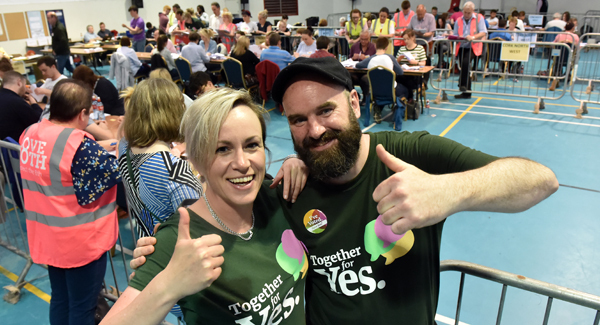
THE Socialist Feminist Movement was quick out of the blocks. By midday on Saturday, they had a table erected outside City Hall, just in front of Dublin Castle, where the referendum result would be declared.
Leaflets had been printed, presumably since the emphatic exit polls on Friday night. “Yes! We Made History,” the headline read.
“Today we celebrate a seminal and immense victory and do so in solidarity with feminist and LGBTQ movements around the world.”
Volunteers buzzed around the area, all smiles and bright T-shirts. There was hay to be made on the progressive sentiment. Now that women had been set free, it was time to round them up and recruit them to the socialist standard.
As with any success, the repeal vote on the Eighth had many parents. Down the road from Dublin Castle on Parliament St, Voices 4 Choice were stopping traffic.
A troupe of women of all ages were doing their thing, adapting the lyrics of popular songs to the struggle for repeal. Tracy Chapman’s ‘Talkin’ Bout A Revolution’ was sung as ‘Talkin’ Bout A Referendum’.
Journey’s ‘Don’t Stop Believing’ had been adapted for the campaign as ‘Don’t’ Stop Repealing’. And on it went, this creative element to a campaign that culminated with transformative change last Friday.
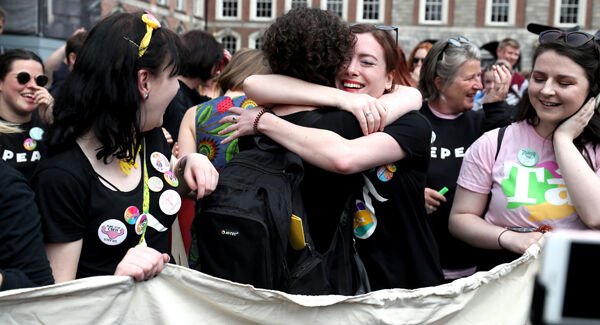
Throughout the day, they poured into the upper yard in the castle to await the result. A succession of arrivals was greeted with cheers, but none more so that that for Ailbhe Smyth.
She has been a tireless advocate for women’s rights over the last four decades, and apart from her leading role in the Together For Yes campaign, she was symbolic of a whole generation of women who had for most of their adult lives been left to believe that their rights were secondary.
Leo Varadkar had last week told his parliamentary party that he didn’t want to see any celebrating when the expected positive result came in.
But there was no stopping the celebrations from those who had been campaigning for months, years, and even decades for this result.
They began drifting into the upper courtyard in Dublin Castle as the first results from constituencies also came through.
By mid-afternoon, a procession of politicians had made their way up to have their deepest thoughts dissected by Miriam O’Callaghan up on the RTÉ gantry.
There were faint echoes of the count for the Marriage Equality referendum three years ago. Here was another example of a changing Ireland, where compassion is elevated, the old, discredited concept of respectability shown the door.
Just as those of a minority sexual orientation had long been discriminated against, so also had women suffered in a regime that valued public probity above private pain.
This was a good day for a whole host of constituencies in society. Some of those celebrating had fought for years for a woman’s right to choose. It was a matter of bodily autonomy above all else.
There were also those who voted yes with some reservations. For this constituency, there are issues around when life begins, what the future holds if there is widespread access to termination, whether a change in the law will alter values in society. Such matters are real concerns for people.
However, the result infers that having considered all these matters, this constituency still decided voting yes was a route that would ensure less, rather than more, pain.
While some in Dublin Castle expressed jubilation at the outcome, others merely experienced relief. At last the country’s laws and politics was catching up with the people.
What really distinguished the vote on Saturday was the final acceptance that Irish solutions to Irish problems no longer work, and have no role in a country trying hard to be grown up.
The Eighth was a classic Irish solution to an Irish problem. Abortion was banned in the constitution, but available for the price of a Ryanair flight. In recent years, the availability has been just a click away with online access a pill.
As such, abortion wasn’t banned, just removed from the State’s front window. Ireland was abortion-free, even if its people weren’t.
That this con job was perpetrated by using the Constitution was an act of gross cynicism. The document is held up as a repository of fundamental civil and human rights, yet there was nothing universal in the ban as per the Eighth Amendment.
The ban applied only to those without the resources or education to find a solution to an unwanted pregnancy, rape, or fatal foetal abnormality.
This was the last of three Irish solutions to Irish problems that defined the law’s failure to keep up with a changing society over the last 50 years.
The ban on contraceptives was addressed in the 1970s with an Irish solution to an Irish problem restricting sale to married couples.
And, right up to the introduction of divorce 20 years later, legal separation was used as a means of facing up to the inevitability of failed relationships.
Now the country has finally faced up to the reality that the law is not an instrument by which to control human behaviour in a manner designed to reflect some notion of a society that never existed in the real, messy world.

CONNECT WITH US TODAY



Be the first to know the latest news and updates