What do families who have already scattered ashes of loved ones do now?
WHAT are we to do now, the families of the faithful who have already scattered our loved ones’ ashes? Can we assume that the new Vatican ban on the practice won’t be applied retrospectively?
Can we also ask if the Catholic Church is bent on alienating us, the relatives of the 1,300 people cremated in Ireland annually?
About 50% of all people who die in Ireland are cremated and, of those, about a quarter choose to bring the ashes home, or to scatter them.
Not all of those people are practising Catholics and many may simply choose to ignore the new guidelines issued by the Congregation for the Doctrine of the Faith and approved by Pope Francis. But for the observant, it is now against Church regulations to scatter the ashes of our departed relatives in the air, on land, at sea, or in some other way.
The measure is designed to counter so-called New Age ideas that death is a “fusion” with Mother Nature, or the “definitive liberation” from the prison of the body.
The new rules also consider it non-Christian to preserve ashes or bone fragments “in mementos, pieces of jewellery or other objects”.
That last instruction is, let’s say, interesting when you consider the bone fragments of saints that have, for centuries, been preserved “in mementos, pieces of jewellery or other objects” in lavishly made Church- approved reliquaries. You can visit them in the treasury houses of the bigger Catholic churches and cathedrals all around the world.
I love visiting those wonderful repositories, packed, as they are, with rings, chasubles, copes, beautifully illuminated books, crosses, crucifixes and breath-taking reliquaries. They offer a tantalising peep into the past.
They also show the deep human need for ritual in life but, more importantly, in death.
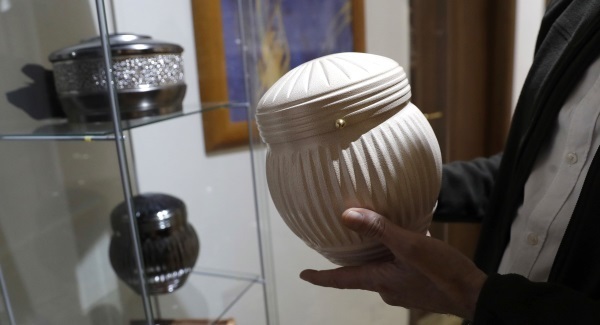
Of course, the key difference between the Church’s collection of mementos and those held by its grieving faithful is that the former are held in a sacred place. That is one of the central concerns behind the latest Vatican document — it insists that ashes should be kept only in sacred places, such as cemeteries.
In truth, the Catholic Church never fully endorsed cremation. It reluctantly allowed it as recently as 1963, so it is not entirely surprising to hear the Church say now that burial is the most “fitting way to express faith”.
I won’t be alone in feeling a deep sense of betrayal in that understandable U-turn. I say “understandable” because this measure is all about exercising more control and we have come to expect that from the Catholic hierarchy.
Though, it has to be said the softening of the rules on eulogies at funerals some years ago was a heartening step. In fact, only last week, at the funeral of a dear friend’s mother it struck me that Catholic funerals were one of the few truly inclusive Church occasions.
There is something genuinely comforting about allowing family members stand on the altar to recall their loved ones in those moving self-penned prayers and eulogies that are often delivered in quavering voices.
It is to the credit of Irish clergy that they allow a little of the profane to be included at the edges of their sacred rites. Allowing those family tributes has neither diluted the funeral liturgy, as was feared, nor turned religious ceremonies into some sort of a This is Your Life show. If anything, it has heightened the integrity of the sacrament and made it more meaningful to relatives and friends.
Thanks, too, to those understanding priests who bend the rules on hymns and music. My wonderful Auntie Mary went out to the strains of the Preservation Hall Jazz Band, a nod to her love of jazz and her visit to New Orleans.
But now? What about those committed Catholics who have passed on believing that the ashes of their living spouses would be scattered as theirs were, in some favoured beauty spot?
Or those deeply Christian people, now departed, who would be rocked to their core to discover that they had contravened some Church regulation?
Of course, they could not possibly know that the Church would move the goal posts, yet it is still not clear if the guidelines are retroactive or not. Worse, there is no explicit instruction on what Catholics should do if they scattered their loved ones’ ashes in a practice now deemed improper.
In the ten years since we, as a family, scattered my father’s ashes, it comforts me to think that he got the dignified funeral that he had wished for. He was a committed Catholic but more than that, he was a truly Christian man in the broadest possible sense. One of the balms during his illness were the regular visits from local priests. They, too, were Christian in the broadest sense — those kind, generous, men helped us navigate some sort of a path through those final bewildering months.
There were lots of bewildering moments in death, too. I remember calling to Glasnevin Cemetery to pick up the urn containing my beloved father’s ashes and wondering what to do with it; I couldn’t, in all conscience, put him in the boot, so I strapped him into the back seat as we drove to our native Kerry. I am almost afraid now to say exactly how we dispensed with those ashes, but I can say that, to us, it was sacred and fitting and solemn.
The Catholic hierarchy has already alienated so many with its indifference to the child abuse scandals and its continuing refusal to include women, to mention the most damaging examples. Many, however, are still happy to dance around the fringes and join in during those important times in a Catholic’s life — baptism, Communion, Confirmation, marriage and death. But for how long?
The Catholic Church is not a democracy, of course. Still, I can’t help feeling these new guidelines will prompt even more people to vote with their feet.
CONNECT WITH US TODAY



Be the first to know the latest news and updates