President may play key role in choosing next taoiseach
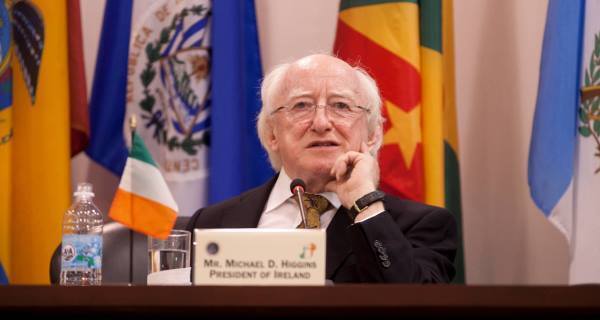
President Higgins can help create the conditions whereby a Government could be cobbled together in some shape or fashion in the following weeks if he chooses to reject the dissolution of the Dáil. Juno McEnroe explains
President may play key role in choosing next taoiseach

When the 158 TDs in the 32nd Dáil meet next week, it will still likely be the case that there is no overall majority support in the chamber for a taoiseach. As with the overall election result, the balance of power hangs in the air and this will be reflected in a vote for the taoiseach, one of the first acts of a new parliament.

With a hung Dáil looming, there are questions over how the house will give majority support to a TD to be leader of the country. So what happens next if that support is not there?

What follows could be intense, drawn out negotiations between political parties, factions of TDs and negotiation teams, more than likely in discreet venues away from Leinster House.

If the Dáil fails to nominate a taoiseach, there is no deadline by which another vote must be tried again. The Dáil can be adjourned until another day. President Michael D Higgins though could play an important part if Enda Kenny fails to get the numbers and is then required to resign. He can then choose whether to seek a dissolution of the Dáil or not. Interestingly, there is precedent here where the Dáil has failed to nominate a taoiseach in the past.

If a taoiseach loses the support of a majority in the Dáil, he must resign, in which case other members of the Government are also deemed to have resigned. The taoiseach is not obliged to seek a dissolution at this point and an alternative taoiseach may be elected without a general election (as occurred in 1994 when John Bruton replaced Albert Reynolds).

If a taoiseach advises the President to dissolve the Dáil having lost the support of a majority, the President is given absolute discretion to refuse the dissolution. The purpose of this is to prevent an unnecessary election by allowing the opportunity for an alternative taoiseach to be elected (and perhaps impose some pressure on the parties to take this option). However, if the President does not perceive that the opportunity exists to avoid an election, he would, in practice, grant the dissolution.

However, if the President does not perceive that the opportunity exists to avoid an election, he would, in practice, grant the dissolution. The power has never been exercised, even though occasions have arisen where it might have been suitable.

University College Cork’s Conor O’Mahony explains: “If there is deadlock on the election of a Taoiseach after the Dáil re-convenes, Enda Kenny may seek a dissolution. However, since Mr Kenny would be deemed to have lost the support of a majority in the Dáil, President Higgins would be free to refuse the dissolution, so as to encourage the parties to exhaust all avenues for breaking the deadlock before proceeding to another election.

“A second election in such a short period of time is undesirable in many ways, and the President has the possibility of affording the parties every opportunity of avoiding it.

“On the other hand, if he sees no realistic way of avoiding it, he may feel it better to proceed to grant the dissolution. The Constitution grants him absolute discretion to make this decision as a neutral arbiter.”

In 1992, outgoing taoiseach Albert Reynolds, John Bruton, and Dick Spring were all proposed in turn as taoiseach. But none were nominated. On December 15, Albert Reynolds announced that he was resigning as taoiseach and that the President had accepted his resignation. Nonetheless, there was no dissolution of the Dáil. Instead, Dáil business continued in an “inter regnum” period up until January 12, 1993, when a taoiseach was finally proposed by the house and appointed.

Similarly, in 1989, the Dáil defeated all motions proposing individuals as taoiseach. This led to the outgoing taoiseach, Charles Haughey, proceeding to Áras an Uachtaráin and formally resigning from the post. But, again, the Dáil was not dissolved and Mr Haughey went on to be nominated taoiseach on another day.

The role of the President in these matters will only apply once the vote takes place, as is expected on March 10, and if the Taoiseach lost it and then sought a dissolution of the Dáil.

In summary, if Enda Kenny no longer enjoys the support of the Dáil, he will resign from office. He then can decide whether or not to seek the dissolution of the Dáil, which the President then has the discretion to accept or reject.

A rejection would allow parties and party leaders time and space to discuss avenues to form a Government.

In having this discretion, President Higgins in a sense can help create the conditions whereby a Government could be cobbled together in some shape or fashion in the following weeks.

It is important to note of course that a president’s power to dissolve a Dáil has never been exercised, even though occasions have arisen where it might have been suitable, including in 1989 when Charles Haughey sought an election rather than, at the time, go into coalition with the PDs.

Long drawn out negotiations between political parties are par for the course in hung parliaments in Europe at the moment. You can expect that advisers in the major parties are taking note of what has happened in Spain as well as Belgium among places.

Spain is still awaiting a government more than three months after it held its election.

Belgium had to wait 589 days in 2010-2011 for a government to be formed.

Ultimately, Mr Kenny will go to the Park whether he can form a coalition, a minority-government or if there is no government. With no new government, he could then continue with a ‘caretaker’ administration or seek the dissolution of the Dail.

If the latter option is decided, the President will decide the next move.

For more election news, analysis and general banter join us HERE

More in this section

Revoiced

Newsletter

Sign up to the best reads of the week from irishexaminer.com selected just for you.

Cookie Policy Privacy Policy Brand Safety FAQ Help Contact Us Terms and Conditions

© Examiner Echo Group Limited