Painful memories of quarrel with the foe on Remembrance Sunday
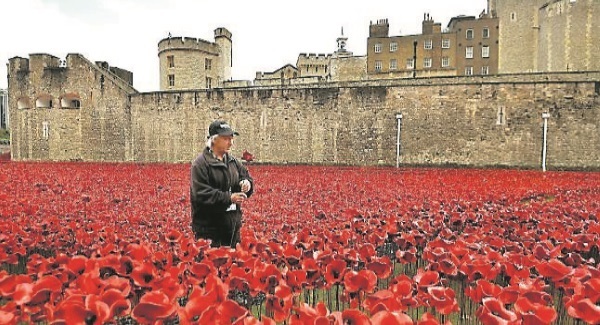
On the eve of Remembrance Sunday tomorrow British cities and towns are a sea of red as the flower, representing the blood sacrifice of two world wars and all the other conflicts of the past century, is everywhere.
Despite 50,000 Irishmen giving their lives in the First World War, and an unknown number volunteering to fight the Nazis in the Second World War, many Irish people feel unable to wear the flower for fear it will also honour British soldiers responsible for everything from the burning of Cork to Bloody Sunday and beyond.
In the immediate aftermath of the 1918 armistice, emotions were conflicted as poppy wars erupted on the Free State’s streets.
The survivors of the 1916 Easter Rising had been initially denounced and jeered by the crowds, despite the Royal Navy bombarding central Dublin, as the rebels were viewed as stabbing the backs of the Irish soldiers fighting in the trenches — fighting for Home Rule in the popular imagination.
The brutality of the British reaction to the Rising, the pace of the executions, and the emotionalised back stories of those who soon became viewed as martyrs recast the rebellion in public consciousness.
But more than 50,000 of the poppy emblems were still sold in Dublin alone in the mid-1920s, though holding on to them was a different matter as a wave of “poppy snatching” was unleashed by the sight of the little flowers.
Remembrance Day would illicit varying levels of unrest right up until the Emergency, when memories, and the generational feelings of grief for the war dead, began to fade.
And now, even in Britain, accusations of the unfortunately named ‘poppy fascism’ have emerged, with the English spirit of individuality breaking out against what some see as a form of enforced national emotional theatre.
Veteran lefty Channel Four News anchor Jon Snow refuses to wear a poppy as he sees it as a political symbol that would detract from his supposed neutrality.
Indeed, The Graham Norton Show was the centre of tabloid outrage this week because guest Sienna Miller — unlike the Corkonian host — appeared on screen without a poppy.
Miller was monstered by the right-wing press, who accused her of insulting the war dead.
Irish football player James McClean put out an eloquent response to similar criticism for refusing to join team mates in donning a poppy: “For me to wear a poppy would be as much a gesture of disrespect for the innocent people who lost their lives in the Troubles — and Bloody Sunday especially — as I have in the past been accused of disrespecting the victims of WWI and WWII. It would be seen as an act of disrespect to those people — to my people.”
It was certainly better put than UFC fighter Conor McGregor’s diatribe against people who attacked him on social media for wearing a poppy.
“I know where my allegiance lies and what I do for my country. I don’t need a stupid flower with 100 different meanings to tell me if I do or do not represent my country,” McGregor ranted.
“Check the facts of its original meaning. ALL soldiers. ALL wars.
“I have the blood of many nations on my gloves. Fought and beat on the world stage. You have a pint in your hand and a Celtic jersey on in your local. Fuck you and the Queen.”
McClean was also at the centre of controversy when he appeared to refuse to turn to face the English flag before a friendly he played with West Brom in the US.
While Derry-born McClean is entitled to his views, maybe if he feels that strongly about things he should not play in the English league where his views clearly offends many of the West Brom fans who hand over part of their wages to help pay his very generous salary?
The British do tradition well and there is a genuine respect and affection shown by the poppy culture as a quiet dignity reflects pride in the sacrifice of the two world wars, and a simmering anger at the casualties of more recent military adventurism in Iraq and Afghanistan.
The truth is that British poppy wearers do not think about what happened in Ireland because the British never think about what happened in Ireland.
At the annual display of remembrance at the Royal Albert Hall it is impossible not to be moved as thousands upon thousands of poppy petals descend from the heavens at the end of the minute’s silence.
But Britain also clings to the memories of the Second World War as a definition of its purpose and role in the world. Partly this is due to the sacrifice of that war, of holding out against fascism long enough for the US to turn the tide of the global conflict, which cost Britain 42% of its entire resources, more than any other anti-Hitler combatant apart from the Soviet Union which lost 46%, and suffered more than 20m fatalities.
The further Britain gets away from the world wars the more it wraps itself in those victories.
Poppy Day was a sedate affair in the 1980s and a minute’s silence was, well, unheard of.
Then the deeply unpopular Tory government of John Major politicised the 50th anniversary of the Second World War in 1995 and, since then, remembrance culture has taken on a life of its own, with a national minute’s silence held on at 11am on every November 11.
I once asked an employer if the silence was compulsory, only to be told: “No, it’s not compulsory, but you are expected to respect others by not speaking during it.”
The American and British Legions of veterans took up the poppy as a symbol after being inspired by a poem from Canadian soldier John McCrea, who wrote it after watching a good friend die in battle. The poem opens with the verses:
“We are the Dead. Short days ago/We lived, felt dawn, saw sunset glow/Loved and were loved, and now we lie/In Flanders fields.
“Take up our quarrel with the foe/To you from failing hands we throw /he torch; be yours to hold it high/If ye break faith with us who die/We shall not sleep, though poppies grow/In Flanders fields.”
The motto of Remembrance Sunday is ‘Never forget’, and it seems, that for very different reasons, Ireland never will.
Remembrance Sunday raises the question of what the symbol of the poppy means, and to whom, writes

CONNECT WITH US TODAY



Be the first to know the latest news and updates