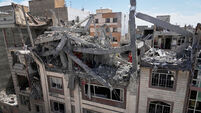
This is what a night in Ireland’s only homeless cafe is like
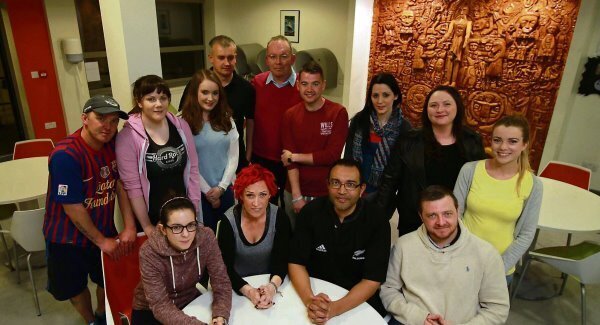
Some of the stars are out tonight. One middle-aged Irishman is, a little blearily, telling project worker Richard Williams that his name is Diego. Or more specifically, Diego Maradona. Diego may have had a few.
“Well, God bless you, buddy,” Richard responds as the man’s real identity is logged on to the computer at the Merchant’s Quay Ireland night cafe in Dublin city centre. The staff tend to know the clients; if they don’t, they set about getting to know them.
Located opposite the Four Courts on the banks of the Liffey, the MQI night cafe has, since it opened almost three months ago, become something of a go-to destination for hundreds of people who otherwise would have ended up sleeping on the streets.
Around 50 people a night stay here — and it doesn’t even have a bed.
The appeal is obvious. While during the day MQI is a well-known centre offering drug and alcohol treatment, its night cafe has become a safe haven and a last resort for many among Dublin’s homeless population.
Just having somewhere that trained staff can listen to your concerns, where you can get a cup of tea, some warm food, and a few hours’ sleep is a precious commodity.
The cafe opened on January 21 and in its first two months accommodated 812 individuals or 3,018 separate referrals.
According to the manager of the night cafe, Brenda Kane, there is little doubt as to where all those people would have been otherwise: “They would have been on the street,” she says. “That’s where they would have been.”
By 11pm the café is filling up with people who in many cases will have exhausted the freephone service operated by the Dublin Region Homeless Executive, and any other options open to them.
Many of the clients actively want to stay here. While Richard is chatting with Diego, Brenda is speaking with a knot of Polish men on the steps outside.
They’re trying to vouch for a new member of the group, a man named Dmitri, to see if he can come in. Between now and 2am or even later, more people might file in, even as the majority of clients will already have gone to sleep on the crash mats dotted around on three separate floors.
As one experienced member of staff, Cecil, puts it: “This is not conducive for anybody to sleep, so really this is a crash pad, literally. Some people will say, ‘Jesus, is this all it is?’ But the way it is, you have people who are very happy with it because it’s in out of the cold.”
Given the daily challenges faced by many of the clients, maybe it’s understandable that some of the clients would be anxious. Brenda says: “These people lead highly stressful lives. There’s nothing in their lives that is constant apart from chaos — chaos is the only constant.”

Janet has been in the night cafe plenty of times since it opened, so much so that she could be described as a regular.
Her friends Derek and Rachel — a couple — and Dean, are the same, even though how they came to be here, their pathways into homelessness, differ in both duration and detail.
Derek and Rachel have been together three years and are engaged. Being a couple has made sourcing accommodation even harder, they say.
“Me and me partner are trying to get a place together and we are together three years,” Rachel says. “We’re engaged and all, and this is the only place we can stay together, you know what I mean?”
They need to prove that they have been together more than a year so they can get joint accommodation, like a six-month STA (short-term accommodation) bed in a hostel.
“It wasn’t like when I first met him, ‘oh, we’re going to be homeless in three years’ time, let’s put this on record’,” she says.
Derek chimes in: “We haven’t been living together — we’re bleedin‘ homeless. Just to try and sort out that we’re a couple is a bleedin‘ nightmare. The amount of letters that I have is ridiculous, you know what I mean?”
They got a letter this very week actually, from one Mr E Kenny. It turns out the Taoiseach popped into the night cafe in March one evening and stayed for two hours.
Brenda says the clients “loved him”, and that staff were also impressed. “He was so engaging,” she says. “He was very knowledgeable of the sector.”
According to Derek, the Taoiseach’s letter outlined how “he was looking into housing things for us and all that”, although there is a mild rebuke: “He told us he’d send us a letter and that he would write to Dun Laoghaire-Rathdown County Council as well, but he hasn’t done that yet.”
As Janet slices a banana to put into a sandwich, Rachel explains the appeal of the night cafe. “If I don’t get in here, I’ll sleep in the street,” she says.
“Same with me,” adds Janet. “If I don’t get in here I’ll sleep on the street.”
According to Rachel: “You get to know staff. There’s a few of us that you’d be talking to as well. They’re very good. The hairdresser comes in on a Friday. You’d have to put your name down fairly early to get your hair done. You get clean underwear and socks, you can have a shower, it’s warm.”
Before they became regular attendees here, their situations called for all kinds of resourcefulness.
Derek explains: “Before we came here I was sleeping on a train. I know a place where you can go and pull the doors open on the DART. I wouldn’t let them know that we’re there cos it would ruin us for the next time we’re there.”
This is the kind of ingenuity that could mean people sleeping rough are never caught by Rough Sleeper counts. The last such count put the number of rough sleepers in the capital at just 168. Brenda says: “If you ask me to estimate, I would say probably three to four times that in the city and surrounding areas.”
The difficulties for people trapped in a cycle of homelessness are well-documented. Spiralling rents, insufficient social housing stock, and a competitive marketplace all mean people down on their luck can suddenly find themselves without a roof over their head.
Derek says: “Just say you’re turning up for a flat. There’s about 10 bleedin‘ people in front of you, and you’re there with rent allowance and others are there with cash, and they’re going to jump on the cash.”
Dean was working when he became homeless. Another man, Mike, explains that the only reason he became homeless was because “the landlord sold the gaff — I could not find anybody out there to take rent allowance”. As he speaks he’s holding his chunk of bread over a bowl of hearty broth. “Incredible. That’s why I’m here now.”
Mike has been homeless for nine weeks and doesn’t have any addictions. He worked in the UK for more than two decades laying wooden floors. As a tradesman, any improvement in the construction sector could see him right again, but he says: “To be honest, at the moment, I’m not too sure. I’m living day to day.”
Of the cafe, he says: “I’m a non user. I come here for the doctor. They’re sorting out my med card. But I can’t stay here, I can’t sleep here. I won’t sleep in the rooms, I have my own issues, I was in borstal, I had my own issues with sleeping, I can’t do it.”
The sleeping arrangements must take some getting used to. One room can take as many as 18 people, each with their own narrow crash mat and standard issue blanket. People sleep in close proximity to each other.
It’s the kind of scene you might imagine being laid out in a town gymnasium following a bombing or natural disaster, yet for many clients it has become not just the norm, but better than many or all of the alternatives.

According to Cecil, one of the staff who must monitor those sleeping, it can be a challenging environment.
“You could have aggro here,” he says, “people arguing over snoring, people arguing over smells, people arguing over people giving out, all that kind of stuff. We are here to observe them or call order, or ask them to leave.
“If anything does happen between people, eyes and ears need to be there for every moment. You could have someone who might decide to light a cigarette, or try to use drugs, or has used it and might overdose.
“Vulnerable people you might put close to the door and people who might be even more chaotic might be downstairs.” He sums it up later with the words: “You could have an eruption at any second.”
The behaviours on display are many and varied. One tall man, a young guy, walks around the building at pace, as though he’s engaged in a form of circuit training.
Another client, almost certainly a foreign gentleman, carries himself with remarkable poise; you could be mistaken for thinking he was a businessman waiting for a train.
And another man seems to be trapped with his own thoughts. He walks around in ’80s issue denim jeans and a pair of slippers, sockless, black jacket over a black fleece, displaying persistent signs of agitation.
At one point he half chucks his sandwich crust at the table, then apologises. His head is often buried in his hands. Diego, meanwhile, is nowhere to be seen.
Cecil recalls a Brazilian man who made an appearance here the previous Wednesday night, only to declare he was going to fly home the next day. “That’s what he told us anyway,” he says. “We don’t know who paid for his flight.”
Also in the previous week, “we had a person in who was perhaps in the middle of a breakdown — well-dressed, but something going on there, whatever it was”, Cecil explains. Yet the atmosphere often seems relaxed.

Staff use the power of gentle intervention and know when to ease themselves into a situation which might otherwise get out of hand. Sometimes you can see a member of staff listening intently as a client dances around them, living whatever experience they are trying to convey.
This unsteady form of theatre is obviously cathartic. When you spend days on end walking and walking, constantly on the move, carrying your bag on your back and waiting on the end of a freephone number before finally hearing a live voice, just having someone really listen to you must seem like a rare moment.
Rachel explains that sometimes she’s so sleepy she can barely stay standing. “I’m walking around like a zombie, people think I’m off of my face,” she says. “I’m deprived of sleep.” She says she can’t sleep without Derek beside her. They hold hands when they drift off.
Derek says the days are spent trying to get simple tasks done in extraordinary circumstances. He’s only after hearing of a place where you can get 12kg of laundry washed for €2, with meal options starting at 25c. “I’m only after finding out now, you know what I mean?” he says.
Everyone agrees that town is still bad for staying out. Homelessness finally sprang to the top of the news agenda and raced up the political priority list following the tragic death of Jonathan Corrie in a Molesworth St doorway, just metres from the Dáil, on December 1.
Undoubted improvements have taken place, but according to Derek: “It’s just the same as the way it was.”
Referring to Mr Corrie’s death, and that of another young man shortly afterwards in Temple Bar, he says: “Those young fellas are dead and this place opened and what else do you hear about it?”
Tonight’s topic is ‘I won’t marry my girlfriend if she cheated more than four times.’ Some of the clients are in their pyjamas readying for bed while others are still shuffling around.
One of them is Abdul, an Iranian man fluent in three languages and with an air of profound sadness. As he speaks, it is as though he is still struggling to fully comprehend how his life turned out this way.
He mentions his brother repeatedly in a mixed tone of love and hurt, how he was “let down” by him, how he would never have come here were it not for him, and how it is his choice to stay. The only other subject to so engage him is the hated freephone service.
“Every day — argument. Tomorrow I ring again — argument. Next week — argument. It’s not going to finish,” he says. “It’s just a headache. They even switch off the phone, they don’t listen, they don’t care, they don’t respect. Even if you say something right, they turn it another way.
“The only plan is my family,” he continues. “If I can get any help from my family, definitely I will do that. Two years ago I was thinking things were going to be better, but unfortunately after two years things are going to be worse, it’s not going to be better. This is not good for me.
“Your brother, he bring you here, and… It is more than strange… If the family, they don’t care, in my opinion you are fucked. Sorry to say this. But if the family doesn’t care, you’re fucked.”
The food is done for the night now, some of the tables packed away and the lights are dimmed. It’s 2am and those that can are settling in to sleep on their mats on the floor, while others rest fitfully on chairs or shuffle around in the gloom of a cafeteria that offers more sanctuary than anywhere else they can find.
A few days later I called the freephone number at 4.30pm, one of the scheduled times when it reopens, and remained on hold for many minutes. Minus the anxiety and uncertainty of those who depend on this number for a bed for the night, it was easy to wonder where Abdul was in the queue, and Janet, and the others.
At what point on the line was Diego, and what name is he going by today?