Seán Quinn’s second coming
As Seán Quinn emerges debt-free after just three years, Seán McCárthaigh ponders on the future of the entrepreneur whose personal history mirrored the rise and fall of the economy

Seán Quinn’s second coming

A short hearing in a courtroom in Dublin yesterday morning brought an end to one remarkable chapter in the colourful career of Ireland’s once richest man, Seán Quinn.

The 68-year-old entrepreneur, whose personal history has mirrored the rise and fall of the Irish economy in the past 15 years, was discharged from bankruptcy by the High Court.

The hearing should allow Quinn the opportunity of starting afresh and a chance to display again the business acumen that once amassed a fortune estimated at almost €5 billion.

A commitment give earlier this week to pay 20,000 from any future earnings over the next two years to the official assignee handling his bankruptcy has sufficed to pave the way for Quinn to emerge clear from debts of €2.8bn after just three years.

That Quinn himself is seen by a large swathe of the population as having played a pivotal role in the financial collapse that engulfed Ireland since 2008 should ensure that his new debt-free status remains a contentious issue.

Loved in his heartland of the Border counties of Cavan and Fermanagh where he continues to enjoy a God-like status, attitudes to Quinn beyond his home turf are, to say the least, less reverential.

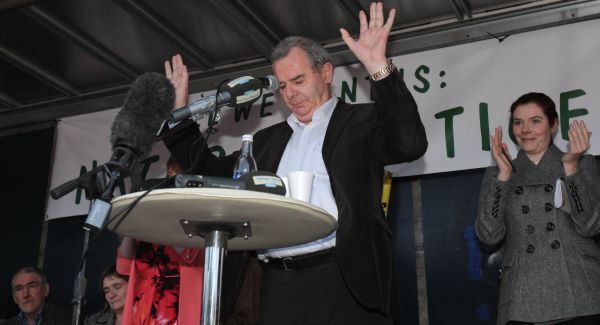
The strength of support from locals, who are unapologetic over their admiration for Quinn for bringing industry and jobs to an economic backwater, was evident last Monday when a crowd of more than 1,000 people turned up at a public meeting in Ballyconnell, Co Cavan, to oppose the proposed sale of Quinn Glass to a Spanish firm, Vidrala.

Local resistance to the involvement of non-locals in running in former Quinn companies has sometimes taken on a more sinister aspect with more than 70 violent attacks and incidents of sabotage, threats and intimidation in recent years including an arson attack on a car outside the home of a senior executive appointed by receivers.

While such attacks have abated in recent months, it remains uncertain if they will resume amid the further break-up of Quinn’s former empire.

However, many components are now owned by a consortium of businessmen from the Border area including former Quinn executives following a 100m deal late last year to acquire it from Aventas — the group appointed to run the businesses after receivers were appointed by Anglo Irish Bank. The transaction was ironically funded by US bondholders who suffered from the group’s original collapse.

The name of the new group’s holding firm — Quinn Business Retention Company — leaves little doubt about where its owners’ sympathy lies.

Just before Christmas, there were triumphant scenes in Quinn’s home village of Derrylin as he made his first appearance at his former headquarters since losing control of the group that bears his name in April 2011.

Asked about Quinn’s new role, the chief executive of the new enterprise, Liam McCaffrey (Quinn’s own former No 2) said he would act as a consultant to the business. “He was hugely important in terms of growing and developing this business over 40 years and it would be foolish not to utilise that. The process that took place in recent years, I think, many of us feel was unduly harsh,” remarked McCaffrey.

Another of the new owners, businessman John McCartan, said there was “something very poetic” about Quinn’s return after his business had been taken “in hostile fashion”. “My message to Seán Quinn is: we are very proud to be here maintaining your legacy,” proclaimed McCartan.

In scenes reminiscent of the fall of Baghdad during the US invasion of Iraq, some Quinn staff took unusual glee in taking a sledgehammer to dismantle the large “Aventas” sign outside the building before setting it alight. To cheers, the removal of the sign once again revealed the famous “Q” logo associated with the Quinn group.

Quinn took care to be photographed walking around the building with a tray, dispensing beer and whiskey to former workers. While the optics might portray the image of a man humbled by his recent experiences, Quinn’s detractors remain dubious about the apparent subservient role for which he seems destined in the short-term.

Put more bluntly, many wonder if the new consortium is simply a front for the reincarnation of a businessman who still has access to substantial wealth, despite his bankrupt status.

That such suspicions remain is due in no small part to evidence which emerged during a High Court case about the conduct of Quinn and his family as their empire started to crumble. Details about the elaborate steps they took to put assets beyond the control of receivers in places like Ukraine and Russia ultimately led to the jailing of Quinn and his son, Seán Junior, for contempt.

Having presented himself as a simple, honest businessman, Ms Justice Elizabeth Dunne observed that the manner in which Quinn had run his vast business group was “as far removed from the concept of honour and respectability as can be.”

Quinn was sentenced to nine weeks in prison in November 2012. His son served a three-month term in Mountjoy Prison earlier that summer.

And the Co Fermanagh man who left at school at 14 and took out a ÂŁ100 loan to start a business extracting gravel from his family farm has certain form when it comes to complying with the rules and regulations governing the conduct of business.

Quinn Insurance was placed in administration by the then financial regulator, Matthew Elderfield in 2010 because of the way the company was being run. It came two years after Quinn himself was forced to quit as chairman of his insurance business after using company money for unauthorised investments in Anglo. For that breach, he was personally fined €200,000, while the company paid a record €3.25m in penalties.

More recently, a court heard Kieran Wallace, the liquidator of the Irish Banking Resolution Corporation (which emerged out of the ashes of Anglo and Irish Nationwide), assert his belief that Quinn and his family might still be hiding up to €500m in undisclosed assets — an allegation vehemently refuted by the Quinns.

And it is Quinn’s links with Ireland’s very own bad bank that will be seen by many people as defining his character and reputation rather than his past commercial accomplishments.

While Quinn carefully cultivated a persona that suggested his love of gambling was confined to weekly poker sessions with friends in pubs around Ballyconnell, in truth his big bet on the share performance of Ireland’s brashest bank was the single biggest contributory factor in his own downfall.

Like other captains of industry, Quinn was impressed with how former Anglo chief executive, Seán FitzPatrick had transformed a small player in Ireland’s banking sector into one of the most dynamic banks in the developed world, courtesy of its can-do attitude to loan requests from property developers, notwithstanding signs of a rapidly overheating property market.

An avowed admirer of FitzPatrick, Quinn sufficiently convinced himself that the good times would prevail indefinitely to spend €2.8bn on buying Anglo’s shares through a little-known mechanism known as “contracts for difference” which allowed his shareholding in Anglo to remain unknown to even the bank itself.

Quinn had built up his interest in the bank from 2006 onwards, committing even more money despite a sliding value in Anglo’s shares in the conviction that they would recover sharply and seemingly happy to ignore gathering clouds of a global economic crisis.

When Anglo executives finally realised that Quinn had owned almost 30% of the bank and the import such information would have on Anglo’s already ailing share price, they took drastic measures to prevent the whole house of cards from coming down.

Resisting having to sell off his Anglo shareholding until the bitter end, Quinn was eventually forced to dispose of it to six members of his family and a group of wealthy businessmen who became known collectively as the “Maple Ten” in a secret deal hatched in desperation by Anglo’s disgraced chief executive, David Drumm.

It is clear Quinn blames Anglo, rather than accept any suggestion of personal greed, for all his woes and never tires of declaring that he and his family were misled by Anglo bosses.

Quinn’s predictable delight in being discharged as a bankrupt today will have been tainted by the announcement on Wednesday that Vidrala has acquired the prized asset of Quinn Glass (which was rebranded last year as Encirc) — a move that confirms the break-up of an empire that once incorporated a diverse range of products and services including packaging, cement, radiators, glass and insurance.

The deal to acquire the jewel in the crown of the former Quinn group, which is worth €408.6m, was presumably beyond the wherewithal of the Quinn Business Retention Company As for Quinn, his family’s fractured relationship with Anglo/IBRC is still a live issue as the High Court is due to hear a landmark case later this year taken by his wife, Patrician and five children against the bank in which they allege over 2.3 billion which they borrowed from Anglo should not be repayable because it had been lent for the unlawful purpose of propping up the bank’s share price.

Whatever the outcome of that hearing, it is clear that yesterday’s proceedings in the High Court will mark the second coming of a Quinn for whom the adjective “mighty” might have been coined. While he may no longer be a man of vast wealth, it seems he is still someone who will pull a lot of strings for some time to come.

More in this section

Revoiced

Newsletter

Sign up to the best reads of the week from irishexaminer.com selected just for you.

Cookie Policy Privacy Policy Brand Safety FAQ Help Contact Us Terms and Conditions

© Examiner Echo Group Limited