MEP revels away from ‘party politics games’
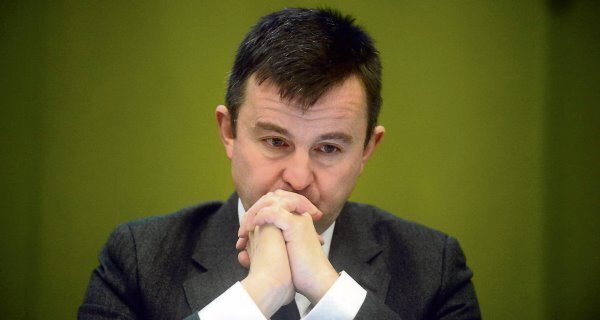
When he was elected to the European Parliament in May, Brian Hayes decided to immerse himself in a new environment, reports Europe Correspondent Ann Cahill

MEP revels away from ‘party politics games’

Irish members of the European Parliament are playing party politics when they should be pulling together as part of ‘team Ireland’, according to newcomer Brian Hayes.

The former junior minister in the Department of Finance took the unusual step of moving his family to Brussels after he won a seat for Fine Gael in Dublin in May. He has been on a steep learning curve since, having succeeded in getting a seat on the prestigious economics committee in the parliament of 751 members.

But coming to work in jeans and sneakers is just one of the changes he has encountered in his new job. The Dublin MEP readily admits to having completely misunderstood the European Parliament when he was coming to Brussels for regular meetings with EU ministers for the past two years.

His new environment has put a lot of other things in perspective too, he says, not least forcing him to consider the way the Dáil is managed and the way European Parliament constituencies are organised in Ireland.

The first thing he needs to get off his chest, however, is the failure of Ireland’s 11 MEPs to work together. “I am frustrated by the appalling kind of party politics games that the Irish MEPs play — I’m going to cut loose here — we have only 11,” he says.

“Among the 11, there is no collegiate view of doing things for the country, I am talking about some of the MEPs — Sinn Féin, some of the Independents —there is no sense that we can work together on key issues.

“There is far too much Punch and Judy politics, trying to replicate the Punch and Judy politics at home, but doing it here is over-dramatising and exaggerated. I do think if we came together as a group of 11 and honestly engaged on issues concerning the country we could achieve an awful lot more.”

Mr Hayes sees himself first and foremost as an Irish MEP and an ambassador for the country, and says that refusing to co-operate on issues of national interest suggests a small mindedness that Ireland cannot afford.

The “silly tweets and nonsensical remarks made by some of the MEPs” do not depress Mr Hayes really, but he believes that if the Irish members took the job seriously, they would all meet as a group and co-operate to inform one another of what is happening on their respective committees.

“There are 23 full committees and just 11 of us so there is no way we can all be on top of everything,” he says. “I try to highlight the important issues on my committee, but there could be an awful lot more done on a collegiate basis by the 11.”

Mr Hayes regrets, too, that Labour did not win a seat in the elections, since they belong to the second biggest group in the parliament, the Socialists. He notes that Nessa Childers is a member of the group as an Independent but as yet is not the significant voice in the group that Proinsias De Rossa was.

Ireland no longer has a representative in the parliament’s third largest group either, the Liberal ALDE, since Fianna Fáil’s Brian Crowley joined the ECR, the group dominated by British conservatives. Mr Hayes remarks that Fine Gael was lucky to return four MEPs who belong to the parliament’s biggest group, the EPP. He describes GUE, to which Sinn Féin’s three MEPs and Luke ‘Ming’ Flanagan belong, as a marginal group with little influence.

The biggest issue on the table for Ireland now is to do with capital markets and legislation that could either kill the industry in Dublin’s financial sector or enhance it. The committee on which Mr Hayes sits, Econ, is working hard on the new rules. While he accepts that some MEPs might not share the same political thinking as Fine Gael, he insists “there are some issues of such significance for Ireland, they break across these ideological barriers”.

The important lesson he has learned since moving to Brussels is that you build a consensus from the centre out, not from the extremes in: “You have to be mindful of where others are coming from. When I was a government minister, an official handed me the legislation. The opposite is the case here.”

Some European Commission officials visited him recently before their latest draft of legislation on money markets went to the Council where the member states will deal with it. “The politicians are involved from day one with the commission, and if I’m to make any headway to defend my country on this I’ve got to make sure people understand our position, because I don’t have a natural majority behind me,” he says.

“In the Dáil, I knew that when push came to shove, I could hit the button and the whip would do the job and the vote would be there. That is not the case here: We have got to win people around — we don’t have a majority on the committee.”

The differences were obvious, too, when he recently submitted five amendments to the report on the European Investment Bank for 2013 dealing with having the bank do more on social housing. There is more parliamentary oversight for the MEP in charge of writing the report for the parliament.

“The point is that he was a member of the ECR [British conservative group] but he took my amendments on board — we do not do that kind of thing in Ireland, we don’t have the tradition of taking other people’s views on boards.”

He believes that, in key issues of conscience, TDs should have the right to choose, and not be held to the party whip. “It is very different here, it is new and exciting for me and I am delighted to be liberated from the whip,” he says.” I think it makes a difference when you have the freedom to make those calls yourself, and I think it encourages the electorate. One of the arguments that is used for the whip system is otherwise ‘they will pick you off — the public — one by one’.But maybe the public need to be part of the debate, maybe they need politicians who will take positions and argue why they will be held, and stick to them.”

Coming to the European Parliament has given him an independence from the party whip, “and I revel in that independence”. It has also given Mr Hayes a new perspective. “I’ve been very pleasantly surprised.”

He particularly likes that MEPs on the Econ committee from his group, the EPP, meet to prepare for each meeting in advance, spending as long doing so as the meeting itself. Mr Hayes points out that the amount of legislation the parliament deals with is multiples of what is done at national government level.

He would like to get rid of the huge constituencies in Ireland, apart from Dublin, whereby constituents do not get to know their MEPs. He would favour 11 single-seat constituencies.

Adamant he will not run home at the next general election — his three children are happily settled into school in Brussels and he spends two to three days a week in Dublin — he says he has not make up his mind whether he will remain in the parliament after his five-year term is up.

More in this section

Revoiced

Newsletter

Sign up to the best reads of the week from irishexaminer.com selected just for you.

Cookie Policy Privacy Policy Brand Safety FAQ Help Contact Us Terms and Conditions

© Examiner Echo Group Limited