Sharon Bowles - A Woman of Substance
But much of the legislation that dictates how EU governments can spend their money and the structure of the single banking union has been shaped by a small band of women.
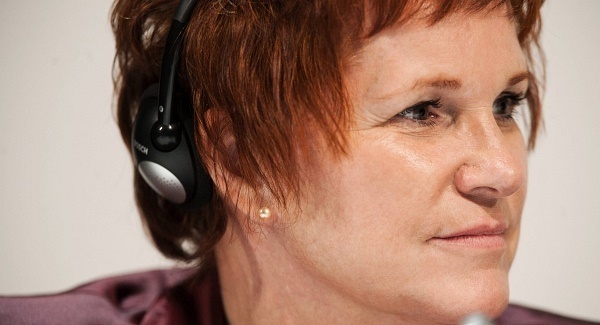
The most recognisable is Sharon Bowles, a physicist and mathematician turned patent lawyer who chaired the European Parliamentâs economics and monetary committee for the past five years. With her ĂŒber red hair and broad English accent, she stands out in any company, but few â including the member states â expected that she or the committee she chaired would play the role that they have, in shaping rules for banking, tax, markets, and governments.
Apart from the fact that the most active on the committee were women, she and two other prominent British MEPs were from a non-euro country with major opt-outs. With three other women and a man or two they have dominated the biggest ever banking and budget reforms in the EU, forcing states to make changes, and in many cases look after smaller countries.
Ranked in a Brussels poll as the most influential Briton in EU policymaking in 2012, and rated among the top 10 most influential regulators and most influential woman in the EU, she is about to leave it all behind. After nine years as a Liberal MEP for South East England, she has decided not to contest the May elections.
She has been perhaps the busiest MEP over the past five years, mediating 63 pieces of legislation on which the parliament had co-decision with the member states; was involved in writing 200 reports and opinions; attended 300 seminars and 320 trialogue negotiation sessions with the council and commission; many more briefings and sessions; chaired hundreds of meetings; and wrote her own amendments and speeches.
âThese are records that will not be broken,â she says, and itâs a safe bet, unless the monetary union is flipped on its head.
The parliament had virtually no role in the bailouts of crisis countries â Greece, Ireland, Portugal, Spain, and Cyprus but in an effort to ensure that any troika in the future would have to be more democratically accountable, two Parliament committees including Econ held a series of hearings with the main players and drew up a highly critical report with recommendations.
Ms Bowles has always been vociferously critical of the Irish taxpayer being forced to bail out the banks without aid from the bondholders. She has pushed the ECB to release the letter written by Jean-Claude Trichet, its former president, threatening the Government unless they took this course of action â âwe keep trying to find that missing letter, that is where Trichet and I would have parted company, â this notion that you could not spook the bond market so the Irish citizens have bailed out the German banking system is basically untenable and long term will have to be made fairerâ.
It was at a time when âpeople had just been peering into the abyss of what was happening with Lemansâ, but it was unfair, she says. Asked if the decisions had in fact been made by German chancellor Angela Merkel and French president Nicola Sarkozy and then taken up by Trichet, she says: âI donât know who started it but â it was the received wisdom at the time, I cannot say, that those with large banking sectors did not want anything rocked⊠there was this great fear that there would have been this knock fears of instability that governments would have to prop up their banks with guarantees which happened anyway in the end.
âThe Germans and the French have always had a view that you can tame the markets and make them do what you want.â
But here they unleashed them? âAbsolutelyâ.
Smell the blood, go after it?
âI think there may be some of my speeches that said that sort of thing. I did criticise lack of market savviness in the council in quite strong words in some plenary speeches, I would probably be even stronger nowâ.
Member states and the commission are used to ruling in economic matters but the Lisbon Treaty gave the European Parliament real powers for the first time, meaning that both the council representing the member states and the European Parliament had equal responsibility in areas like agriculture. However it was not clear what it meant for the financial area.
âI looked at the treaty and we did not have a lot more powers than we already had. There was a tiny window to do something in competition and we made the most of that. Tax was out but there was this multi-lateral surveillance in the middle of the monetary union part and I said we will see where that will take us.
âWe never thought we would get something like the six or two pack. We had conversations with the secretariat trying to make something of that. But then it came on a plate and we did it in spades,â she says referring to what has now become the rule book for governments and their national budgets.
The battles with the European Commission that drafted the legislation and the council defending what the member states wanted gave the parliament huge exposure.
This, with their several very public victories, made it feel empowered and willing to support the Econ Committee in full parliament votes.
But the pressure was immense as the committee stuck out for changes to legislation. Perhaps the biggest was when they insisted that any government breaking the budget rules would almost automatically be punished â to ensure the powerful nations would not be able to escape sanctions as happened under the Growth and Stability Pact.
âWhen we were doing the six-pack we had ministers phoning us on our mobiles, people from specific member states telling us we had to give in. In the long hold-out over the summer, I even had the president of the parliament telling me âdonât you think it is time you compromisedâ.â
âI think this is where Jean-Claude Juncker said âyou know Sharon we are all afraid of you because we discovered when you say no you mean noâ. So we did well but there were times there was only me and Trichet hanging out,â she recalls.
It also meant managing MEPs from the right and left and all the shades in between, and those who were under pressure from their governments. âIt was a bit like running an election campaign to get those six-pack votes throughâ.
The fact that the president of the ECB reports to the Econ Committee monthly in a public session where they take questions, gave her a unique opportunity to get to know Trichet and his successor Mario Draghi.
âTrichet is more orthodox, more old school. By comparison I think Mario Draghi is more open, maybe a kind of moderniser â the staid and stuffy smoke and mirrors kind of days are really gone â though one has to say that Mario has used it quite well in some respects, so it was a natural transition.â
So was the Italian the person who saved the euro by pledging to do whatever it took and introducing â long term refinancing operation?
She recalls saying to him after one meeting: ââMario, I think you are going to have to do something before you do not have a central bank to be president ofâ. I said that to him privately and he said, âyes, yes yes, I am working on itâ,â and, she said, she told him that the committee would probably support him.
It was not that she had some special, secret line of information from the central bank, âthat would be totally wrongâ.
The occasional private discussion tends to be on the sidelines of meetings and sometimes was about how the committee would view various changes. They were all aware of the enormity of the dangers and challenge of the crisis.
âThere was a point at which even if he did something that was wrong I think the public line would have had to be that we supported him because the ECB was the institution that was holding the respect and that was more important than anything else and that was the way the parliament felt.â
Looking back she believes one of her strengths has been that she was not a career politician. âI did not mind asking questions and I did not mind someone thinking I am a foolâ.