All for one: legacy of mass protest is an inward culture of individualism
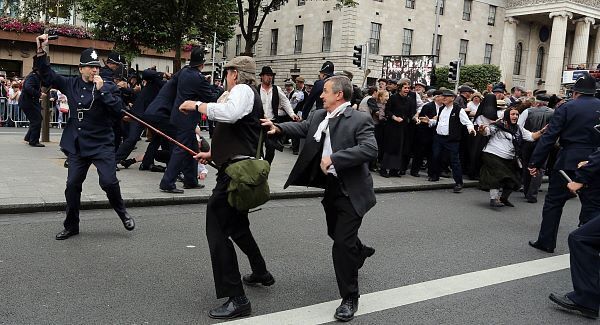
The 1913 lockout was visceral and left vulnerable people shattered. It inflicted horrible hardship on families who lived in the worst of slums.
Days later, the Archbishop of Dublin, William Walsh, condemned the plan to send the children of strikers to England for the duration. Children were taken through Dublin port to England nonetheless, but at the cost of stoking a sectarian onslaught on the strikers.
Anti-clericalism was not the winning card then that it is now. Over the following Christmas and New Year, the workers, beaten down, drifted back to work. The strike was broken; apparently unsuccessful.
People of an age can remember the television drama, Strumpet City, in 1980, an adaptation, by Hugh Leonard, of James Plunket’s book of that name. It was one of the very best dramas produced for Irish television.
Today, as we kiss the rod with which we were beaten in yesterday’s budget, will there be a protest?
Is the lockout commemoration a re-enactment of something that’s stuck in sepia, or is the lockout a living part of our politics?
Clearly, for some people, it is. The excavation, again, of those events has reminded us of an episode that, if never forgotten, was certainly never re-enacted. James Connolly, along with Jim Larkin, one of the key leaders of the lockout, concluded that Marxism had only limited support in Catholic Ireland. Socialism, to be successful, would have to ally with nationalism. A terrible beauty was born and Connolly’s Citizen Army marched from Liberty Hall to join Padraig Pearse’s Irish Volunteers. The rest is history.
Except, it is not. It is current affairs. It is the backstory behind the long curve of history that led to yesterday’s budget. The lockout was less a failure than it appeared at the time. The ITGWU, which had apparently been crushed, reemerged as the largest and strongest Irish trade union. Eamon Gilmore and Pat Rabbitte are two of the most prominent alumni of its descendant, SIPTU.
But the role of the trade unions and the mainstream left, in Irish politics, has always, after periodic protest, been to fall in behind and prop up the national project. The radical change that is their embarkation point is invariably co-opted by conservative forces for continuity; not for change. The enormous store of political capital garnered by the Labour Party in 2011 is being exhausted on a project, successful in its own terms, for the restoration of the very structures of state and politics it was founded to fundamentally change.
Yesterday’s budget, regardless of the protest crashing over it, is, in a sense, a success, whatever its current cost. It is another step in a process that is successfully restoring not only economic sovereignty, but laying the foundations for a return, at some point, to some measure of prosperity. Not to acknowledge that, today, would be wrong.
There is reason to believe that regardless of the short-term verdict of the electorate on the parties in coalition, the verdict of history will be favourable for them, at least in economic terms.
Sovereignty, statehood, but not socialism or even social democracy, are the totems of the policy of the Irish left, which can be traced to the lessons of the lockout, at least for Connolly. It led him to the GPO. It led Labour into Government Buildings. It is leading the country back out of the crisis, all the better to pursue the hucksterism, if not the capitalism, consistently preferred by generations of Irish electors.
The trade unions have made a contribution, to be sure. How many people were less-cowered, and better-supported, because they were in a trade union? We will never know. But I would say very many. The challenge for the unions is that they can claim credit for a legal architecture that enforces workers’ rights but that makes the unions less necessary. Social democracy in Europe, via the EU, brought a raft of progressive changes that have benefited everybody, not least women and people with disabilities.
The successes of the unions, and of the left in the workplace and across a broader social agenda, have, paradoxically, been a major driver of increased individualism in society.
People acting together, in numbers, are less necessary to achieve what, before, they could never have hoped to do alone. Personal empowerment, enhanced in the rights-based law so loved by the left, is only one of the tombstones of collectivism. Another is the end of socialism as a realisable economic objective.
The aim of modern social democracy is little more than to manicure the claws of capitalism.
Two hundred years ago, the industrial revolution, and its massing of workers in appalling conditions, created the impetus, and the setting, for the collective action that underpinned socialism and trade unions.
Today, another and far greater revolution is begun. Modern information technology is potentially empowering every person in ways that only recently were inconceivable. Hand-held gizmos make everyone their own publisher and mouth-piece. Life is increasingly led not in a social context, but in front of flickering screens controlled by key strokes that, in turn, exert a control that profoundly undermines sustained, collective engagement.
We are always on our own in front of those screens. Human contact is synthetic and always only on our own terms.
These broad sweeps are challenged by a myriad of exceptions. But the cultural and technological curve of our modern society is ever more insidiously individualistic. The anniversary of the lockout is commemorated in ways that re-enact, but cannot reanimate, what created it. In periodic crises, the left is a powerful vehicle for protest. Labour was, before it went into government in 2011. The Irish left, on the outside of this government, occasionally fulfils a similar role. But its disunity strictly limits its effect.
A hundred years ago, there was an unprecedented opportunity for fundamental change. It passed.
This, the greatest crisis since, was another. It is passing, too. That is the success of this government, of Labour in government, and of yesterday’s budget. What will matter is not the unfolding hullaballoo, but that the same port is in sight again. No matter that we always go down in sight of the shore.
The political legacy of the 1913 lockout is now meagre and arguably diminishing. But in Sean O’Casey’s great plays, like The Plough and the Stars, and in Plunkett’s Strumpet City, there is a lasting bequest. Irish revolutions were always to gain respectability.
Now, we are nearly there again; respectable, but not revolutionary.