How Boeing’s dream was grounded
The Dreamliner debacle is a reflection of how a gritty and innovative company lost its distinctive culture, writes Clive Irving

How Boeing’s dream  was grounded

IT was 22 years ago, and I was looking for Boeing’s headquarters along a gray industrial strip with rusting railroad tracks alongside.

Halfway down the strip, next to an aging plant that in the Second World War had turned out the B-17 Flying Fortress bombers, I found it: a modest but handsome building with touches of a 1930s-era airline terminal.

The inimitable smell of burned kerosene was in the air: on the other side of the strip was Boeing Field, where every new jet was flight-tested. Nearby was a tired-looking afterhours joint called Joyce’s Final Approach.

It wasn’t the kind of impressive address you’d expect for a corporate icon. Yet it was here, driven by a gritty and unflashy company spirit of innovation, that became the birthplace of a surpassing American technical achievement — the jet age — and the place where the Boeing Airplane Company emerged from provincial obscurity to become a brilliantly game-changing force in aviation.

I did not realise it then, but I was about to fall under the spell of Boeing’s own ‘Greatest Generation’, the men — and, more significantly, the culture — that produced, in the jet airliner, a machine that shrank the world, democratised air travel, and, for a while, made “Boeing” a universal generic. I was there to interview the small team of engineers, known as the aeromen, who created the Boeing 747. I ended up being drawn much deeper into Boeing’s history.

Now, with the grounding of the 787 Dreamliner, Boeing is facing its worst crisis since it pioneered jets. The tangibles of the crisis are already apparent, paramount among them how to manage quality-control of thousands of components outsourced from 135 sites around the world. But I am wondering how much this crisis has to do with something as intangible as corporate culture.

How much did Boeing’s ethos, its distinctively scrappy character, allow it to become the success it became? And, as importantly, has it lost its touch because, somewhere along the way, Boeing stopped being Boeing?

MOST jet-airliners have the same basic form: wings sharply angled back from the fuselage and engines hanging beneath the wings in pods.

Its genesis was in Nazi Germany, but in 1945, a team of experts, codenamed Lusty, was flown by the US government to Europe to scoop up German scientific secrets. They discovered a research centre disguised as a farm in the middle of a forest.

Among the team was a Boeing engineer and one of the most seminal minds in aviation history, George Schairer. He came across a new formula for high-speed flight. It involved wings raked back like an arrowhead. Schairer immediately wrote a seven-page letter to his colleagues in Seattle, sketching the wings and urging them to try out the idea in a wind tunnel.

Boeing put the German high-speed wing in the wind tunnel and saw that the principle behind it was correct. That was the easy bit. Sorting out the details and then asking test pilots to fly the airplane proved extremely scary. Yet in over little more than a decade, Schairer and his engineers produced the world’s fastest bomber, the B-47, and were on their way to producing the world’s first truly great jet airliner, the 707.

Soon after I began talking to those who worked on the 747, it became apparent that their lives had been inhabited by a kind of incubus — a lurking, pouncing, tormenting genius called George Schairer.

By the early 1990s, Schairer had retired, but I found him at his ranch-style house in a bucolic cul-de-sac, 10 miles or so from Boeing Field.

It was hard to match this gracious man with the irascible and capricious autocrat described by his proteges. But as I built up a fuller picture, it was obvious that Schairer was as far from being a company man, a respecter of organisation plans and bureaucracy, as you could get. Deeply intuitive himself (he had been known to walk around an airplane with an aerodynamic problem and spot the flaw with one glance), he looked for breakaway independence of mind in others.

Schairer’s men out-thought the competition. Until they created the 707, in 1954, the Douglas and Lockheed companies had dominated the airplane business; after the 707, the competition was left in the dust.

Boeing’s tolerance of mavericks was a reflection of its roots. The pacific northwest was one of the last parts of the union to be settled, lumber one of its earliest industries. Scandinavians came and thrived; their rugged independence stamped the landscape.

Boeing was founded in 1917, producing a few wooden-framed seaplanes from a barn on a filthy Seattle backwater. When Boeing plants supplied thousands of bombers to the US Air Force during the Second World War, the company was still thought to be provincial. But the generals who ordered airplanes got a shock when Schairer’s first jet bomber left behind the pursuit plane assigned to track it. These hicks had invented the jet age.

The special chemistry of Boeing was

- One part the men and their originality of thought;

- One part a kind of corporate innocence that more than once left them outwitted by competitors with sharper elbows and lobbying skills in Washington, DC;

- And one part a stubborn adhesion to a place.

Boeing Field resonated with the thunder of their own perfected science, the machines that increasingly became familiar at every airport around the world. This seemed like fulfilment enough: no need to swagger and strut, they seemed to feel; the jets are truly sexy and we own them.

It couldn’t last.

Eventually, a foreign competitor emerged. The French thought up Airbus as a way of pooling European resources and produced the first twin-engined wide-body, the A300, in 1972. Then, in 1984, Airbus unveiled a smaller twinjet called the A320 and aimed it at Boeing’s longest-lasting cash cow, the 737. In that model, they took a technological leap by introducing a far more automated cockpit and a completely new way of flying the airplane, used until then only in military jets.

Even then, Boeing was complacent. In my regular trips to Seattle in the 1990s, I picked up a tone of disdainful Francophobia. Some Boeing managers implied that the A320 was a step too far technically. Airlines, however, liked it, and so did passengers. Its cabin was wider than the 737’s, and it was easier to load with cargo. Without a serious revamp, the 737 would be outclassed.

At the same time, a change of corporate ambition was clear. Boeing was now much more than a maker of airliners. Its military business was growing.

Elected in 1996, the company’s new president, Phil Condit, had been an engineer who took a gung-ho pleasure in pushing an airplane to its limits. As president, Condit had a much bigger idea: that to really make a mark, Boeing should merge with McDonnell Douglas, an aerospace conglomerate that included the rump of the old Douglas Airplane Company.

Condit achieved the merger in 1997. Some of the older generation of engineers that I had kept in touch with admitted they were uneasy: Douglas was too much in the hands of bean counters; pretty soon they grumbled that Douglas had taken over Boeing rather than the reverse.

Then in 2001, The Seattle Times ran a banner headline: ‘Boeing Bolts’.

The city was stunned.

Condit had decided to move Boeing’s corporate headquarters to Chicago, to the Morton Salt skyscraper. Seattle was just another cog.

In Chicago, the primacy of Boeing’s distinct engineering culture was fading. In 2003, Harry Stonecipher, a former president of McDonnell Douglas, replaced Condit (done in by corruption charges and by a serious loss of market share to Airbus). Two years later, Stonecipher was also gone.

Among the aeromen, there appeared to be only one candidate to succeed Stonecipher: Alan Mulally, an alpha engineer and forceful salesman; he was a compelling leader and esteemed by his peers. Instead, the top job went to an outsider, Jim McNerney, whose CV included Procter & Gamble, McKinsey, GE, and 3M. (A year later, a disaffected Mulally became president and CEO of Ford, and is now widely regarded as its saviour.) The direct line of succession from the aeromen had been snuffed out.

I returned to Seattle in 2006, invited to take an early look at a radical new project, the 787 Dreamliner. All that existed of it at that point was a mock-up of its cabin. When the 707 was launched in the 1950s, Boeing built a mock-up in a warehouse in lower Manhattan, and presented it complete with flight attendants and the sounds of a simulated flight; Charles Lindbergh himself attended.

The Dreamliner debut couldn’t have been more different. The cabin itself was a knockout, a real generational leap in comfort with larger windows, mood lighting, an arching roofline, and cleaner, moister air. But the site was a featureless building hidden behind a furniture showroom in a rather dispiriting suburb of Seattle. And the commercial division’s new executive quarters, nearby, felt more like a bank, with people in cubicles silently staring at monitors. More significant, the roar had been stilled: Boeing Field was miles away and the business of creating airplanes had become unmoored from the presence of them.

In 2008, the machinists who assembled the airplanes held an eight-week strike that cost Boeing $100m a day. Then Boeing decided to build a new production line for the Dreamliner in South Carolina. Finally, in 2011, the company and the union came to a new four-year contract deal. By then, however, the Dreamliner production was badly snarled, and Boeing had to accept that the skill pool of the Seattle machinists was indispensable.

Then there is the Mulally question. Of course you can’t put a value on an absence. But Mulally was a hands-on polymath with an instinct for where a screw-up was imminent. His spirit was both rigorous and infectious, and he was clearly an exceptional leader. When machinists on the factory floor had a gripe, he listened — and acted. His departure left a hole in the air.

AM I making too much of the corporate aesthetic? Does the separation of management and product matter? I needed to remember that for all the magic that had been made here those early jets were relatively crude machines. In its first decade the 707 had a series of crashes, any one of which today would have grounded the fleet.

Today the corporate realities of the 21st century leave little room for a small cadre of headstrong visionaries. Can-do doesn’t do any more.

But this isn’t just any business, and Boeing isn’t just a corporation. Boeing’s originating genius was tied to that semi-mystical quality known as locus, and I do believe it shaped the way people thought. Boeing engineers had a particular approach to craft that engendered ingenuity, a fastidiousness about detail that could cohabit with a near-reckless will to break out of the box. That tension was managed.

I believe the corporate move to Chicago weakened the tolerance for that unruly élan in which the product developed. The Morton Salt executives don’t need to go down into the salt mines. The Boeing executives do, I am sure, need to smell the kerosene.

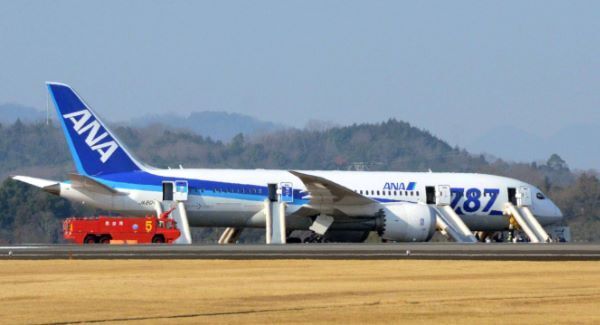
Picture: An All Nippon Airways flight sits at Takamatsu airport in western Japan after it made an emergency landing last month. A cockpit message showed battery problems in the latest trouble for the Boeing 787 Dreamliner. Picture: AP

More in this section

Revoiced

Newsletter

Sign up to the best reads of the week from irishexaminer.com selected just for you.

Cookie Policy Privacy Policy Brand Safety FAQ Help Contact Us Terms and Conditions

© Examiner Echo Group Limited