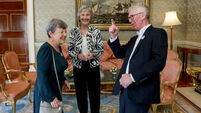
Driven to his wit’s end
THERE are certain characteristics that we associate with Colm Meaney, or at least with the screen persona that has enveloped him over the past two decades.
In films such as Intermission, Con Air, and the much-loved adaptations of Roddy Doyle’s Barrytown trilogy (The Commitments, The Snapper, and The Van), Meaney has invariably played characters prone to brash physical behaviour, quirky facial expressions, and hilarious hot-tempered rants.
His latest role, however, finds him playing delightfully against type. In new Irish film Parked, the Dubliner’s elusive character, Fred, is a returned emigrant who has found himself living in his car in a Dublin car park overlooking the Irish Sea. While attempting to find a home and retrieve his dignity, Fred befriends a young drug addict who resides in the same park. Like Fred, Cathal (Colin Morgan) is a man whose life is in drydock, and in the comic yet poignant relationship that blossoms between the two men the film offers a glimpse of life on the margins, without indulging in too much sentiment.
“I loved the script and the story,” says Meaney. “And the added incentive was that it was a character I hadn’t really played before. I tend to be cast in slightly bigger, more overt roles, if you like. But I knew this guy would have to be a more internal and subdued performance. It was a challenge.”
In person, Meaney is a convivial man and the passion that so frequently marks his onscreen characters bubbles away, too, in his own persona. He is extremely proud of Parked, and the film is certainly an accomplished debut by director Darragh Byrne. Its slender narrative opens up a whole world to the viewer but without making any conclusive or melodramatic judgements on that world or its inhabitants. The performances are crisp and nuanced while the photography is wonderful, capturing beautiful frosty mornings on the seafront as well as the insistent brightness of a leafy, suburban Dublin basking in the first whiff of Spring.
Meaney agrees that the photography in Parked uniquely sets the mood of the film.
“John Conroy is a great director of photography and you can see it on the screen,” he says. “We were working here in January. We had huge snowfalls, sleet, hail, rain, wind, and every fucking thing. So it was a tough, tough shoot. But John is a big horse of a man and he’d be geeing you onwards, saying ‘C’mon Colm. We can get this’. He’s this powerful man, but with the sensitivity of a great artist.”
Dividing his time between homes in Spain and Los Angeles, Meaney says he relishes every opportunity to come home. “I love coming back,” he says. “When I got to the airport yesterday I just clapped my hands together and it was like, ‘Jaysus, I’ll be able to pick up a few pints in Dublin tonight.’” Pints with his brother in the illustrious Fagan’s of Drumcondra ensued.
As well as shooting Parked earlier this year, Meaney also recently completed work on a new film by Terry George (director of Hotel Rwanda) set in Belfast. The latter film — Whole Lotta Sole — is slated for release in 2012. Notably, with its plot involving a robbery at a fish market, it reunites the Dubliner with some auld acquaintances from his pre-acting days: the humble fish of Ireland.
“Yes, that’s right,” Meaney says, spluttering a laugh when his brief days as a fisherman are mentioned. It was while working on a trawler off Howth at the turn of the ’70s that the young Dubliner, still only a teenager, acted on a notion to journey into the Abbey theatre and inquire about the school of acting.
“It had been in my head for a long time before that, from as early as when I was 14. I remember one summer I was working as a lounge-boy in The Parnell Mooney during the school holidays, and Dónal McCann was doing a show across the street in the Gaiety, and he used to come in to the pub. So I said to him one day ‘how do I become an actor?’ and he said, ‘Wha’? Go down to the school of acting in de Abbey and see if ye’re any good.’”
It was fateful advice. Meaney spent the early ’70s learning his trade with the Abbey, going on to carve out a reputation as a distinguished actor at home and in Britain and America. Having moved to the States in the 1980s he started to pick up work in television, appearing in shows such as Moonlighting and McGyver, and, of course, Star Trek: The Next Generation. A cameo in the pilot episode of Gene Roddenberry’s rebooted series turned into a 12-year role as the much loved Chief Miles O’Brien.
Meaney will soon be seen in a new television show, the hotly tipped Hell on Wheels, which starts airing on American cable channel AMC next month. The show is a western that charts the development of the railroads throughout the US in the era immediately following the Civil War. Meaney plays one of the lead characters, businessman Thomas ‘Doc’ Durant.
“He’s a historical character,” says the actor. “He owned the railroad. He was this larger than life venture capitalist who became passionate about the railroad and it’s not just about the money for him. But the dialogue in this show is just great. It’s a period drama set in the 1860s, so I get to say lines like ‘there will be perfidy of epic proportions.’”
As far as Meaney is concerned, the best writing in America at the moment is in television rather than movies, and he has high hopes for the new show. It is, however, just one of many projects that he has worked on recently. Among the most intriguing is The Hot Potato, a caper movie starring Meaney and Ray Winstone as two London wide-boys who find a lump of uranium and try to hawk it to buyers around Europe.
“Winstone is one of these men of the earth, you know,” he says, before proceeding to mimic his co-star: “It’s all ‘Come on, Colm. Let’s ’ave this. What you ’aving? ’Ave the lobster. ’Ave the fucking lobster, Colm.’ So every night was extraordinary. Working with him for six weeks was like being on tour with a band or something.”
Meaney’s career has taken him far afield yet — despite the slight tinge of an American accent that colours his speech — he remains something of a quintessential Irishman. Would he ever come home to live here again?
“I don’t know,” he says. “I wouldn’t say no but I don’t have any plans to. I have a French wife and one daughter in Connecticut and my other daughter — the little one — was born in Spain. But she actually travels on an Irish passport. So it’s all very complicated. But I’d like to think I might do one day, yeah.”
* Parked is released today.

CONNECT WITH US TODAY



Be the first to know the latest news and updates