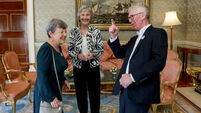
When the going gets really tough the tough go for a cheering hair cut

I HAVE always lived by the maxim, that “when the going gets tough, the tough get their hair cut”.

When the going gets really tough the tough go for a cheering hair cut

The therapeutic value of a good haircut should never be under-estimated. And this is not just a woman thing. Earlier this year, a male friend of mine — on holidays in Turkey — was most impressed not only by the whole haircut and hot shave routine, but by the burning away of those stray hairs we all get in stray places after a certain age, with the naked flame from a cigarette lighter! Now, it seems, such therapy is being far more broadly supported, and even as a cure for contagion.

I’m referring of course to all the talk about banks, bonds and bailouts, especially in relation to Greece in the last couple of weeks. The headline ‘Ireland revives haircut demand’ was to be seen in all the financial pages earlier this month, followed last week by a proposal to ‘burn the banks’. (Whoever would have thought that Michael Noonan and I would share this interest in matters tonsorial?). Only last weekend the British banks were being urged by their government to take a ‘haircut’ in order to contain the Greek contagion. The rest of Europe is so fed up that they’ve got the GIP, which is the polite way of referring to their problem with PIGS.

Well really! Does anybody still follow what on earth is going on?

Starting with the banks, bonds and bailouts. When governments want to raise money they issue bonds: people buy bonds as a safe investment and on the understanding that after an agreed fixed period of time they will get their money back, plus a specified interest payment. It’s considered a safe investment because usually governments never really run out of money. Government bonds may be issued locally — like Irish Prize Bonds — or internationally. If the bonds are sold internationally, to other countries and foreign investors, they are called sovereign bonds. Sovereign debt refers to sovereign bonds sold to other countries to raise money to meet the state’s spending. Burning the bondholder happens when a government doesn’t pay back the amount it promised. Asking for banks to take haircuts is asking them to take back less than was agreed on the original terms of the Sovereign Debt.

So far, so good. It’s when we look at this issue across Europe that we meet up with the PIGS — the acronym for Portugal, Ireland, Greece and Spain, which together form the peripheral economies of Europe currently taking up massive loans from the European System of Central Banks. GIPS refers to the same set of states, but is considered a little less rude. The problem is that those states within Europe who are lending the money to GIPS are now owed so much money that there is a fear that if the GIPS don’t pay back, then the banking systems of those countries that lent the money may collapse. As the extent of the GIPS financial imprudence has been uncovered, people who had invested their money in the commercial banks in the GIPS began to withdraw it. This left banks in these states with a shortage of money to lend to other customers, so they began to borrow more from those banks that had money. As the lending banks get more and more nervous about whether or not they will get their money back, they begin to get much more strict about their lending terms. They begin to insist on austerity packages, such as fiscal reforms and sales of state assets, as a way for the states doing the borrowing to show that they are really serious about sorting out their debts.

But as the governments of the borrowing states try and show that they are really serious about sorting out the debts, the citizens in these states get really fed up. In Greece, they have got so fed up that the main opposition party is refusing to support the Government’s austerity package and Greece’s largest trade union called a 48 hour general strike for Tuesday and Wednesday of this week. The Greek government set about a three-day debate to win over a majority in parliament for the austerity package needed to qualify for continued loans. That austerity package (passed yesterday) demands €28bn spending cuts, €50bn worth of privatisations and the loss of some 150,000 jobs.

Meanwhile, the other European states that still had banks and money and dearly wanted to hold on to both (that’s mostly Germany, France and the UK — though no one has yet to use the acronym FUGK) started to think of ways that the indebted states could save a bit of money without upsetting everyone as much. The technical term for this is ‘soft restructuring’. Soft restructuring refers to a variety of ways that lending banks change their terms — like lengthening the loan period, or a review of the loan conditions. Others include giving the banks haircuts and burning bondholders. So where do Greece and Ireland stand on this? Clearly the Greek government is trying to be as single-minded as the Irish government, but when asked about the Greeks’ capacity to accept the austerity measures, Michael Noonan wasn’t so sure that the Greeks were up for it. In fairness, neither were the Greeks.

So, how come Ireland is coping with this pain and the Greeks are not? A lot of the news commentary and talk at the moment focuses on Greece’s governmental shortcomings: the government is beleaguered and everyone’s trust in the administration is low. But perhaps more importantly, the Greek people are angry and frustrated.

Fundamentally, they cannot be sure that their government is doing the right thing. Speaking to the Financial Times on Tuesday, the governor of the Greek Central Bank suggested that over the last 18 months, as the country lurched closer and closer to financial disaster, Greek politicians did their best to downplay the crisis. In consequence, there has been no national conversation or debate about what went wrong. And now there is no consensus about how to put it right.

BY contrast, in Ireland, we had the most conclusive of national conversations — a general election campaign, with a result that gave little doubt as to where most people thought the responsibility for the crisis rested. We’re typically inclined to think that elections don’t make a difference and that nothing has really changed: but the fact of the matter is that we have already begun the first steps towards recovery. We have a clear governmental majority and a strong cross party consensus that things need to be done differently from now on. Of course, many of us are still uncertain about the details of these changes, but we have all accepted that we cannot continue with the way things were.

Earlier this month, when Mary Robinson gave the Annual Lecture to the independent think-tank, TASC, she referred to this palpable change of mood amongst the Irish people. “None of the grim economic realities have changed“, she argued, “but the public mood is capable of having a life of its own and of helping us to change our circumstances in a more positive way”. With a clear imperative to rethink how we do government and what kind of a society we want, there is now, according to Robinson, “a moment in time, a shift in the public mood to change our ideas about what is normal”. In short, we are in a period of transition, where we still have the chance to shape what the outcomes might be. My advice is go get your hair done and face the future!

x

More in this section

Revoiced

Newsletter

Sign up to the best reads of the week from irishexaminer.com selected just for you.

Cookie Policy Privacy Policy Brand Safety FAQ Help Contact Us Terms and Conditions

© Examiner Echo Group Limited