If it’s goodbye Mary Lou, then SF faces Stalingrad south of the border
The longer trends are what count and, on that score, the only party with something to celebrate is Fine Gael. It is 27 years since FG won a general election and the party feels it keenly. At last, more than one opinion poll suggests the spell might finally be broken next time.
The other noticeable trend — less frequently remarked upon — is the continuing slump in Sinn Féin fortunes. This weekend Sinn Féin gathers for its annual árd fheis after what party stalwart Rita O’Hare admits has been “a difficult year” for the party — and it’s not the first.
“The pace of change North and South has been slow,” she laments. Where now for republicanism? Having been the only Dáil party on the winning side of the Lisbon Treaty argument and with their distant cousins in Fianna Fáil performing woefully, the Shinners might expect to be polling a bit better than 9%.
If the electorate isn’t looking for a truly radical alternative in times like these, when will it, the republican grassroots must be asking themselves mournfully? Why isn’t it capitalising on capitalism’s woes?
The leadership’s response is a rare revamp of the frontbench. Donegal-based West Tyrone MP Pat Doherty, vice-president since John Joe McGirl’s death in 1988 — and just three years Gerry Adams’s senior — has been put out to grass.
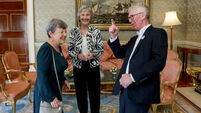
In his place, in a tacit admission that the party needs to build support outside Ulster, the members will be asked — or told — to approve the nomination of Mary Lou McDonald. Not bad for a 39-year-old who was in Fianna Fáil only a few years back. Bonus — no-one accuses her of ever having sat on the IRA army council.
In other circumstances, Gerry Adams might be applauded for putting some distance between the party and its paramilitary roots. The painful reality, though, is that every single stop has to be pulled out to save Mary Lou’s European seat. If she were to lose it, as she did the battle in Dublin Central in 2007, the grey beards might conclude she has the smell of political death about her. Don’t bet on another 21-year stint as vice-president.
For once, the party is being brutally honest about its prospects. “Our objective is to retain the two seats that we hold,” Adams confesses. With three serious unionist candidates running in the North, Bairbre de Brún will walk home, possibly topping the poll. For Mary Lou, though, it’s an uphill battle, compounded by the fact that the constituency is shrinking from a four-seater to a three-seater. There’s a Fine Gael seat and, more than likely, a Fianna Fáil seat, although if their 13% poll rating is reflected in real votes, nothing can be taken for granted.
That leaves one more to fill and if Labour is doing as well as some polls suggest, that could mean curtains for Mary Lou. She will have to milk her status as the strongest anti-Lisbon candidate for all it’s worth — at a time when being anti-Lisbon isn’t as fashionable as it was a few months back.
Curtains for Mary Lou, of course, means curtains for Sinn Féin’s hopes of being anything more than a bit player on the Southern scene for years to come. Dublin really will be Stalingrad for the 26-county operation.
Republicans have long memories, of course. Unlike more mainstream politicians, they think in terms of decades, not months or years. They have learned the need to be patient. But confident predictions of a united Ireland by 2016 are beginning to look hubristic.
The rise and plateauing of Sinn Féin’s fortunes is the subject of The Long March, an authoritative and coolly dispassionate new study by Cambridge University academic Dr Martyn Frampton which benefits from interviews with most of the household names in Sinn Féin.
And Frampton has good news for the grassroots: the leadership hasn’t sold out — “the struggle… does indeed go on,” he concludes. But that infamous patience will be sorely tested.
As recently as 2004, the party could credibly claim it would hold the balance of power in the Dáil next time out. Adams’s goal — the ‘republicanisation’ of Irish society — had appeared close at hand.
The peace process had paid off handsomely in terms of a steady stream of good publicity; the experience of office in the North had reaped sheaves of respectability. Sinn Féin really did have a “Janus-faced political appeal”, as Frampton puts it, appearing at one and the same time a party of government and a party of protest. The prospect of Sinn Féin ministers from the North meeting Sinn Féin counterparts from the South in meetings of the all-Ireland ministerial council tantalised.
But 2004 and Mary Lou’s win in Dublin were, in hindsight, the party’s high point. The near misses of 2002 were missed again — in many cases by a wide mark — and Seán Crowe’s seat was lost altogether.
Peace, universal free healthcare, wealth redistribution and clean hands (sort of) should have been a popular platform. But then the party’s past came back to haunt it in the shape of the Northern Bank robbery, revelations involving money-laundering, the Robert McCartney murder and eccentric definitions of what constitutes a crime. The party that preached to the rest looked to be suffused with gangsterism.
Ending the armed campaign, decommissioning and buying into the PSNI all looked like efforts at playing catch-up. The Southern electorate was grateful — and moved on. That the leadership itself — previously so skilful — was widely held responsible for the 2007 disaster only compounded matters.
ACCORDING to that leadership, “Sinn Féin is a party in transition”. Transition to what isn’t immediately obvious. That the Government squandered the public finances is scarcely a unique analysis. And Adams is still bleating on about “an approach in which the economy serves society, serves the people”.
He wants a European Union “that serves the citizens of that union”. Sinn Féin is “pledged to bring in a first-class education for every child”. Well-meaning platitudes — but platitudes nonetheless.
Frampton, rightly, points out that all these positions are purely tactical anyway: everything and everyone is subsumed within the one and only true goal, and on that point there can never be any revisionism. As long as they go about it peacefully, who cares, most of us will say?
The question for delegates this weekend, though, is: why should the leadership’s latest strategy be any less delusional than all the previous ones? Bombing the hell out of the northern bit of Ireland didn’t work: it brought the Brits in, not out.
The same goes for the ‘Armalite and ballot box’ strategy: that one collapsed under the weight of its own contradictions. Now the republican faithful are supposed to believe that, finally, the process for reunification has been perfected: “the big challenge for Sinn Féin in the next decade is to become nation-builders”. No, I can’t imagine what that means either.
The Long March: The Political Strategy of Sinn Féin 1981-2007, by Martyn Frampton, is published by Palgrave Macmillan
CONNECT WITH US TODAY



Be the first to know the latest news and updates