Mother knows best — but when will health experts get the message?

Every time she tried to quieten him, he scratched and bit her. He was seven, and already strong and agile.
She knew from experience that if she put him in the car he would break everything he could get hold of — indicators, mirrors, the gear stick. So she managed to get the boot open and forced him in there.
That’s when she realised there was a witness to the whole scene, a woman with a child in a buggy.
The woman was terrified at what she had seen and threatened to ring the gardaí. In fact she did ring them, and a week later they began an investigation into child abuse.
Anna Karin Kingston tells this story in the introduction to her remarkable book, Mothering Special Needs – A Different Maternal Journey.
Her son, the one it was alleged she abused, is autistic. The snug, safe darkness of the boot of her car was one of the few places in which he could find calmness — his escape from a noisy and demanding world, as Anna describes it.
In the course of research for her book, Anna discovered she was not alone. The book tells the story of 18 different women, all mothers of children with disabilities. And it reveals the remarkable similarity in their journeys.
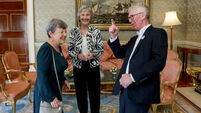
I have to declare a vested interest at this point because my wife Frieda was asked by the author to launch the book. As Frieda read it, she identified to such an extent with the experiences recounted by Anna that she found it hard to keep her speech at the launch to a reasonable length. What Frieda and I subsequently found remarkable was how little has changed. The mothers in this book all have young children.
We are the parents of a woman with an intellectual disability who is now in her 30s. There’s a generation, in some senses, between us. And yet the attitudes women still encounter appear to have changed very little.
More than once in the book, the word “crap” is used. It’s used by mothers to describe the reaction of others to the news that disability has come to live in their homes. The most common reaction still is “you have a special gift from God”.
It was crap back then, and it’s crap still. Every time we were told how wonderful it was to have a child with Down’s syndrome, because of how specially loveable they were, we used to reply that she was loved, but frequently far from loveable.
More fundamental is the set of assumptions that are made about the mothers of people with intellectual disabilities. Let’s talk about fathers first, though.
Anna Karin Kingston says, and of course she’s absolutely right, “the father’s employment status does not change because of his child’s special needs, his role as a father does not appear to be under the same scrutiny as the mother. She faces most of those challenges and consequently has to adjust to a different reality of motherhood and reconstruct her subjectivity”.
It is mothers who carry the burden of disability, and mothers who can be labelled by it. A mother at the end of her tether with an autistic child, a mother who knows only one way of providing relief for the child and herself, can all too easily be labelled a bad mother.
Mothers who cry for help with intolerable burdens, burdens for which nothing can prepare them, are all too often offered help to become better parents — in fact to become better mothers.
Years and years ago, my wife challenged a psychological assessment of her daughter (which turned out to be wrong). The psychologist’s response was to tell her that “some mothers get all sorts of notions about their children”.
In the more recent experiences chronicled by the book, a mother was refused information about her child on the basis that “mothers don’t always understand these things”.
Is it any wonder that so many of the mothers interviewed for the book describe their experiences in quasi-military terms — “it wasn’t just a battle, it was a war” ; “the battle was on” ; “so then you take on the battle with the system”.
And in a context where, in the last few months, the State spent tens of millions in legal fees dragging one family through the courts in order to prove a point about the right of the State to decree what level of education is appropriate for a child with autism, it’s hardly surprising that so many mothers see their lives in terms of a battle with bureaucracy.
At the heart of the bureaucracy, sadly, are the professionals. Not the professionals who see their role as advocates for the child and the mothers, but the other ones, the ones who instinctively see themselves as defenders of a system that is rigid and inflexible.
As Anna Karin Kingston says, professionals have… “the ultimate power, controlling service provisions such as education and respite care, and mothers have to restrict their resistance to a certain extent if they want their children to remain in the system”.
If someone holds the key to your child’s future, it probably doesn’t make sense to tell them how patronising or condescending they are.
YET it is one of the most dehumanising aspects of many mothers’ lives when they are trying to achieve the best for their children.
One mother quoted in the book (and her experience would resonate with thousands of mothers) said: “Listen to mum! Not only for special needs, every mother. This crack that they spout off ‘mum knows best’, they don’t. They say that when they don’t even... it’s only lip service, but if only they believed in it because it is very, very true. Mothers are given a very special gift, even more than fathers, mothers are given a sense of knowing when their child is very upset about something, We have it in us. I really believe that. We feel their feelings and for professionals not to listen to that, and to dismiss, and they do it all the time”.
When she was launching the book, my wife quoted another of the mothers, who said: “I was trying to be a good Irish girl who’s quiet… But I think that probably my personality has been brought out, the real me. So something good has come out of it… I probably feel that I didn’t realise I had all this ability until this happened... I had to fight, for every thing I ever got for Donnacha, I had to fight for it”.
My wife demanded that every policy maker and every professional in the field should read this book.
They’d learn from it, that’s for sure. But perhaps they’d also be inspired by the courage and resilience of so many women. And maybe, at last, things would start to change.

CONNECT WITH US TODAY



Be the first to know the latest news and updates