Clodagh Finn: Is another statue the best way to honour our revolutionary women?
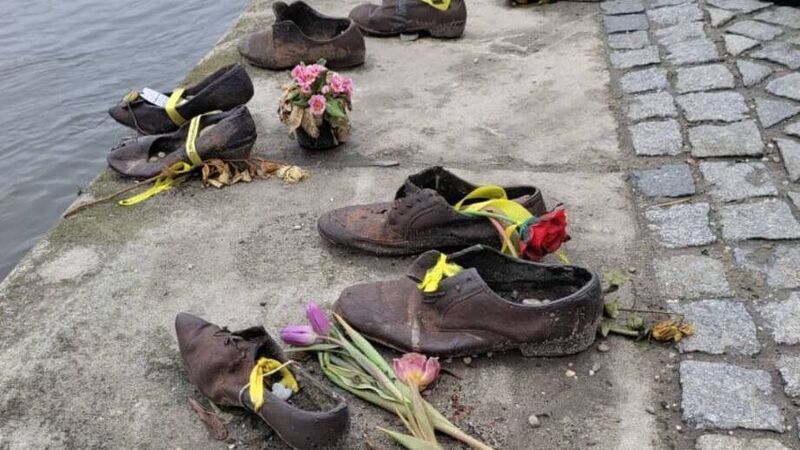
‘Shoes on the Danube Bank’ in Budapest is a chilling reminder of the hardship Hungarian Jews faced at the hands of the Arrow Cross.

is one of the most thought-provoking and evocative pieces of public art I have ever seen.
As the title suggests, it is a display of some 60 pairs of shoes, cast in iron, which are scattered along the river embankment in Budapest to commemorate the thousands of Hungarian Jews who were ordered to remove their footwear before being shot and thrown in the water by members of the fascist Arrow Cross militia in 1944.
The guidebooks explain the context — the Nazi occupation of Hungary during the Second World War — and tell us that the memorial, installed in 2005, was the joint work of Hungarian sculptor Gyula Pauer and filmmaker Can Togay.
The visceral response to it, however, has to be witnessed in person.
The mind reaches for that expression — to truly know a person you must walk a mile in their shoes — but it can’t possibly begin to understand the last terror-filled moments of those wearing the battered boots, wedges, and sling-backs left behind on the bank.
HISTORY HUB
If you are interested in this article then no doubt you will enjoy exploring the various history collections and content in our history hub. Check it out HERE and happy reading
The punch holes and eyelets on a pair of Oxford lace-ups are so realistically rendered that you can almost imagine the stockinged feet that once stepped out of them. What did that man endure in his final moments?
A pair of tiny boots conjures up a horror too awful to contemplate, although this consciousness-raising art installation does indeed jolt people into a kind of contemplation.
Flowers, candles, and handwritten notes have been placed in the shoes; baby steps across the bridge of time to our shared humanity.
In a very different context, the displays of red shoes which have come to represent the women killed by gender-based violence have the same chilling effect.
Just last month, in the Romanian capital of Bucharest, several pairs of red shoes lined the steps of the city’s concert hall to draw attention to the fact that about one woman a week has been killed in that country each week in 2026.
That has particular resonance here at a time when the media is running articles entitled: “Why is Northern Ireland the ‘UK’s most dangerous place to be a woman’?”
Indeed, the red shoes campaign, first created by Mexican visual artist Elina Chauvet in 2009, has been used to great effect here and in several countries around the world.
As Chauvet has said in interviews, her installation was intended as a call to conscience to honour the hundreds — perhaps thousands — of women who disappeared, were tortured, and then murdered in Juárez, a city on the Mexico-US border, during the 1990s and 2000s.
Her artwork was so evocative that the march for solidarity has been replicated all over the world.
The power of public monuments to shake us from our daily sleepwalk through the cityscape came to mind during the week with the happy — and oh so long-awaited — news that Dublin City Council has finally approved a monument on O’Connell St to honour Irish women of the revolutionary period.
It is, according to reports, to be situated between the Spire and the James Larkin statue, erected in front of the GPO.
As councillor Donna Cooney, the chair of the council’s commemorations and naming committee, reminded us: “There are no statues to women whatsoever on O’Connell St and very few in Dublin except for fictional characters.”
On an aside, can you name the statues of the *six men featured on the capital’s main thoroughfare? No Googling now.
Here’s a hint. One of them also has a statue on St Patrick Street in Cork although, unlike the Dublin version, he is not missing a thumb.
Having outstretched arms is certainly dramatic, but it leaves limbs vulnerable — as has proven to be the case when a football fan during the fever of Italia ‘90 celebrations apparently clambered on to said statue and, inadvertently, broke the good man’s thumb.
The thumb is now safe in the Little Museum of Dublin, but how it got there is a story for another day.
I will reveal, though, that the man in question is temperance campaigner Fr Theobald Mathew.
Here’s another piece of interesting trivia: His monument was sculpted by a woman, Tipperary native Mary Redmond, one of the few female sculptors to win a public commission in the 19th century.
Now, at last, some of those women will be remembered in a €1m project designed to bring a new monument to the city centre.
But you have to ask: Do we really need another statue on a plinth; a piece of granite raised high above the consciousness of the ordinary people passing below it? Or a Molly Malone-type installation open to the indignity of groping hands?
(On a recent outing, I saw that tourists — perhaps a few homebirds too — have beaten a path through the box-hedged encasement that is supposed to protect her.)
Perhaps it is time to consider a public monument at street level like the one in Budapest or the various iterations of the red shoe campaigns.
Those powerful works came to mind this week too because shoes, or rather the ones so famously erased from history, once stood near the spot earmarked for the proposed new monument.
They belonged to Elizabeth O’Farrell, a nurse, Cumann na mBan member, and coincidentally great-grandaunt of Cooney. O’Farrell was beside Pádraig Pearse when he surrendered after the Easter Rising of 1916.
Her feet were visible in the first photograph published by the , but all trace of her was edited out in subsequent editions.
Some say this was because compositors thought the extra pair of feet confusing. In any event, the photo came to symbolise the “airbrushing” of women and their involvement in all aspects of life from history.
It is also true that O’Farrell said she had deliberately stepped out of the photo herself, but she said later that she regretted it when she saw the manner in which women and their contributions were overlooked in the State.
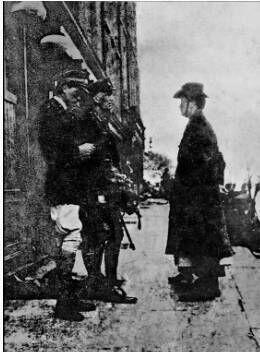
Happily, O’Farrell has since been publicly restored to history. On International Women’s Day 2021, artist Sinéad Guckian’s painting Her Surrender — which changes the angle to put her at the centre of the image — was unveiled in the Seanad.
At the time, senators said they hoped the painting rectified, in a very small way, the historic wrong done to her.
How, though, do you rectify the myriad wrongs and decades-long sin of omission that have been perpetrated against women of the revolutionary period from early 1900s to the Civil War and far beyond?
Well, I suppose you start with one step. And here it is. That step. Let’s hope it will be one that brings the life, work, and experiences of these forgotten women closer to the people. And one that reflects movement and agency.
Perhaps an artist will consider a monument showing Máire Comerford, head to the wind on a bicycle, as she cycled through gunfire to dispatch messages during the Civil War?
The Sinn Féin, Cumann na mBan, and White Cross member later said, with some amusement, how one outraged cinematographer filming on what was then Sackville St felt she had ruined his shot.
“‘That girl,’ he declared, ‘has ruined my picture. I’ve risked my life for nothing, for no one will believe that serious fighting is taking place if a girl cycles through the thick of it.’”
She added that she hoped his “ruined” shot was still in some forgotten vault of rejected out-takes. Now wouldn’t it be quite something if we could rescue that “rejected out-take” and put it back on the street where the action took place?
- *The six men on O’Connell St are, in order of appearance, Daniel O’Connell, William Smith O’Brien, John Gray, James Larkin, Fr Mathew, and Charles Stewart Parnell.


CONNECT WITH US TODAY



Be the first to know the latest news and updates