Sarah Harte: We've gone backwards as a country when it comes to drink-driving
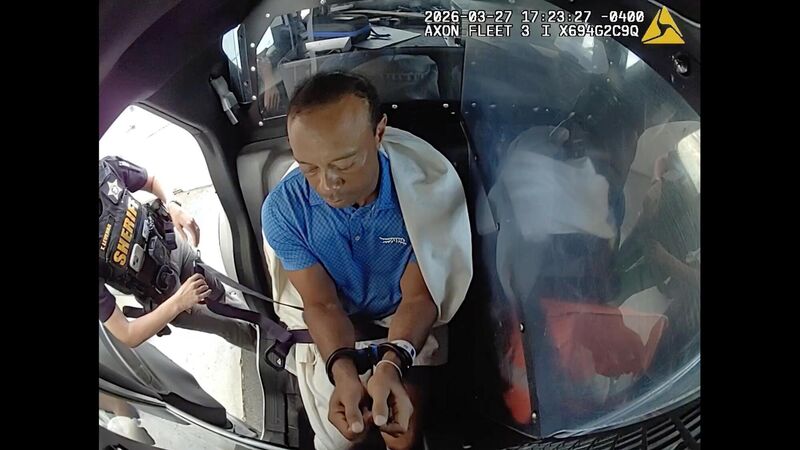
Last week, we saw the bodycam footage of golf legend Tiger Woods, who rolled over his SUV. Picture: Martin County Sheriff's Office via AP
Last week, we saw the bodycam footage of golf legend Tiger Woods, who rolled over his SUV. Woods allegedly had opioids on his person. It was his fourth car crash.
We have our own problems around driving when impaired. While Gen Z are driving the growth in the zero-alcohol market, some unspoken permission slip allows more people to get behind the wheel when drunk or high. A backsliding in social norms makes our roads more dangerous.
A 2025 Road Safety Authority (RSA) survey found that one in eight Irish motorists admitted to drink-driving in the previous 12 months. This represented a 20% increase compared to 2024.
The number of people adopting a ‘zero alcohol before driving’ rule has declined. Younger people have slipped in risk perception around drink-driving. 19% of younger adults (under 35 years) did not believe that any amount of alcohol impaired their ability to drive. Drinkaware confirms that awareness of the problems with drink-driving is lower among under-35s.
According to an RSA Driver Attitudes & Behaviour survey 2020-2024, attitudes towards drink-driving and speeding have relaxed, driven by a ‘norm relaxation’ effect.
Drink-driving was once culturally tolerated here across the board. In older generations, it was socially acceptable to drive home pissed, with the kids in the back without safety belts. Health and safety were not a major concern in the 1970s and 80s.
Then, gradually, the culture shifted. In my generation, fewer of us got behind the wheel when drunk. I knew the odd clown who didn’t get the memo, but it felt like those selfish assholes were in the minority.
When I was going out in the 90s, there was a lack of taxis and high heels were in fashion. We used to bring out a backpack with trainers, and in the winter, gloves, and a woolly hat. Outside the nightclub at two in the morning, as we changed into our trainers, we accepted that we would have to walk home.
As reported in the last weekend, a man who crashed his car while drink-driving three times in one week may evade prosecution because no blood sample was taken within the three-hour legal window following an arrest.
A consultant at Cork University Hospital pointed out that three hours often doesn’t give gardaí enough time to arrange for a community medic to take a sample.
Dr Eoin Fogarty, a consultant in Emergency and Retrieval Medicine, also said that if this had happened in Australia, the man's car would have been seized after he failed his breathalyser test. Instead, gardaí had to hand him back his keys.
According to Alcohol Action Ireland, alcohol is involved in over a third of driver deaths on our roads. More than 1,000 people get behind the wheel each day after drinking alcohol. Fewer than 14 of them will be caught.
Only 1.3% of all holders of driving licences in the Republic are annually tested for drink-driving at roadside checkpoints. We have the lowest roadside breath-testing rate in the EU.
The RSA survey showed that the most common scenario in which a driver was impaired was on a rural road. If you are a risk-taker, then you roll the dice more readily in rural Ireland.
The quiet road home means that factually, you know that you have a far higher chance of making it home undetected out of your head than, say, driving in Dublin or Cork City.
If you live in rural Ireland, as I do, you may feel that there is no visible Garda presence. An Irish Examiner/Ipsos poll of people living in rural Ireland found two-thirds of people thought there was not enough of a garda presence in their area.
I hate driving after a certain point in the evening. You can spot the drunken drivers. They drive slowly, attempting to judge the margins, as the car undulates from side to side. They are also possibly stoned.
The coked-up drivers pass you out on a solid white line, often coming from behind a line of cars to go for it, even on a blind bend.
Your immediate reaction is to look for somewhere on the verge to pull in should an explosive crash happen.
On drug-driving, according to new research from the Royal College of Surgeons Ireland, University of Medicine and Health Sciences, and the Medical Bureau of Road Safety, there has been "a dramatic increase in the detection of cocaine and cannabis among Irish drivers suspected of driving under the influence, pointing to changing patterns of drug use on Irish roads".
Cannabis remains the most common drug in drug-driving cases, but cocaine detections have increased 21% year-on-year.
The Garda Commissioner said cocaine was the substance of choice for most drivers caught, particularly among young people.
Some of you won’t thank me for pointing it out, but of the 9,000 drivers tested, 83% were men.’ Why is this happening?
Maybe there’s an element of social contagion, peer reinforcement.
I read a study from Cornell University suggesting that small groups can tip entire norms, triggering widespread norm change, which could explain rapid increases in tolerance.
In critical mass theory, it is believed that minorities can overturn social conventions once a tipping point is reached.
Tolerance for drug-taking has increased generally. It’s no longer a subculture. It has become normalised in everyday life (the statistics bear this out), therefore logically tipping into drivers’ behaviour.
Behaviours like drink- or drug-driving are not fixed. We know this because my generation did not drink and drive like their parents.
Social norms are always in flux. Bad behaviour to some extent depends on collective tolerance.
Clearly, we need to act on several levels simultaneously. Radical attitudinal transformation is needed regarding drink- and drug-driving.
Do we carry out a nationwide survey among young people to understand the tiggers of their behaviours, given that they were born into a different world than we were?
Our public awareness campaigns are not working. Do we educate our children too late? Is the message too weak? How do we sociologically frame drink- and drug-driving to increase the social stigma?
Read More
Public education needs to be complemented with more punitive measures for those who contravene the law. Why should a man who got caught drink-driving three times in one week not have his car seized?
We should impound a vehicle after a failed breath test as we currently do with uninsured drivers. Why is there a distinction? And we need to allow emergency doctors and nurses to take blood samples in hospital settings.
Maybe we should install mandatory alcohol ignition interlock devices, preventing a car from starting if a driver’s breath sample exceeds the limit?
So many people in this country, like the Treacy family, whose son Ciarán was featured in the RSA’s ‘Crashed Lives’ campaign, have had their lives destroyed.
Losing a child is the worst tragedy. Losing your child because somebody else is drunk or high is preventable.
Apart from tackling the cultural normalisation of driving while impaired, we need clearer, more draconian laws to help gardaí do their jobs and incentivise people not to endanger other drivers.


CONNECT WITH US TODAY



Be the first to know the latest news and updates