Shona Murray: EU's failure to rein in Orban could threaten veto of small nations like Ireland
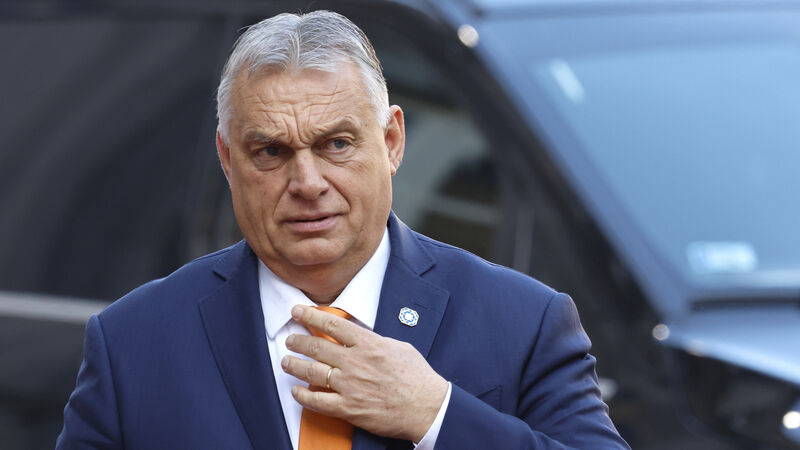
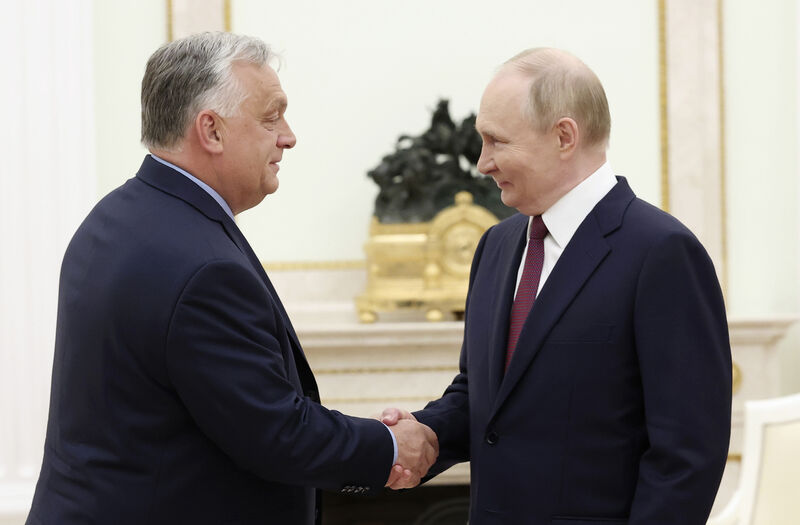
Hungary’s prime minister Viktor Orban at an EU summit in Brussels earlier this month. Considered Putin’s greatest ally in Europe, Hungary has consistently sought to veto EU policies.

This week should have been characterised by an unwavering display of solidarity and unity by the EU. But any hope of this was shattered when just days before the fourth anniversary of Russia’s full-scale invasion of Ukraine, Hungary’s prime minister Viktor Orban — Putin’s greatest ally in Europe — announced he would block all decisions relating to Ukraine by brandishing his government’s powerful veto.
The announcement meant the EU would return to crisis mode, having been knocked off kilter by one of its own members.
Once again, the EU finds itself at the mercy of one member state hijacking meaningful and consequential EU policy for its own domestic pursuits.
Victor Orban claims Ukraine is “attacking” Hungary and Slovakia’s energy infrastructure by not fixing the Drujba (Russian for 'friendship') pipeline, which allows Russian oil flow from Russia through Ukraine.
Budapest and Bratislava have an exemption from Western sanctions on buying Russian oil.
The pipeline is out of operation due to Russian airstrikes, which damaged it.
Nobody really understands Orban’s demands that Ukraine should now fix the pipe which Russia destroyed, so Russia can sell Hungary and Slovakia cheap oil and then use that revenue to kill Ukrainian civilians.
But Orban will likely be placated by Brussels and other EU countries for the greater good to prevail.
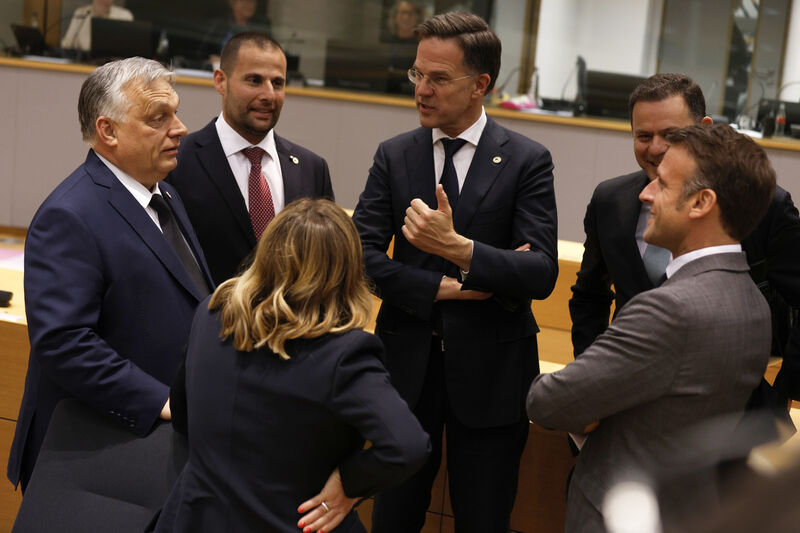
Budapest is a serial abuser of the EU’s veto system, which exists for smaller countries like Ireland and many others (the EU is mainly made up of small countries) to have democratic equality at the powerful European Council, where prime ministers and heads of state sit. Foreign policy, including sanctions policy, must be agreed upon unanimously.
Last Monday, three days after his bombshell announcemet, EU foreign ministers met in Brussels. They had been poised to announce deeper sanctions against Moscow in a bid to further weaken Russia’s ability to continue the war. It would be the EU’s 20th sanctions package since February 2022.
Moreover, the EU is soon due to deliver the first tranche of a €90bn lifeline for Ukraine to cover its costs over the next two years as it continues to traverse the cruel and relentless Russian campaign of ballistic missiles and purposeful attacks on Ukraine’s energy infrastructure. Also, now blocked by Orban.
At least 161 people were killed in January, and millions were plunged into darkness with no electricity or heating amid -25C temperatures in some parts of Ukraine, creating as much hardship on Ukrainians as at any other time of the war.
At the very least, the EU had hoped to portray a strength amid a situation of unprecedented tension among US allies, as well as Russia combined. The EU is reckoning with an aggressive, unpredictable White House which sees Brussels as an enemy and the EU as an entity that should be weakened.
But Hungary, and at times Slovakia, is willing to do the bidding of Putin and insult the memories of the hundreds of thousands of lives lost in Ukraine due to Putin’s asymmetrical attack.
“I am astounded about the Hungarian position,” German minister for foreign affairs, Johann Wadephul, said to reporters on Monday. “I do not believe it is right for Hungary to betray its own struggle for freedom and European sovereignty,” referring to the famous 1956 Soviet massacre against the Hungarian uprising.
This sentiment is echoed widely.
But the question is what to do about Hungary, and what impact will that have on small, responsible member states like Ireland, Lithuania, Estonia, and others.
There is a complete realisation that Hungary will continue this path if allowed. Past attempts to strip Budapest of its voting rights due to the myriad investigations into serious democratic backsliding and stripping the judiciary of its independence have amounted to nothing, given the high threshold of 26 countries being required to vote in favour.
There is now a renewed momentum to end the veto system and thereby neuter Hungary of its ability to disrupt the passage of important EU policies.
One of the most common, and often glibly applied, complaints about the EU is that it is too slow. That decisions take ages, and the EU is essentially impotent. Much of this is due to the cross purposes that arise when 27 countries each have their own agenda. However, by and large, in a moment of existential crisis — such as the covid pandemic and the Ukraine war — a consensus can arise, and the EU functions well.
Orban is in the middle of a national election where he is trailing in the polls to former fellow Fidez party member, Péter Magyar. His modus operandi is clearly to provoke and inflame tensions in Brussels as a show of power and control.
His message to voters is that it’s not his fault the economy is stagnant, and democracy is backsliding. The fault lies with Ukraine and Brussels. Billboards tell Hungarians that Orban will save them from the EU and Ukraine forcing them to the frontlines of the war. Or from paying towards supporting Ukraine amid its ongoing suffering.
“Our message to Brussels: We won’t pay!” say some billboards, with pictures of key EU officials such as Commission president Ursula von der Leyen, as well as Ukrainian president Volodymyr Zelenskyy.
The problem is that even smaller countries, particularly those on the frontline of the war with Russia such as the Baltics, who value their right to veto as much as Ireland or anyone else, now think the only way for the EU to act as a strong, geopolitical entity is to switch some decisions to qualified majority.
Meaning 65% of the population of the EU, or 15 out of 17 countries. If this policy is pursued, the positions of larger countries will almost always prevail. But because the bloc has failed to rein in Orban’s blackmail tendencies, the equal, democratic aspect of the EU is now in peril.

CONNECT WITH US TODAY



Be the first to know the latest news and updates