Terry Prone: Hemingway's cocktail of brain chemicals and concussion could have been dementia
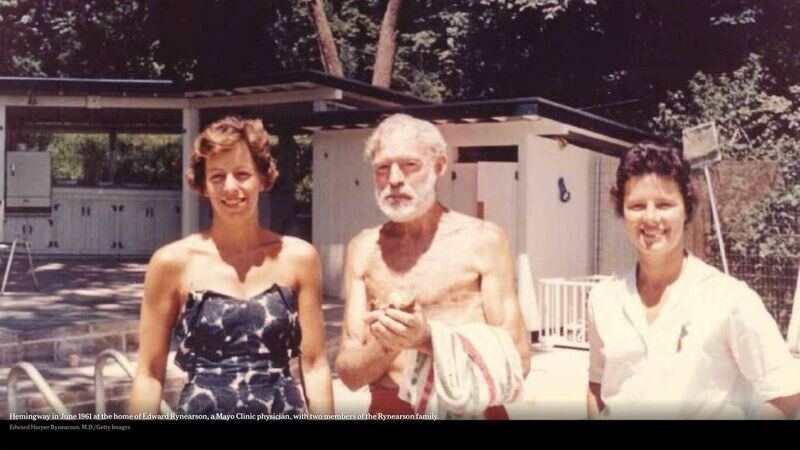
Ernest Hemingway in June 1961 at the home of a Mayo Clinic doctor with two members of the doctor's family. He hardly exists and — at 61 years of age — looks so fragile and shrunken, he could be two decades older.
Two photographs, taken only a few years apart, of ostensibly the same man: Ernest Hemingway. Impelling, the story their contrast tells.
The first was taken in 1957 by Yousuf Karsh, a leading 20th-century photographer who branded himself as “Karsh of Ottawa”.
It shows a man in a roll collar sweater, all manly and outdoorsy, his face full and full of life. It’s a black and white shot that almost revs in its portrayal of power awaiting action.
The second shot was taken in a garden four years later. The picture is filled with sunshine and colour, the man in the middle startlingly lacking both.
Hemingway stands between two female members of his psychiatrist’s family who favour the camera with uncomplicated frank smiles. The thin little man between them doesn’t smile at the camera. To state the obvious: He doesn’t look like himself at all.
No macho presence is evident. Nothing to remind anyone that this man, perhaps more than anything else, loved going on safari and shooting down big wild animals. He hardly exists and — at 61 years of age — looks so fragile and shrunken, he could be two decades older.
Less than a month later, Hemingway shot himself. He left a legacy in literature and a public memory of an aggressive pushy man with a tendency to particularly cherish very young women and creepily calling himself “Papa” in correspondence with them.
A hypochondriac always making the most of relatively minor injuries, whose decline into depression, paranoia, and consequent electric shock treatment was essentially driven by alcoholism.
It had to be alcoholism that changed “a man of peculiar gentleness, the shyest man I ever photographed”, as Karsh described him, into a blustering bombast.
Karsh encountered one significant aspect of Hemingway — an aspect experienced by friends, lovers, wives, and sons, at least in the early stages of their relationships. But the other side was increasingly present, including suicidal ideation.
It’s easy — perhaps too easy — to assume that hunger to take his own life came from alcohol consumption
However, a few years ago, an academic press in South Carolina brought out a book entitled Hemingway’s Brain by a psychiatrist named Andrew Farah, which effectively drove a stake through the heart of much of the Hemingway biographical material produced up to then.
Farah points out that suicide runs in families and it ran like a message through a stick of rock through the Hemingway family, with his father, Dr Clarence Hemingway, who wanted his son to follow him into general practice, shooting himself in his late 50s.
“I’ll probably go the same way,” wrote Hemingway at the time.
His fiction also picked up on his father’s death. For Whom the Bell Tolls saw the main character’s father kill himself with a gun his own father had used in the Civil War. Dr Hemingway took his life with an old Civil War gun.
The trail of self-inflicted death, starting before the writer took his own life, continued. It took seven close relatives, including his brother and sister and — long after his death — his granddaughter Margaux, a successful model in her day.
His suicide, in short, was at base the consequence of a genetic code pointing toward self-destructive behaviour.
Research has established just how powerful is that genetic code when it comes to suicide.
Monozygotic or “identical” twins have a significantly higher rate for completed (and even attempted) suicides than do fraternal or non-identical twins.

Andrew Farah points to adoption research which, he says, proves the power of genetic influence in self-harm even when different parenting and environments are in play.
“The rate of suicide among biological siblings of adopted children who commit suicide is six times higher than the rate among controls (in this case, siblings of non-suicidal adopted persons) even when the adopted siblings are raised separately.
“Environment certainly plays some role, but the risk conveyed by DNA is undeniable. It has been estimated that as much as 43% of suicidal behaviour may be explained by genetics, while the remaining 57% may be due to illness or environmental factors.”
The bottom line is that Hemingway’s life-long attraction to suicide may have been as heritable as diabetes or any other disorder that uses DNA as a carrier.
When you add concussion, about which little was known during Hemingway’s life, the cocktail within his brain was disastrous — and arguably mis-diagnosed during his lifetime.
He fell off horses, was knocked out in ambulance collisions, head-injured in airplane crashes. All of this when sucking it up and getting over it was the main prescription, especially for a man obsessed by outdoor displays of strength and virility.
In retrospect, it’s possible to be pretty sure that the repeated instances of concussion did cumulative damage to his brain, causing him to self-medicate with alcohol, not knowing that neither drink nor the electro-convulsive therapy were treating what was actually wrong with him.
Nothing removed his paranoia, which convinced him the FBI was spying on him. The fact that J Edgar Hoover’s FBI actually did have Hemingway under surveillance makes ironically sad the belief on the part of some of his peers that his prating on this topic was self-aggrandising nonsense.
The last decade has taught us that contact sports stars who suffer from dementia have a clear causative thread leading inexorably back to their repeated concussions.
To study Hemingway’s deterioration is to realise that what he experienced in his last few years was dementia, similarly caused
That dementia was complicated by his alcohol consumption and by haemochromatosis — which, without adequate treatment, can lead to iron overload in the brain that contributes to the development of dementia. Hemingway had a bunch of neurological disasters happening to him which went untreated or wrongly treated.
These disasters afflicted a man who had zero interest in, or sympathy for, mental illness of any kind. He told F Scott Fitzgerald that Fitzgerald’s wife, Zelda, was mentally ill after one brief meeting, and would have wanted Fitzgerald to leave her immediately.
The only area of mental illness for which he had any tolerance, never mind compassion, was post traumatic stress disorder, which was then called “shell shock”.
He submitted to electro-shock and other forms of treatment, which achieved nothing for him other than to add to his misery, paranoia, and desire to die.
Anyone who has ever been impatient with Hemingway’s grandiosity would have to be saddened by the desperation of an artist who — in between flights to bring him to the Mayo Clinic — tried to kill himself by running onto the whirling propellers of a parked plane. (The pilot stopped the engines.)
He survived to get more ineffectual treatment, to pose for an infinitely sad picture in someone else’s garden, and to shoot himself just a fortnight after being released from hospital.
CONNECT WITH US TODAY
Be the first to know the latest news and updates